
C4 June 2018 Q4
4.
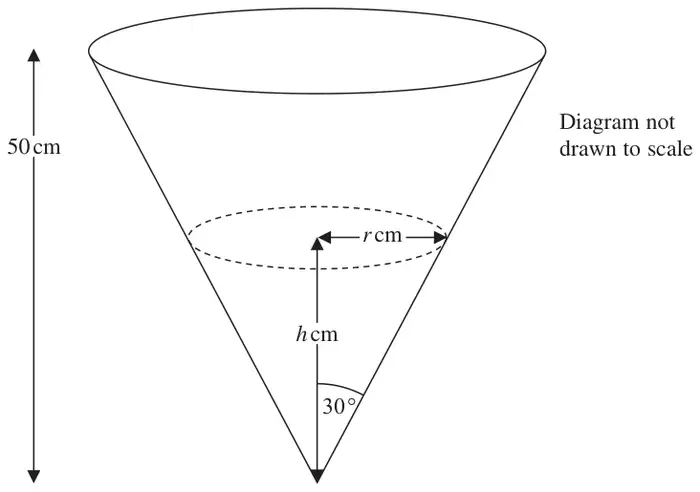
A water container is made in the shape of a hollow inverted right circular cone with semi-vertical angle of 30°, as shown in Figure 1. The height of the container is 50 cm.
When the depth of the water in the container is \(h\) cm, the surface of the water has radius \(r\) cm and the volume of water is \(V\) cm3.
[You may assume the formula \(V = \dfrac{1}{3}\pi r^2 h\) for the volume of a cone.] (2)
Given that the volume of water in the container increases at a constant rate of 200 cm3 s−1,
Give your answer in its simplest form in terms of \(\pi\). (4)
| Scheme | Marks |
|---|---|
| \(\dfrac{r}{h} = \tan 30 \Rightarrow r = h\tan 30\ \left\{\Rightarrow r = \dfrac{h}{\sqrt{3}} \text{ or } r = \dfrac{\sqrt{3}}{3}h\right\}\) or \(\dfrac{h}{r} = \tan 60 \Rightarrow r = \dfrac{h}{\tan 60}\ \left\{\Rightarrow r = \dfrac{h}{\sqrt{3}} \text{ or } r = \dfrac{\sqrt{3}}{3}h\right\}\) or \(\dfrac{r}{\sin 30} = \dfrac{h}{\sin 60} \Rightarrow r = \dfrac{h\sin 30}{\sin 60}\ \left\{\Rightarrow r = \dfrac{h}{\sqrt{3}} \text{ or } r = \dfrac{\sqrt{3}}{3}h\right\}\) or \(h^2 + r^2 = (2r)^2 \Rightarrow r^2 = \dfrac{1}{3}h^2\) Correct use of trigonometry to find \(r\) in terms of \(h\) or correct use of Pythagoras to find \(r^2\) in terms of \(h^2\) | M1 |
| \(\left\{V = \dfrac{1}{3}\pi r^2 h \Rightarrow\right\}\ V = \dfrac{1}{3}\pi\left(\dfrac{h}{\sqrt{3}}\right)^2 h \Rightarrow V = \dfrac{1}{9}\pi h^3\ *\) Correct proof of \(V = \dfrac{1}{9}\pi h^3\) or \(V = \dfrac{1}{9}h^3\pi\). Or shows \(\dfrac{1}{9}\pi h^3\) or \(\dfrac{1}{9}h^3\pi\) with some reference to \(V =\) in their solution | A1 * |
| (2) |
Notes
Note: Allow M1 for writing down \(r = h\tan 30\)
Note: Give M0 A0 for writing down \(r = \dfrac{h\sqrt{3}}{3}\) or \(r = \dfrac{h}{\sqrt{3}}\) with no evidence of using trigonometry on \(r\) and \(h\) or Pythagoras on \(r\) and \(h\)
Note: Give M0 (unless recovered) for evidence of \(\dfrac{1}{3}\pi r^2 h = \dfrac{1}{9}\pi h^3\) leading to either \(r^2 = \dfrac{1}{3}h^2\) or \(r = \dfrac{h\sqrt{3}}{3}\) or \(r = \dfrac{h}{\sqrt{3}}\)
| Scheme | Marks |
|---|---|
| Way 1 | |
| \(\dfrac{\mathrm{d}V}{\mathrm{d}t} = 200\) | |
| \(\dfrac{\mathrm{d}V}{\mathrm{d}h} = \dfrac{1}{3}\pi h^2\) \(\dfrac{1}{3}\pi h^2\) o.e. | B1 |
| Either • \(\left\{\dfrac{\mathrm{d}V}{\mathrm{d}h} \times \dfrac{\mathrm{d}h}{\mathrm{d}t} = \dfrac{\mathrm{d}V}{\mathrm{d}t} \Rightarrow\right\}\ \left(\dfrac{1}{3}\pi h^2\right)\dfrac{\mathrm{d}h}{\mathrm{d}t} = 200\) • \(\left\{\dfrac{\mathrm{d}h}{\mathrm{d}t} = \dfrac{\mathrm{d}V}{\mathrm{d}t} \div \dfrac{\mathrm{d}V}{\mathrm{d}h} \Rightarrow\right\}\ \dfrac{\mathrm{d}h}{\mathrm{d}t} = 200 \times \dfrac{1}{\frac{1}{3}\pi h^2}\) either \(\left(\text{their } \dfrac{\mathrm{d}V}{\mathrm{d}h}\right) \times \dfrac{\mathrm{d}h}{\mathrm{d}t} = 200\) or \(200 \div \left(\text{their } \dfrac{\mathrm{d}V}{\mathrm{d}h}\right)\) | M1 |
| When \(h = 15,\ \dfrac{\mathrm{d}h}{\mathrm{d}t} = 200 \times \dfrac{1}{\frac{1}{3}\pi(15)^2}\ \left\{= \dfrac{200}{75\pi} = \dfrac{600}{225\pi}\right\}\) dependent on the previous M mark | dM1 |
| \(\dfrac{\mathrm{d}h}{\mathrm{d}t} = \dfrac{8}{3\pi}\ (\text{cm}\,\text{s}^{-1})\) \(\dfrac{8}{3\pi}\) | A1 cao |
| (4) | |
| (6 marks) |
Notes
Way 2
| Scheme | Marks |
|---|---|
| \(\dfrac{\mathrm{d}V}{\mathrm{d}t} = 200 \Rightarrow V = 200t + c \Rightarrow \dfrac{1}{9}\pi h^3 = 200t + c\) | |
| \(\left(\dfrac{1}{3}\pi h^2\right)\dfrac{\mathrm{d}h}{\mathrm{d}t} = 200\) \(\dfrac{1}{3}\pi h^2\) o.e. as in Way 1 | B1 M1 |
| When \(h = 15,\ \dfrac{\mathrm{d}h}{\mathrm{d}t} = 200 \times \dfrac{1}{\frac{1}{3}\pi(15)^2}\ \left\{= \dfrac{200}{75\pi} = \dfrac{600}{225\pi}\right\}\) dependent on the previous M mark | dM1 |
| \(\dfrac{\mathrm{d}h}{\mathrm{d}t} = \dfrac{8}{3\pi}\ (\text{cm}\,\text{s}^{-1})\) \(\dfrac{8}{3\pi}\) | A1 cao |
| (4) |
B1: Correct simplified or un-simplified differentiation of \(V\). E.g. \(\dfrac{1}{3}\pi h^2\) or \(\dfrac{3}{9}\pi h^2\)
Note: \(\dfrac{\mathrm{d}V}{\mathrm{d}h}\) does not have to be explicitly stated, but it should be clear that they are differentiating their \(V\)
M1: \(\left(\text{their } \dfrac{\mathrm{d}V}{\mathrm{d}h}\right) \times \dfrac{\mathrm{d}h}{\mathrm{d}t} = 200\) or \(200 \div \left(\text{their } \dfrac{\mathrm{d}V}{\mathrm{d}h}\right)\)
dM1: dependent on the previous M mark
Substitutes \(h = 15\) into an expression which is a result of either \(200 \div \left(\text{their } \dfrac{\mathrm{d}V}{\mathrm{d}h}\right)\) or \(200 \times \dfrac{1}{\left(\text{their } \frac{\mathrm{d}V}{\mathrm{d}h}\right)}\)
A1: \(\dfrac{8}{3\pi}\) (units are not required)
Note: Give final A0 for using \(\dfrac{\mathrm{d}V}{\mathrm{d}t} = -200\) to give \(\dfrac{\mathrm{d}h}{\mathrm{d}t} = -\dfrac{8}{3\pi}\), unless recovered to \(\dfrac{\mathrm{d}h}{\mathrm{d}t} = \dfrac{8}{3\pi}\)