
C4 June 2016 Q7
7.
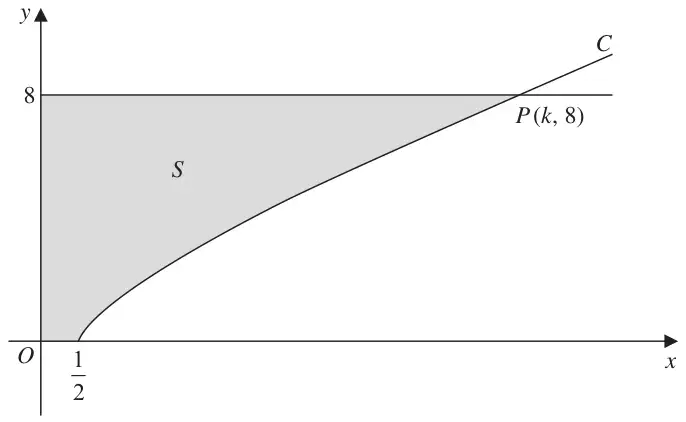
Figure 3 shows a sketch of part of the curve \(C\) with equation \[y = (2x - 1)^{\frac{3}{4}}, \qquad x \geqslant \frac{1}{2}\]
The curve \(C\) cuts the line \(y = 8\) at the point \(P\) with coordinates \((k, 8)\), where \(k\) is a constant.
The finite region \(S\), shown shaded in Figure 3, is bounded by the curve \(C\), the \(x\)-axis, the \(y\)-axis and the line \(y = 8\). This region is rotated through \(2\pi\) radians about the \(x\)-axis to form a solid of revolution.
| Scheme | Marks |
|---|---|
| \(y = (2x - 1)^{\frac{3}{4}},\quad x \geqslant \dfrac{1}{2}\) passes though \(P(k, 8)\) | |
| \(\left\{\displaystyle\int (2x - 1)^{\frac{3}{2}}\,\mathrm{d}x\right\} = \dfrac{1}{5}(2x - 1)^{\frac{5}{2}}\ \{+c\}\) \((2x \pm 1)^{\frac{3}{2}} \to \pm\lambda(2x \pm 1)^{\frac{5}{2}}\) or \(\pm\lambda u^{\frac{5}{2}}\) where \(u = 2x \pm 1\); \(\lambda \neq 0\) \(\dfrac{1}{5}(2x - 1)^{\frac{5}{2}}\) with or without \(+c\). Must be simplified. | M1 A1 |
| (2) |
| Scheme | Marks |
|---|---|
| \(\{P(k, 8) \Rightarrow\}\ 8 = (2k - 1)^{\frac{3}{4}} \Rightarrow k = \dfrac{8^{\frac{4}{3}} + 1}{2}\) Sets \(8 = (2k - 1)^{\frac{3}{4}}\) or \(8 = (2x - 1)^{\frac{3}{4}}\) and rearranges to give \(k =\) (or \(x =\)) a numerical value. | M1 |
| So, \(k = \dfrac{17}{2}\) \(k\) (or \(x\)) \(= \dfrac{17}{2}\) or 8.5 | A1 |
| (2) |
Notes
SC: Allow Special Case SC M1 for a candidate who sets \(8 = (2k - 1)^{\frac{3}{2}}\) or \(8 = (2x - 1)^{\frac{3}{2}}\) and rearranges to give \(k =\) (or \(x =\)) a numerical value.
| Scheme | Marks |
|---|---|
| \(\pi\displaystyle\int \left((2x - 1)^{\frac{3}{4}}\right)^2\mathrm{d}x\) For \(\pi\displaystyle\int \left((2x - 1)^{\frac{3}{4}}\right)^2\) or \(\pi\displaystyle\int (2x - 1)^{\frac{3}{2}}\). Ignore limits and \(\mathrm{d}x\). Can be implied. | B1 |
| \(\left\{\displaystyle\int_{\frac{1}{2}}^{\frac{17}{2}} y^2\,\mathrm{d}x\right\} = \left[\dfrac{(2x - 1)^{\frac{5}{2}}}{5}\right]_{\frac{1}{2}}^{\frac{17}{2}} = \left(\left(\dfrac{16^{\frac{5}{2}}}{5}\right) - (0)\right)\ \left\{= \dfrac{1024}{5}\right\}\) Note: It is not necessary to write the "\(-0\)" Applies \(x\)-limits of “8.5” (their answer to part (b)) and 0.5 to an expression of the form \(\pm\beta(2x - 1)^{\frac{5}{2}};\ \beta \neq 0\) and subtracts the correct way round. | M1 |
| \(\{V_{\text{cylinder}}\} = \pi(8)^2\left(\dfrac{17}{2}\right)\ \{= 544\pi\}\) \(\pi(8)^2(\text{their answer to part } (b))\). \(V_{\text{cylinder}} = 544\pi\) implies this mark | B1 ft |
| \(\left\{\text{Vol}(S) = 544\pi - \dfrac{1024\pi}{5}\right\} \Rightarrow \text{Vol}(S) = \dfrac{1696}{5}\pi\) An exact correct answer in the form \(k\pi\). E.g. \(\dfrac{1696}{5}\pi\), \(\dfrac{3392}{10}\pi\) or \(339.2\pi\) | A1 |
| (4) | |
| (8 marks) |
Notes
M1: Can also be given for applying \(u\)-limits of “16” (2("part (b)") \(-\) 1) and 0 to an expression of the form \(\pm\beta u^{\frac{5}{2}};\ \beta \neq 0\) and subtracts the correct way round.
Note: You can give M1 for \(\left[\dfrac{(2x - 1)^{\frac{5}{2}}}{5}\right]_{\frac{1}{2}}^{\frac{17}{2}} = \dfrac{1024}{5}\)
Note: Give M0 for \(\left[\dfrac{(2x - 1)^{\frac{5}{2}}}{5}\right]_0^{\frac{17}{2}} = \left(\left(\dfrac{16^{\frac{5}{2}}}{5}\right) - (0)\right)\)
B1ft: Correct expression for the volume of a cylinder with radius 8 and their (part (b)) height \(k\).
Note: If a candidate uses integration to find the volume of this cylinder they need to apply their limits to give a correct expression for its volume.
So \(\pi\displaystyle\int_0^{8.5} 8^2\,\mathrm{d}x = \pi\big[64x\big]_0^{8.5}\) is not sufficient for B1 but \(\pi(64(8.5) - 0)\) is sufficient for B1.
Alt. (c)
| Scheme | Marks |
|---|---|
| \(\text{Vol}(S) = \pi(8)^2\left(\dfrac{1}{2}\right) + \underline{\underline{\pi}}\displaystyle\int_{0.5}^{8.5}\left(8^2 - \underline{\underline{(2x - 1)^{\frac{3}{2}}}}\right)\mathrm{d}x\) For \(\underline{\underline{\pi}}\displaystyle\int \ldots\ldots\ \underline{\underline{(2x - 1)^{\frac{3}{2}}}}\). Ignore limits and \(\mathrm{d}x\). | B1 |
| \(= \pi(8)^2\left(\dfrac{1}{2}\right) + \pi\left[64x - \dfrac{1}{5}(2x - 1)^{\frac{5}{2}}\right]_{0.5}^{8.5}\) | |
| \(= \underline{\underline{\pi(8)^2\left(\dfrac{1}{2}\right)}} + \underline{\underline{\pi}}\left(\left(\underline{\underline{64(\text{"}8.5\text{"})}} - \dfrac{1}{5}(2(8.5) - 1)^{\frac{5}{2}}\right) - \left(\underline{\underline{64(0.5)}} - \dfrac{1}{5}(2(0.5) - 1)^{\frac{5}{2}}\right)\right)\) as above | M1 B1 |
| \(\left\{= 32\pi + \pi\left(\left(544 - \dfrac{1024}{5}\right) - (32 - 0)\right)\right\} \Rightarrow \text{Vol}(S) = \dfrac{1696}{5}\pi\) | A1 |
| (4) |
MISREADING IN BOTH PARTS (B) AND (C)
Apply the misread rule (MR) for candidates who apply \(y = (2x - 1)^{\frac{3}{2}}\) to both parts (b) and (c)
(b)
| Scheme | Marks |
|---|---|
| \(\{P(k, 8) \Rightarrow\}\ 8 = (2k - 1)^{\frac{3}{2}} \Rightarrow k = \dfrac{8^{\frac{2}{3}} + 1}{2}\) Sets \(8 = (2k - 1)^{\frac{3}{2}}\) or \(8 = (2x - 1)^{\frac{3}{2}}\) and rearranges to give \(k =\) (or \(x =\)) a numerical value. | M1 |
| So, \(k = \dfrac{5}{2}\) \(k\) (or \(x\)) \(= \dfrac{5}{2}\) or 2.5 | A1 |
| (2) |
(c)
| Scheme | Marks |
|---|---|
| \(\pi\displaystyle\int \left((2x - 1)^{\frac{3}{2}}\right)^2\mathrm{d}x\) For \(\pi\displaystyle\int \left((2x - 1)^{\frac{3}{2}}\right)^2\) or \(\pi\displaystyle\int (2x - 1)^3\). Ignore limits and \(\mathrm{d}x\). Can be implied. | B1 |
| \(\left\{\displaystyle\int_{\frac{1}{2}}^{\frac{5}{2}} y^2\,\mathrm{d}x\right\} = \left[\dfrac{(2x - 1)^4}{8}\right]_{\frac{1}{2}}^{\frac{5}{2}} = \left(\left(\dfrac{4^4}{8}\right) - (0)\right)\ \{= 32\}\) Applies \(x\)-limits of “2.5” (their answer to part (b)) and 0.5 to an expression of the form \(\pm\beta(2x - 1)^4;\ \beta \neq 0\) and subtracts the correct way round. | M1 |
| \(V_{\text{cylinder}} = \pi(8)^2\left(\dfrac{5}{2}\right)\ \{= 160\pi\}\) \(\pi(8)^2(\text{their answer to part } (b))\). Sight of \(160\pi\) implies this mark | B1 ft |
| \(\{\text{Vol}(S) = 160\pi - 32\pi\} \Rightarrow \text{Vol}(S) = 128\pi\) An exact correct answer in the form \(k\pi\). E.g. \(128\pi\) | A1 |
| (4) |
(corrected from the printed mark scheme: the upper limit on the integral in the misread (c) scheme is printed as \(\frac{17}{2}\); it is \(\frac{5}{2}\), as used in the rest of that line.)
Note: Mark parts (b) and (c) using the mark scheme above and then working forwards from part (b) deduct two from any A or B marks gained.
E.g. (b) M1A1 (c) B1M1B1A1 would score (b) M1A0 (c) B0M1B1A1
E.g. (b) M1A1 (c) B1M1B0A0 would score (b) M1A0 (c) B0M1B0A0
Note: If a candidate uses \(y = (2x - 1)^{\frac{3}{4}}\) in part (b) and then uses \(y = (2x - 1)^{\frac{3}{2}}\) in part (c) do not apply a misread in part (c).