
C4 June 2016 Q5
5.
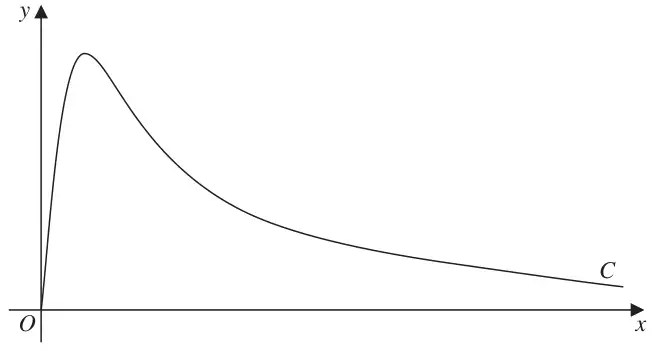
Figure 2 shows a sketch of the curve \(C\) with parametric equations \[x = 4\tan t, \qquad y = 5\sqrt{3}\sin 2t, \qquad 0 \leqslant t < \frac{\pi}{2}\]
The point \(P\) lies on \(C\) and has coordinates \(\left(4\sqrt{3}, \dfrac{15}{2}\right)\).
Give your answer as a simplified surd. (4)
The point \(Q\) lies on the curve \(C\), where \(\dfrac{\mathrm{d}y}{\mathrm{d}x} = 0\)
| Scheme | Marks |
|---|---|
| \(x = 4\tan t,\quad y = 5\sqrt{3}\sin 2t,\quad 0 \leqslant t < \dfrac{\pi}{2}\) | |
| Way 1 | |
| \(\dfrac{\mathrm{d}x}{\mathrm{d}t} = 4\sec^2 t,\ \dfrac{\mathrm{d}y}{\mathrm{d}t} = 10\sqrt{3}\cos 2t\) \(\Rightarrow \dfrac{\mathrm{d}y}{\mathrm{d}x} = \dfrac{10\sqrt{3}\cos 2t}{4\sec^2 t}\ \left\{= \dfrac{5}{2}\sqrt{3}\cos 2t\cos^2 t\right\}\) Either both \(x\) and \(y\) are differentiated correctly with respect to \(t\) or their \(\dfrac{\mathrm{d}y}{\mathrm{d}t}\) divided by their \(\dfrac{\mathrm{d}x}{\mathrm{d}t}\) or applies \(\dfrac{\mathrm{d}y}{\mathrm{d}t}\) multiplied by their \(\dfrac{\mathrm{d}t}{\mathrm{d}x}\) Correct \(\dfrac{\mathrm{d}y}{\mathrm{d}x}\) (Can be implied) | M1 A1 oe |
| \(\left\{\text{At } P\left(4\sqrt{3}, \dfrac{15}{2}\right),\ t = \dfrac{\pi}{3}\right\}\) | |
| \(\dfrac{\mathrm{d}y}{\mathrm{d}x} = \dfrac{10\sqrt{3}\cos\left(\frac{2\pi}{3}\right)}{4\sec^2\left(\frac{\pi}{3}\right)}\) dependent on the previous M mark Some evidence of substituting \(t = \dfrac{\pi}{3}\) or \(t = 60^\circ\) into their \(\dfrac{\mathrm{d}y}{\mathrm{d}x}\) | dM1 |
| \(\dfrac{\mathrm{d}y}{\mathrm{d}x} = -\dfrac{5}{16}\sqrt{3}\) or \(-\dfrac{15}{16\sqrt{3}}\) \(-\dfrac{5}{16}\sqrt{3}\) or \(-\dfrac{15}{16\sqrt{3}}\) from a correct solution only | A1 cso |
| (4) |
Notes
1st A1: Correct \(\dfrac{\mathrm{d}y}{\mathrm{d}x}\). E.g. \(\dfrac{10\sqrt{3}\cos 2t}{4\sec^2 t}\) or \(\dfrac{5}{2}\sqrt{3}\cos 2t\cos^2 t\) or \(\dfrac{5}{2}\sqrt{3}\cos^2 t(\cos^2 t - \sin^2 t)\) or any equivalent form.
Note: Give the final A0 for a final answer of \(-\dfrac{10}{32}\sqrt{3}\) without reference to \(-\dfrac{5}{16}\sqrt{3}\) or \(-\dfrac{15}{16\sqrt{3}}\)
Note: Give the final A0 for more than one value stated for \(\dfrac{\mathrm{d}y}{\mathrm{d}x}\)
Way 2
| Scheme | Marks |
|---|---|
| \(\tan t = \dfrac{x}{4} \Rightarrow \sin t = \dfrac{x}{\sqrt{(x^2 + 16)}},\ \cos t = \dfrac{4}{\sqrt{(x^2 + 16)}} \Rightarrow y = \dfrac{40\sqrt{3}x}{x^2 + 16}\) | |
| \(\left\{\begin{aligned} u &= 40\sqrt{3}x & v &= x^2 + 16 \\ \dfrac{\mathrm{d}u}{\mathrm{d}x} &= 40\sqrt{3} & \dfrac{\mathrm{d}v}{\mathrm{d}x} &= 2x \end{aligned}\right\}\) | |
| \(\dfrac{\mathrm{d}y}{\mathrm{d}x} = \dfrac{40\sqrt{3}(x^2 + 16) - 2x(40\sqrt{3}x)}{(x^2 + 16)^2}\ \left\{= \dfrac{40\sqrt{3}(16 - x^2)}{(x^2 + 16)^2}\right\}\) \(\dfrac{\pm A(x^2 + 16) \pm Bx^2}{(x^2 + 16)^2}\) Correct \(\dfrac{\mathrm{d}y}{\mathrm{d}x}\); simplified or un-simplified | M1 A1 |
| \(\dfrac{\mathrm{d}y}{\mathrm{d}x} = \dfrac{40\sqrt{3}(48 + 16) - 80\sqrt{3}(48)}{(48 + 16)^2}\) dependent on the previous M mark Some evidence of substituting \(x = 4\sqrt{3}\) into their \(\dfrac{\mathrm{d}y}{\mathrm{d}x}\) | dM1 |
| \(\dfrac{\mathrm{d}y}{\mathrm{d}x} = -\dfrac{5}{16}\sqrt{3}\) or \(-\dfrac{15}{16\sqrt{3}}\) \(-\dfrac{5}{16}\sqrt{3}\) or \(-\dfrac{15}{16\sqrt{3}}\) from a correct solution only | A1 cso |
| (4) |
Way 3
| Scheme | Marks |
|---|---|
| \(y = 5\sqrt{3}\sin\left(2\tan^{-1}\left(\dfrac{x}{4}\right)\right)\) | |
| \(\dfrac{\mathrm{d}y}{\mathrm{d}x} = 5\sqrt{3}\cos\left(2\tan^{-1}\left(\dfrac{x}{4}\right)\right)\left(\dfrac{2}{1 + \left(\frac{x}{4}\right)^2}\right)\left(\dfrac{1}{4}\right)\) \(\dfrac{\mathrm{d}y}{\mathrm{d}x} = \pm A\cos\left(2\tan^{-1}\left(\dfrac{x}{4}\right)\right)\left(\dfrac{1}{1 + x^2}\right)\) Correct \(\dfrac{\mathrm{d}y}{\mathrm{d}x}\); simplified or un-simplified. | M1 A1 |
| \(\dfrac{\mathrm{d}y}{\mathrm{d}x} = 5\sqrt{3}\cos\left(2\tan^{-1}\left(\sqrt{3}\right)\right)\left(\dfrac{2}{1 + 3}\right)\left(\dfrac{1}{4}\right)\ \left\{= 5\sqrt{3}\left(-\dfrac{1}{2}\right)\left(\dfrac{1}{2}\right)\left(\dfrac{1}{4}\right)\right\}\) dependent on the previous M mark Some evidence of substituting \(x = 4\sqrt{3}\) into their \(\dfrac{\mathrm{d}y}{\mathrm{d}x}\) | dM1 |
| \(\dfrac{\mathrm{d}y}{\mathrm{d}x} = -\dfrac{5}{16}\sqrt{3}\) or \(-\dfrac{15}{16\sqrt{3}}\) \(-\dfrac{5}{16}\sqrt{3}\) or \(-\dfrac{15}{16\sqrt{3}}\) from a correct solution only | A1 cso |
| (4) |
| Scheme | Marks |
|---|---|
| \(\left\{10\sqrt{3}\cos 2t = 0 \Rightarrow t = \dfrac{\pi}{4}\right\}\) | |
| So \(x = 4\tan\left(\dfrac{\pi}{4}\right),\ y = 5\sqrt{3}\sin\left(2\left(\dfrac{\pi}{4}\right)\right)\) At least one of either \(x = 4\tan\left(\dfrac{\pi}{4}\right)\) or \(y = 5\sqrt{3}\sin\left(2\left(\dfrac{\pi}{4}\right)\right)\) or \(x = 4\) or \(y = 5\sqrt{3}\) or \(y\) = awrt 8.7 | M1 |
| Coordinates are \(\left(4, 5\sqrt{3}\right)\) \(\left(4, 5\sqrt{3}\right)\) or \(x = 4,\ y = 5\sqrt{3}\) | A1 |
| (2) | |
| (6 marks) |
Notes
Note: Also allow M1 for either \(x = 4\tan(45)\) or \(y = 5\sqrt{3}\sin\big(2(45)\big)\)
Note: M1 can be gained by ignoring previous working in part (a) and/or part (b)
Note: Give A0 for stating more than one set of coordinates for \(Q\).
Note: Writing \(x = 4,\ y = 5\sqrt{3}\) followed by \(\left(5\sqrt{3}, 4\right)\) is A0.