
C4 June 2014 Q8
8. Relative to a fixed origin \(O\), the point \(A\) has position vector \(\begin{pmatrix}-2\\4\\7\end{pmatrix}\) and the point \(B\) has position vector \(\begin{pmatrix}-1\\3\\8\end{pmatrix}\)
The line \(l_1\) passes through the points \(A\) and \(B\).
The point \(P\) has position vector \(\begin{pmatrix}0\\2\\3\end{pmatrix}\)
Given that angle \(PBA\) is \(\theta\),
The line \(l_2\) passes through the point \(P\) and is parallel to the line \(l_1\)
The points \(C\) and \(D\) both lie on the line \(l_2\)
Given that \(AB = PC = DP\) and the \(x\) coordinate of \(C\) is positive,
| Scheme | Marks |
|---|---|
| \(\overrightarrow{OA} = -2\mathbf{i} + 4\mathbf{j} + 7\mathbf{k},\ \overrightarrow{OB} = -\mathbf{i} + 3\mathbf{j} + 8\mathbf{k}\ \&\ \overrightarrow{OP} = 0\mathbf{i} + 2\mathbf{j} + 3\mathbf{k}\) | |
| \(\overrightarrow{AB} = \pm\left((-\mathbf{i} + 3\mathbf{j} + 8\mathbf{k}) - (-2\mathbf{i} + 4\mathbf{j} + 7\mathbf{k})\right);\ = \mathbf{i} - \mathbf{j} + \mathbf{k}\) | M1; A1 |
| (2) |
Notes
M1: Finding the difference (either way) between \(\overrightarrow{OB}\) and \(\overrightarrow{OA}\).
If no “subtraction” seen, you can award M1 for 2 out of 3 correct components of the difference.
A1: \(\mathbf{i} - \mathbf{j} + \mathbf{k}\) or \(\begin{pmatrix}1\\-1\\1\end{pmatrix}\) or \((1, -1, 1)\) or benefit of the doubt \(\begin{matrix}1\\-1\\1\end{matrix}\)
| Scheme | Marks |
|---|---|
| \(\{l_1: \mathbf{r}\} = \begin{pmatrix}-2\\4\\7\end{pmatrix} + \lambda\begin{pmatrix}1\\-1\\1\end{pmatrix}\) or \(\{\mathbf{r}\} = \begin{pmatrix}-1\\3\\8\end{pmatrix} + \lambda\begin{pmatrix}1\\-1\\1\end{pmatrix}\) | B1ft |
| (1) |
Notes
B1ft: \(\{\mathbf{r}\} = \begin{pmatrix}-2\\4\\7\end{pmatrix} + \lambda\begin{pmatrix}1\\-1\\1\end{pmatrix}\) or \(\{\mathbf{r}\} = \begin{pmatrix}-1\\3\\8\end{pmatrix} + \lambda\begin{pmatrix}1\\-1\\1\end{pmatrix}\), with \(\overrightarrow{AB}\) or \(\overrightarrow{BA}\) correctly followed through from (a).
Note: \(\mathbf{r} =\) is not needed.
| Scheme | Marks |
|---|---|
| \(\overrightarrow{PB} = \overrightarrow{OB} - \overrightarrow{OP} = \begin{pmatrix}-1\\3\\8\end{pmatrix} - \begin{pmatrix}0\\2\\3\end{pmatrix} = \begin{pmatrix}-1\\1\\5\end{pmatrix}\) or \(\overrightarrow{BP} = \begin{pmatrix}1\\-1\\-5\end{pmatrix}\) | M1 |
| \(\{\cos\theta =\}\ \dfrac{\overrightarrow{AB}\bullet\overrightarrow{PB}}{\left|\overrightarrow{AB}\right|.\left|\overrightarrow{PB}\right|} = \dfrac{\begin{pmatrix}1\\-1\\1\end{pmatrix}\bullet\begin{pmatrix}-1\\1\\5\end{pmatrix}}{\sqrt{(1)^2 + (-1)^2 + (1)^2}\,.\sqrt{(-1)^2 + (1)^2 + (5)^2}}\) Applies dot product formula between their \(\left(\overrightarrow{AB} \text{ or } \overrightarrow{BA}\right)\) and their \(\left(\overrightarrow{PB} \text{ or } \overrightarrow{BP}\right)\). | M1 |
| \(\{\cos\theta\} = \dfrac{-1 - 1 + 5}{\sqrt{3}.\sqrt{27}} = \dfrac{3}{9} = \underline{\dfrac{1}{3}}\) Correct proof | A1 cso |
| (3) |
Notes
M1: An attempt to find either the vector \(\overrightarrow{PB}\) or \(\overrightarrow{BP}\).
If no “subtraction” seen, you can award M1 for 2 out of 3 correct components of the difference.
M1: Applies dot product formula between their \(\left(\overrightarrow{AB} \text{ or } \overrightarrow{BA}\right)\) and their \(\left(\overrightarrow{PB} \text{ or } \overrightarrow{BP}\right)\).
A1: Obtains \(\{\cos\theta\} = \dfrac{1}{3}\) by correct solution only.
Note: If candidate starts by applying \(\dfrac{\overrightarrow{AB}\bullet\overrightarrow{PB}}{\left|\overrightarrow{AB}\right|.\left|\overrightarrow{PB}\right|}\) correctly (without reference to \(\cos\theta = \ldots\))
they can gain both 2nd M1 and A1 mark.
Note: Award the final A1 mark if candidate achieves \(\{\cos\theta\} = \dfrac{1}{3}\) by either taking the dot product between
(i) \(\begin{pmatrix}1\\-1\\1\end{pmatrix}\) and \(\begin{pmatrix}-1\\1\\5\end{pmatrix}\) or (ii) \(\begin{pmatrix}-1\\1\\-1\end{pmatrix}\) and \(\begin{pmatrix}1\\-1\\-5\end{pmatrix}\). Ignore if any of these vectors are labelled incorrectly.
Note: Award final A0, cso for those candidates who take the dot product between
(iii) \(\begin{pmatrix}1\\-1\\1\end{pmatrix}\) and \(\begin{pmatrix}1\\-1\\-5\end{pmatrix}\) or (iv) \(\begin{pmatrix}-1\\1\\-1\end{pmatrix}\) and \(\begin{pmatrix}-1\\1\\5\end{pmatrix}\)
They will usually find \(\{\cos\theta\} = -\dfrac{1}{3}\) or may fudge \(\{\cos\theta\} = \dfrac{1}{3}\).
If these candidates give a convincing detailed explanation which must include reference to the direction of their vectors then this can be given A1 cso
Alternative Method 1: The Cosine Rule
| Scheme | Marks |
|---|---|
| \(\overrightarrow{PB} = \overrightarrow{OB} - \overrightarrow{OP} = \begin{pmatrix}-1\\3\\8\end{pmatrix} - \begin{pmatrix}0\\2\\3\end{pmatrix} = \begin{pmatrix}-1\\1\\5\end{pmatrix}\) or \(\overrightarrow{BP} = \begin{pmatrix}1\\-1\\-5\end{pmatrix}\) Mark in the same way as the main scheme. | M1 |
| Note \(\left|\overrightarrow{PB}\right| = \sqrt{27}\), \(\left|\overrightarrow{AB}\right| = \sqrt{3}\) and \(\left|\overrightarrow{PA}\right| = \sqrt{24}\) | |
| \(\left(\sqrt{24}\right)^2 = \left(\sqrt{27}\right)^2 + \left(\sqrt{3}\right)^2 - 2\left(\sqrt{27}\right)\left(\sqrt{3}\right)\cos\theta\) Applies the cosine rule the correct way round | M1 oe |
| \(\cos\theta = \dfrac{27 + 3 - 24}{18} = \dfrac{1}{3}\) Correct proof | A1 cso |
| (3) |
Alternative Method 2: Right-Angled Trigonometry
| Scheme | Marks |
|---|---|
| \(\overrightarrow{PB} = \overrightarrow{OB} - \overrightarrow{OP} = \begin{pmatrix}-1\\3\\8\end{pmatrix} - \begin{pmatrix}0\\2\\3\end{pmatrix} = \begin{pmatrix}-1\\1\\5\end{pmatrix}\) or \(\overrightarrow{BP} = \begin{pmatrix}1\\-1\\-5\end{pmatrix}\) Mark in the same way as the main scheme. | M1 |
| Either \(\left(\sqrt{24}\right)^2 + \left(\sqrt{3}\right)^2 = \left(\sqrt{27}\right)^2\) or \(\overrightarrow{AB}\bullet\overrightarrow{PA} = \begin{pmatrix}1\\-1\\1\end{pmatrix}\bullet\begin{pmatrix}-2\\2\\4\end{pmatrix} = -2 - 2 + 4 = 0\) Confirms \(\Delta PAB\) is right-angled | M1 |
| So, \(\left\{\cos\theta = \dfrac{AB}{PB} \Rightarrow\right\} \cos\theta = \dfrac{\sqrt{3}}{\sqrt{27}} = \dfrac{1}{3}\) Correct proof | A1 cso |
| (3) |
| Scheme | Marks |
|---|---|
| \(\{l_2: \mathbf{r} =\}\ \begin{pmatrix}0\\2\\3\end{pmatrix} + \mu\begin{pmatrix}1\\-1\\1\end{pmatrix}\) \(\mathbf{p} + \lambda\mathbf{d}\) or \(\mathbf{p} + \mu\mathbf{d}\), \(\mathbf{p} \neq 0\), \(\mathbf{d} \neq 0\) with either \(\mathbf{p} = 0\mathbf{i} + 2\mathbf{j} + 3\mathbf{k}\) or \(\mathbf{d} =\) their \(\overrightarrow{AB}\), or a multiple of their \(\overrightarrow{AB}\). Correct vector equation. | M1 A1 ft |
| (2) |
Notes
M1: Writing down a line in the form \(\mathbf{p} + \lambda\mathbf{d}\) or \(\mathbf{p} + \mu\mathbf{d}\) with either \(\mathbf{a} = \begin{pmatrix}0\\2\\3\end{pmatrix}\) or \(\mathbf{d} =\) their \(\overrightarrow{AB}\) \(\mathbf{d} =\) their \(\overrightarrow{AB}\),
or a multiple of their \(\overrightarrow{AB}\) found in part (a).
A1ft: Writing \(\begin{pmatrix}0\\2\\3\end{pmatrix} + \mu\begin{pmatrix}1\\-1\\1\end{pmatrix}\) or \(\begin{pmatrix}0\\2\\3\end{pmatrix} + \mu\mathbf{d}\), where \(\mathbf{d} =\) their \(\overrightarrow{AB}\) or a multiple of their \(\overrightarrow{AB}\) found in part (a).
Note: \(\mathbf{r} =\) is not needed.
Note: Using the same scalar parameter as in part (b) is fine for A1.
| Scheme | Marks |
|---|---|
| \(\overrightarrow{OC} = \begin{pmatrix}0\\2\\3\end{pmatrix} + \begin{pmatrix}1\\-1\\1\end{pmatrix} = \begin{pmatrix}1\\1\\4\end{pmatrix}\) or \(\overrightarrow{OD} = \begin{pmatrix}0\\2\\3\end{pmatrix} - \begin{pmatrix}1\\-1\\1\end{pmatrix} = \begin{pmatrix}-1\\3\\2\end{pmatrix}\) Either \(\overrightarrow{OP}\) + their \(\overrightarrow{AB}\) or \(\overrightarrow{OP}\) − their \(\overrightarrow{AB}\) At least one set of coordinates are correct. | M1 A1 ft |
| \(\left\{C(1, 1, 4),\ D(-1, 3, 2)\right\}\) Both sets of coordinates are correct. | A1 ft |
| (3) |
Notes
M1: Either \(\overrightarrow{OP}\) + their \(\overrightarrow{AB}\) or \(\overrightarrow{OP}\) − their \(\overrightarrow{AB}\).
Note: This can be implied at least two out of three correct components for either their \(C\) or their \(D\).
A1ft: At least one set of coordinates are correct. Ignore labelling of \(C\), \(D\)
A1ft: Both sets of coordinates are correct. Ignore labelling of \(C\), \(D\)
Note: You can follow through either or both accuracy marks in this part using their \(\overrightarrow{AB}\) from part (a).
| Scheme | Marks |
|---|---|
| Way 1 \(\dfrac{h}{\sqrt{(-1)^2 + (1)^2 + (5)^2}} = \sin\theta\) \(\dfrac{h}{\text{their } \left|\overrightarrow{PB}\right|} = \sin\theta\) | M1 |
| \(h = \sqrt{27}\sin(70.5...)\ \left\{= \sqrt{27}\dfrac{\sqrt{8}}{3} = 2\sqrt{6} = \text{awrt } 4.9\right\}\) \(\sqrt{27}\sin(70.5...)\) or \(\sqrt{27}.\dfrac{\sqrt{8}}{3}\) or \(2\sqrt{6}\) or awrt 4.9 or equivalent | A1 oe |
| \(\text{Area } ABCD = \dfrac{1}{2}\,2\sqrt{6}\left(\sqrt{3} + 2\sqrt{3}\right)\) \(\dfrac{1}{2}(\text{their } h)(\text{their } AB + \text{their } CD)\) | dM1 |
| \(\left\{= \dfrac{1}{2}\,2\sqrt{6}\left(3\sqrt{3}\right) = 3\sqrt{18}\right\} = \underline{9\sqrt{2}}\) \(9\sqrt{2}\) | A1 cao |
| (4) | |
| (15 marks) |
Notes
Helpful Diagram!
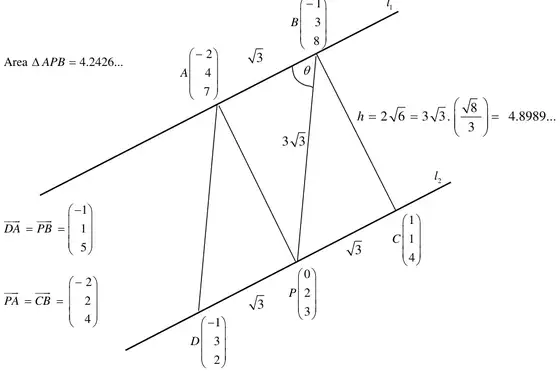
\(\overrightarrow{PA} = \overrightarrow{CB} = \begin{pmatrix}-2\\2\\4\end{pmatrix}\) and \(\overrightarrow{AB} = \begin{pmatrix}1\\-1\\1\end{pmatrix}\), so \(BC \perp AB\) Candidates do not need to prove this result for part (f)
8. (f) Way 2
| Scheme | Marks |
|---|---|
| \(h = \left|\overrightarrow{CB}\right| = \sqrt{(-2)^2 + (2)^2 + (4)^2} = \sqrt{24} = 2\sqrt{6} = 4.8989...\) Attempts \(\left|\overrightarrow{PA}\right|\) or \(\left|\overrightarrow{CB}\right|\) \(\left|\overrightarrow{PA}\right| = \left|\overrightarrow{CB}\right| = \sqrt{24}\) | M1 A1 oe |
| \(\text{Area } ABCD = \dfrac{1}{2}\sqrt{24}\left(\sqrt{3} + 2\sqrt{3}\right)\) or \(\dfrac{1}{2}\sqrt{24}\sqrt{3} + \sqrt{24}\sqrt{3}\) \(\dfrac{1}{2}h(\text{their } AB + \text{their } CD)\) | dM1 oe |
| \(= \underline{9\sqrt{2}}\) \(9\sqrt{2}\) | A1 cso |
| (4) |
8. (f) Way 3: Finds the area of either triangle \(APB\) or \(APD\) or \(BCP\) and triples the result.
| Scheme | Marks |
|---|---|
| \(\text{Area } \Delta APB = \dfrac{1}{2}\sqrt{3}\left(3\sqrt{3}\right)\sin\theta\) Attempts \(\dfrac{1}{2}\)(their \(AB\))(their \(PB\))\(\sin\theta\) | M1 |
| \(= \dfrac{1}{2}\sqrt{3}\left(3\sqrt{3}\right)\sin(70.5...)\) \(\dfrac{1}{2}\sqrt{3}\left(3\sqrt{3}\right)\sin(70.5...)\) or \(3\sqrt{2}\) or awrt 4.24 or equivalent | A1 |
| \(\text{Area } ABCD = 3\left(3\sqrt{2}\right)\) \(3 \times \text{Area of } \Delta APB\) | dM1 |
| \(= \underline{9\sqrt{2}}\) \(9\sqrt{2}\) | A1 cso |
| (4) |
M1: Way 1: \(\dfrac{h}{\text{their } \left|\overrightarrow{PB}\right|} = \sin\theta\)
Way 2: Attempts \(\left|\overrightarrow{PA}\right|\) or \(\left|\overrightarrow{CB}\right|\)
Way 3: Attempts \(\dfrac{1}{2}\)(their \(PB\))(their \(AB\))\(\sin\theta\)
Note: Finding \(AD\) by itself is M0.
A1: Either
- \(h = \sqrt{27}\sin(70.5...)\) or \(\left|\overrightarrow{PA}\right| = \left|\overrightarrow{CB}\right| = \sqrt{24}\) or equivalent. (See Way 1 and Way 2)
or
- the area of either triangle \(APB\) or \(APD\) or \(BDP\) \(= \dfrac{1}{2}\sqrt{3}\left(3\sqrt{3}\right)\sin(70.5...)\) o.e. (See Way 3).
dM1: which is dependent on the 1st M1 mark.
A full method to find the area of trapezium \(ABCD\). (See Way 1, Way 2 and Way 3).
A1: \(9\sqrt{2}\) from a correct solution only.
Note: A decimal answer of 12.7279... (without a correct exact answer) is A0.