
C4 June 2013 (R) Q6
6. Relative to a fixed origin \(O\), the point \(A\) has position vector \(21\mathbf{i} - 17\mathbf{j} + 6\mathbf{k}\) and the point \(B\) has position vector \(25\mathbf{i} - 14\mathbf{j} + 18\mathbf{k}\).
The line \(l\) has vector equation \[\mathbf{r} = \begin{pmatrix}a\\b\\10\end{pmatrix} + \lambda\begin{pmatrix}6\\c\\-1\end{pmatrix}\] where \(a\), \(b\) and \(c\) are constants and \(\lambda\) is a parameter.
Given that the point \(A\) lies on the line \(l\),
Given also that the vector \(\overrightarrow{AB}\) is perpendicular to \(l\),
The image of the point \(B\) after reflection in the line \(l\) is the point \(B^{\prime}\).
| Scheme | Marks |
|---|---|
| \(l: \mathbf{r} = \begin{pmatrix}a\\b\\10\end{pmatrix} + \lambda\begin{pmatrix}6\\c\\-1\end{pmatrix}, \quad \overrightarrow{OA} = \begin{pmatrix}21\\-17\\6\end{pmatrix}, \quad \overrightarrow{OB} = \begin{pmatrix}25\\-14\\18\end{pmatrix}\) | |
| \(A\) is on \(l\), so \(\begin{pmatrix}21\\-17\\6\end{pmatrix} = \begin{pmatrix}a\\b\\10\end{pmatrix} + \lambda\begin{pmatrix}6\\c\\-1\end{pmatrix}\) | |
| \(\{\mathbf{k}: 10 - \lambda = 6 \Rightarrow\}\ \lambda = 4\) \(\lambda = 4\) | B1 |
| \(\{\mathbf{i}: a + 6\lambda = 21 \Rightarrow\}\ a + 6(4) = 21\) Substitutes their value of \(\lambda\) into \(a + 6\lambda = 21\) | M1 |
| \(a = -3\) \(a = -3\) | A1 cao |
| (3) |
Notes
B1: \(\lambda = 4\) seen or implied.
M1: Substitutes their value of \(\lambda\) into \(a + 6\lambda = 21\)
A1: \(a = -3\).
Note: Award B1M1A1 if the candidate states \(a = -3\) from no working.
Alternative Method Using Simultaneous equations for part (a).
B1: For \(60 - 6\lambda = 36\)
M1: \(60 - 6\lambda = 36\) and \(a + 6\lambda = 21\) solved simultaneously to give \(a = \ldots\)
A1: \(a = -3\), cao.
| Scheme | Marks |
|---|---|
| \(\left\{\overrightarrow{AB}\right\} = \begin{pmatrix}25\\-14\\18\end{pmatrix} - \begin{pmatrix}21\\-17\\6\end{pmatrix} = \begin{pmatrix}4\\3\\12\end{pmatrix}\) or \(\left\{\overrightarrow{BA}\right\} = \begin{pmatrix}21\\-17\\6\end{pmatrix} - \begin{pmatrix}25\\-14\\18\end{pmatrix} = \begin{pmatrix}-4\\-3\\-12\end{pmatrix}\) Finds the difference between \(\overrightarrow{OA}\) and \(\overrightarrow{OB}\). Ignore labelling. | M1 |
| \(\left\{\overrightarrow{AB} \perp l \Rightarrow \overrightarrow{AB}\bullet\mathbf{d} = 0\right\} \Rightarrow \begin{pmatrix}4\\3\\12\end{pmatrix}\bullet\begin{pmatrix}6\\c\\-1\end{pmatrix} = 24 + 3c - 12 = 0; \Rightarrow c = -4\) See notes. | M1; A1 ft |
| \(\{\mathbf{j}: b + c\lambda = -17 \Rightarrow\}\ b + (-4)(4) = -17;\ \Rightarrow b = -1\) See notes. | ddM1; A1 cso cao |
| (5) |
Notes
M1: Finds the difference between \(\overrightarrow{OA}\) and \(\overrightarrow{OB}\). Ignore labelling.
If no “subtraction” seen, you can award M1 for 2 out of 3 correct components of the difference.
M1: Applies the formula \(\overrightarrow{AB}\bullet\begin{pmatrix}6\\c\\-1\end{pmatrix}\) or \(\overrightarrow{BA}\bullet\begin{pmatrix}6\\c\\-1\end{pmatrix}\) correctly to give a linear equation in \(c\) which is set equal to zero. Note: The dot product can also be with \(\pm k\begin{pmatrix}6\\c\\-1\end{pmatrix}\).
A1ft: \(c = -4\) or for finding a correct follow through \(c\).
ddM1: Substitutes their value of \(\lambda\) and their value of \(c\) into \(b + c\lambda = -17\)
Note that this mark is dependent on the two previous method marks being awarded.
A1: \(b = -1\)
| Scheme | Marks |
|---|---|
| \(|AB| = \sqrt{4^2 + 3^2 + 12^2}\) or \(|AB| = \sqrt{(-4)^2 + (-3)^2 + (-12)^2}\) See notes. | M1 |
| So, \(|AB| = 13\) | A1 cao |
| (2) |
Notes
M1: An attempt to apply a three term Pythagoras in order to find \(|AB|\),
so taking the square root is required here.
A1: 13 cao
Note: Don’t recover work for part (b) in part (c).
| Scheme | Marks |
|---|---|
| \(\overrightarrow{OB^{\prime}}\left\{= \overrightarrow{OA} + \overrightarrow{BA}\right\} = \begin{pmatrix}21\\-17\\6\end{pmatrix} + \begin{pmatrix}-4\\-3\\-12\end{pmatrix};\ = \begin{pmatrix}17\\-20\\-6\end{pmatrix}\) See notes for alternative methods. | M1;A1 cao |
| (2) | |
| (12 marks) |
Notes
M1: For a full applied method of finding the coordinates of \(B^{\prime}\).
Note: You can give M1 for 2 out of 3 correct components of \(B^{\prime}\).
A1: For either \(\begin{pmatrix}17\\-20\\-6\end{pmatrix}\) or \(17\mathbf{i} - 20\mathbf{j} - 6\mathbf{k}\) or \((17, -20, -6)\) cao.
Helpful diagram!
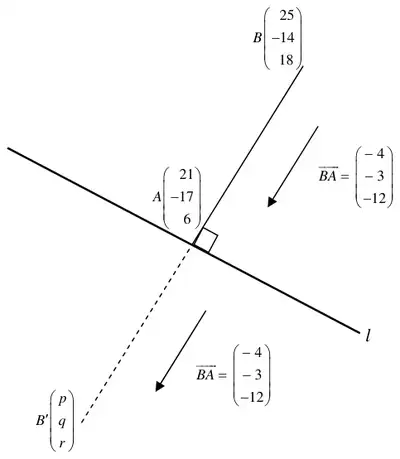
Acceptable Methods for the Method mark in part (d)
| Way 1 | \(\overrightarrow{OB^{\prime}}\left\{= \overrightarrow{OA} + \overrightarrow{BA}\right\} = \begin{pmatrix}21\\-17\\6\end{pmatrix} + \begin{pmatrix}-4\\-3\\-12\end{pmatrix}\) (using their \(\overrightarrow{BA}\)) |
| Way 2 | \(\overrightarrow{OB^{\prime}}\left\{= \overrightarrow{OA} - \overrightarrow{AB}\right\} = \begin{pmatrix}21\\-17\\6\end{pmatrix} - \begin{pmatrix}4\\3\\12\end{pmatrix}\) (using their \(\overrightarrow{AB}\)) |
| Way 3 | \(\overrightarrow{OB^{\prime}}\left\{= \overrightarrow{OB} + 2\overrightarrow{BA}\right\} = \begin{pmatrix}25\\-14\\18\end{pmatrix} + 2\begin{pmatrix}-4\\-3\\-12\end{pmatrix}\) (using their \(\overrightarrow{BA}\)) |
| Way 4 | \(\overrightarrow{OB^{\prime}}\left\{= \overrightarrow{OB} - 2\overrightarrow{AB}\right\} = \begin{pmatrix}25\\-14\\18\end{pmatrix} - 2\begin{pmatrix}4\\3\\12\end{pmatrix}\) (using their \(\overrightarrow{AB}\)) |
| Way 5 | \(\begin{pmatrix}25\\-14\\18\end{pmatrix} \to \begin{pmatrix}\text{Minus } 4\\\text{Minus } 3\\\text{Minus } 12\end{pmatrix} \to \begin{pmatrix}21\\-17\\6\end{pmatrix} \to \begin{pmatrix}\text{Minus } 4\\\text{Minus } 3\\\text{Minus } 12\end{pmatrix}\left\{\to \begin{pmatrix}17\\-20\\-6\end{pmatrix}\right\}\), so \(\overrightarrow{OA}\) + their \(\overrightarrow{BA}\) |
| Way 6 | \(\overrightarrow{OB^{\prime}}\left\{= 2\overrightarrow{OA} - \overrightarrow{OB}\right\} = 2\begin{pmatrix}21\\-17\\6\end{pmatrix} - \begin{pmatrix}25\\-14\\18\end{pmatrix}\) |
| Way 7 | \(\overrightarrow{OB} = 25\mathbf{i} - 14\mathbf{j} + 18\mathbf{k}\), \(\overrightarrow{OA} = 21\mathbf{i} - 17\mathbf{j} + 6\mathbf{k}\) and \(\overrightarrow{OB^{\prime}} = p\mathbf{i} + q\mathbf{j} + r\mathbf{k}\), \((21, -17, 6) = \left(\dfrac{25 + p}{2}, \dfrac{-14 + q}{2}, \dfrac{18 + r}{2}\right)\) \(p = 21(2) - 25 = 17\) \(q = -17(2) + 14 = -20\) \(r = 6(2) - 18 = -6\) M1: Writing down any two equations correctly and an attempt to find at least two of \(p\), \(q\) or \(r\). |