
C4 June 2008 Q3
3.
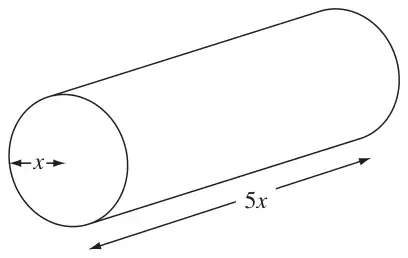
Figure 2 shows a right circular cylindrical metal rod which is expanding as it is heated. After \(t\) seconds the radius of the rod is \(x\) cm and the length of the rod is \(5x\) cm.
The cross-sectional area of the rod is increasing at the constant rate of 0.032 cm\(^2\) s\(^{-1}\).
| Scheme | Marks |
|---|---|
| From question, \(\dfrac{\mathrm{d}A}{\mathrm{d}t} = 0.032\) | B1 |
| \(\left\{A = \pi x^2 \Rightarrow \dfrac{\mathrm{d}A}{\mathrm{d}x} =\right\} 2\pi x\) | B1 |
| \(\dfrac{\mathrm{d}x}{\mathrm{d}t} = \dfrac{\mathrm{d}A}{\mathrm{d}t} \div \dfrac{\mathrm{d}A}{\mathrm{d}x} = (0.032)\dfrac{1}{2\pi x};\ \left\{= \dfrac{0.016}{\pi x}\right\}\) | M1; |
| When \(x = 2\) cm, \(\dfrac{\mathrm{d}x}{\mathrm{d}t} = \dfrac{0.016}{2\pi}\) | |
| Hence, \(\dfrac{\mathrm{d}x}{\mathrm{d}t} = 0.002546479\ldots\) (cm s\(^{-1}\)) | A1 cso |
| (4) |
Notes
B1: \(\dfrac{\mathrm{d}A}{\mathrm{d}t} = 0.032\) seen or implied from working.
B1: \(2\pi x\) by itself seen or implied from working
M1: \(0.032 \div\) Candidate’s \(\dfrac{\mathrm{d}A}{\mathrm{d}x}\);
A1 cso: awrt 0.00255
| Scheme | Marks |
|---|---|
| \(V = \underline{\pi x^2(5x)} = \underline{5\pi x^3}\) | B1 |
| \(\dfrac{\mathrm{d}V}{\mathrm{d}x} = 15\pi x^2\) | B1ft |
| \(\dfrac{\mathrm{d}V}{\mathrm{d}t} = \dfrac{\mathrm{d}V}{\mathrm{d}x} \times \dfrac{\mathrm{d}x}{\mathrm{d}t} = 15\pi x^2.\left(\dfrac{0.016}{\pi x}\right);\ \{= 0.24x\}\) | M1ft |
| When \(x = 2\) cm, \(\dfrac{\mathrm{d}V}{\mathrm{d}t} = 0.24(2) = \underline{0.48}\) (cm\(^3\) s\(^{-1}\)) | A1 cso |
| (4) | |
| (8 marks) |
Notes
B1: \(V = \underline{\pi x^2(5x)}\) or \(\underline{5\pi x^3}\)
B1ft: \(\dfrac{\mathrm{d}V}{\mathrm{d}x} = 15\pi x^2\) or ft from candidate’s \(V\) in one variable
M1ft: Candidate’s \(\dfrac{\mathrm{d}V}{\mathrm{d}x} \times \dfrac{\mathrm{d}x}{\mathrm{d}t}\);
A1 cso: 0.48 or awrt 0.48