
C4 June 2007 Q7
7.
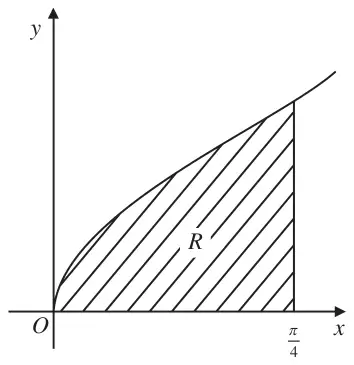
Figure 1 shows part of the curve with equation \(y = \sqrt{(\tan x)}\). The finite region \(R\), which is bounded by the curve, the \(x\)-axis and the line \(x = \dfrac{\pi}{4}\), is shown shaded in Figure 1.
| \(x\) | 0 | \(\dfrac{\pi}{16}\) | \(\dfrac{\pi}{8}\) | \(\dfrac{3\pi}{16}\) | \(\dfrac{\pi}{4}\) |
|---|---|---|---|---|---|
| \(y\) | 0 | 1 |
The region \(R\) is rotated through \(2\pi\) radians around the \(x\)-axis to generate a solid of revolution.
| x | 0 | \(\frac{\pi}{16}\) | \(\frac{\pi}{8}\) | \(\frac{3\pi}{16}\) | \(\frac{\pi}{4}\) |
|---|---|---|---|---|---|
| y | 0 | 0.445995927… | 0.643594252… | 0.817421946… | 1 |
| Scheme | Marks |
|---|---|
| 0.446 or awrt 0.44600 | B1 |
| awrt 0.64359 | B1 |
| awrt 0.81742 | B1 |
| (3) |
Notes
Enter marks into ePEN in the correct order.
In (a) for \(x = \tfrac{\pi}{16}\) writing 0.4459959… then 0.45600 gains B1 for awrt 0.44600 even though 0.45600 is incorrect.
Way 1
| Scheme | Marks |
|---|---|
| Area \(\approx\) \(\dfrac{1}{2} \times \dfrac{\pi}{16};\ \times \underline{\left\{0 + 2(0.44600 + 0.64359 + 0.81742) + 1\right\}}\) | B1 M1ft A1ft |
| \(= \dfrac{\pi}{32} \times 4.81402\ldots = 0.472615308\ldots = \underline{0.4726}\) (4dp) | A1 cao |
| (4) |
Notes
B1: Outside brackets \(\tfrac{1}{2} \times \tfrac{\pi}{16}\) or \(\tfrac{\pi}{32}\)
M1ft: For structure of trapezium rule \(\{\ldots\ldots\ldots\}\); (0 can be implied)
A1ft: Correct expression inside brackets which all must be multiplied by \(\tfrac{h}{2}\).
A1 cao: for seeing 0.4726
Aliter (b) Way 2
| Scheme | Marks |
|---|---|
| Area \(\approx \tfrac{\pi}{16} \times \left\{\tfrac{0+0.44600}{2} + \tfrac{0.44600+0.64359}{2} + \tfrac{0.64359+0.81742}{2} + \tfrac{0.81742+1}{2}\right\}\) | B1 |
| which is equivalent to: Area \(\approx\) \(\dfrac{1}{2} \times \dfrac{\pi}{16};\ \times \underline{\left\{0 + 2(0.44600 + 0.64359 + 0.81742) + 1\right\}}\) | M1ft A1ft |
| \(= \dfrac{\pi}{16} \times 2.40701\ldots = 0.472615308\ldots = \underline{0.4726}\) | A1 cao |
| (4) |
B1: \(\tfrac{\pi}{16}\) and a divisor of 2 on all terms inside brackets.
M1ft: One of first and last ordinates, two of the middle ordinates inside brackets ignoring the 2. A1ft: Correct expression inside brackets if \(\tfrac{1}{2}\) was to be factorised out. A1 cao: 0.4726
\(\mathit{Area} = \tfrac{1}{2} \times \tfrac{\pi}{20} \times \{0 + 2(0.44600 + 0.64359 + 0.81742) + 1\} = 0.3781\), gains B0M1A1A0
In (b) you can follow though a candidate’s values from part (a) to award M1 ft, A1 ft
Beware: In part (b) a candidate can also add up individual trapezia in this way:\[\text{Area} \approx \tfrac{1}{2}.\tfrac{\pi}{16}\underline{(0 + 0.44600)} + \tfrac{1}{2}.\tfrac{\pi}{16}\underline{(0.44600 + 0.64359)} + \tfrac{1}{2}.\tfrac{\pi}{16}\underline{(0.64359 + 0.81742)} + \tfrac{1}{2}.\tfrac{\pi}{16}\underline{(0.81742 + 1)}\]
| Scheme | Marks |
|---|---|
| Volume \(= (\pi)\underline{\displaystyle\int_0^{\frac{\pi}{4}}\left(\sqrt{\tan x}\right)^2\mathrm{d}x} = (\pi)\underline{\int_0^{\frac{\pi}{4}}\tan x\,\mathrm{d}x}\) | M1 |
| \(= (\pi)\big[\underline{\ln\sec x}\big]_0^{\frac{\pi}{4}}\) or \(= (\pi)\big[\underline{-\ln\cos x}\big]_0^{\frac{\pi}{4}}\) | A1 |
| \(= (\pi)\left[\left(\ln\sec\tfrac{\pi}{4}\right) - (\ln\sec 0)\right]\) or \(= (\pi)\left[\left(-\ln\cos\tfrac{\pi}{4}\right) - (\ln\cos 0)\right]\) | dM1 |
| \(= \pi\left[\ln\left(\tfrac{1}{\frac{1}{\sqrt{2}}}\right) - \ln\left(\tfrac{1}{1}\right)\right] = \pi\left[\ln\sqrt{2} - \ln 1\right]\) or \(= \pi\left[-\ln\left(\tfrac{1}{\sqrt{2}}\right) - \ln(1)\right]\) | |
| \(= \underline{\pi\ln\sqrt{2}}\) or \(\underline{\pi\ln\tfrac{2}{\sqrt{2}}}\) or \(\underline{\tfrac{1}{2}\pi\ln 2}\) or \(\underline{-\pi\ln\left(\tfrac{1}{\sqrt{2}}\right)}\) or \(\underline{-\tfrac{\pi}{2}\ln\left(\tfrac{1}{2}\right)}\) | A1 aef |
| (4) | |
| (11 marks) |
Notes
M1: \(\underline{\displaystyle\int\left(\sqrt{\tan x}\right)^2\mathrm{d}x}\) or \(\underline{\displaystyle\int\tan x\,\mathrm{d}x}\). Can be implied. Ignore limits and \((\pi)\)
A1: \(\tan x \to \underline{\ln\sec x}\) or \(\tan x \to \underline{-\ln\cos x}\)
dM1: The correct use of limits on a function other than tan x; ie \(x = \tfrac{\pi}{4}\) ‘minus’ \(x = 0\). \(\ln(\sec 0) = 0\) may be implied. Ignore \((\pi)\)
A1 aef: \(\underline{\pi\ln\sqrt{2}}\) or \(\underline{\pi\ln\tfrac{2}{\sqrt{2}}}\) or \(\underline{\tfrac{1}{2}\pi\ln 2}\) or \(\underline{-\pi\ln\left(\tfrac{1}{\sqrt{2}}\right)}\) or \(\underline{-\tfrac{\pi}{2}\ln\left(\tfrac{1}{2}\right)}\) must be exact. (corrected from the printed mark scheme: printed \(\tfrac{\pi}{2}\ln\left(\tfrac{1}{2}\right)\), which is negative and not equal to \(\tfrac{1}{2}\pi\ln 2\))
If a candidate gives the correct exact answer and then writes 1.088779…, then such a candidate can be awarded A1 (aef). The subsequent working would then be ignored. (isw)
Beware: In part (c) the factor of \(\pi\) is not needed for the first three marks.