
C4 January 2013 Q6
6.
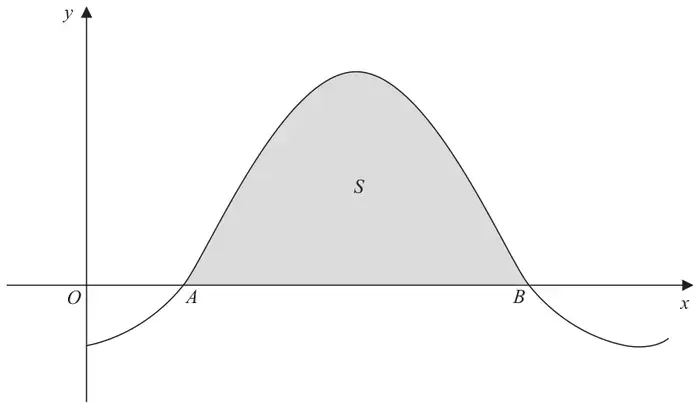
Figure 3 shows a sketch of part of the curve with equation \(y = 1 - 2\cos x\), where \(x\) is measured in radians. The curve crosses the \(x\)-axis at the point \(A\) and at the point \(B\).
The finite region \(S\) enclosed by the curve and the \(x\)-axis is shown shaded in Figure 3. The region \(S\) is rotated through \(2\pi\) radians about the \(x\)-axis.
| Scheme | Marks |
|---|---|
| \(\{y = 0 \Rightarrow\}\ 1 - 2\cos x = 0\) \(1 - 2\cos x = 0\), seen or implied. | M1 |
| At least one correct value of \(x\). (See notes). | A1 |
| \(\Rightarrow x = \dfrac{\pi}{3}, \dfrac{5\pi}{3}\) Both \(\dfrac{\pi}{3}\) and \(\dfrac{5\pi}{3}\) | A1 cso |
| (3) |
Notes
M1: \(1 - 2\cos x = 0\).
This can be implied by either \(\cos x = \dfrac{1}{2}\) or any one of the correct values for \(x\) in radians or in degrees.
1st A1: Any one of either \(\dfrac{\pi}{3}\) or \(\dfrac{5\pi}{3}\) or 60 or 300 or awrt 1.05 or 5.23 or awrt 5.24.
2nd A1: Both \(\dfrac{\pi}{3}\) and \(\dfrac{5\pi}{3}\).
| Scheme | Marks |
|---|---|
| \(V = \pi\displaystyle\int_{\frac{\pi}{3}}^{\frac{5\pi}{3}} (1 - 2\cos x)^2\,\mathrm{d}x\) For \(\pi\displaystyle\int (1 - 2\cos x)^2\). Ignore limits and \(\mathrm{d}x\) | B1 |
| \(\left\{\displaystyle\int (1 - 2\cos x)^2\,\mathrm{d}x\right\} = \displaystyle\int (1 - 4\cos x + 4\cos^2 x)\,\mathrm{d}x\) \(= \displaystyle\int 1 - 4\cos x + 4\left(\frac{1 + \cos 2x}{2}\right)\mathrm{d}x\) \(\cos 2x = 2\cos^2 x - 1\) See notes. | M1 |
| \(= \displaystyle\int (3 - 4\cos x + 2\cos 2x)\,\mathrm{d}x\) | |
| \(= 3x - 4\sin x + \dfrac{2\sin 2x}{2}\) Attempts \(\int y^2\) to give any two of \(\pm A \to \pm Ax,\ \pm B\cos x \to \pm B\sin x\) or \(\pm\lambda\cos 2x \to \pm\mu\sin 2x\). | M1 |
| Correct integration. | A1 |
| \(V = \{\pi\}\left(\left(3\left(\tfrac{5\pi}{3}\right) - 4\sin\left(\tfrac{5\pi}{3}\right) + \dfrac{2\sin\left(\frac{10\pi}{3}\right)}{2}\right) - \left(3\left(\tfrac{\pi}{3}\right) - 4\sin\left(\tfrac{\pi}{3}\right) + \dfrac{2\sin\left(\frac{2\pi}{3}\right)}{2}\right)\right)\) Applying limits the correct way round. Ignore \(\pi\). | ddM1 |
| \(= \pi\left(\left(5\pi + 2\sqrt{3} - \dfrac{\sqrt{3}}{2}\right) - \left(\pi - 2\sqrt{3} + \dfrac{\sqrt{3}}{2}\right)\right)\) \(= \pi\left((18.3060\ldots) - (0.5435\ldots)\right) = 17.7625\pi = 55.80\) | |
| \(= \pi\left(4\pi + 3\sqrt{3}\right)\) or \(4\pi^2 + 3\pi\sqrt{3}\) Two term exact answer. | A1 |
| (6) | |
| (9 marks) |
Notes
B1: (M1 on epen) For \(\pi\displaystyle\int (1 - 2\cos x)^2\). Ignore limits and \(\mathrm{d}x\).
1st M1: Any correct form of \(\cos 2x = 2\cos^2 x - 1\) used or written down in the same variable.
This can be implied by \(\cos^2 x = \dfrac{1 + \cos 2x}{2}\) or \(4\cos^2 x \to 2 + 2\cos 2x\) or \(\cos 2A = 2\cos^2 A - 1\).
2nd M1: Attempts \(\int y^2\) to give any two of \(\pm A \to \pm Ax,\ \pm B\cos x \to \pm B\sin x\) or \(\pm\lambda\cos 2x \to \pm\mu\sin 2x\).
Do not worry about the signs when integrating \(\cos x\) or \(\cos 2x\) for this mark.
Note: \(\displaystyle\int (1 - 2\cos x)^2 = \int 1 + 4\cos^2 x\) is ok for an attempt at \(\int y^2\).
1st A1: Correct integration. Eg. \(3x - 4\sin x + \dfrac{2\sin 2x}{2}\) or \(x - 4\sin x + \dfrac{2\sin 2x}{2} + 2x\) oe.
3rd ddM1: Depends on both of the two previous method marks. (Ignore \(\pi\)).
Some evidence of substituting their \(x = \dfrac{5\pi}{3}\) and their \(x = \dfrac{\pi}{3}\) and subtracting the correct way round.
You will need to use your calculator to check for correct substitution of their limits into their integrand if a candidate does not explicitly give some evidence.
Note: For correct integral and limits decimals gives: \(\pi\left((18.3060\ldots) - (0.5435\ldots)\right) = 17.7625\pi = 55.80\)
2nd A1: Two term exact answer of either \(\pi\left(4\pi + 3\sqrt{3}\right)\) or \(4\pi^2 + 3\pi\sqrt{3}\) or equivalent.
Note: The \(\pi\) in the volume formula is only required for the B1 mark and the final A1 mark.
Note: Decimal answer of 55.802... without correct exact answer is A0. (corrected from the printed mark scheme: printed as 58.802...; the volume is \(\pi(4\pi + 3\sqrt{3}) = 55.802\ldots\))
Note: Applying \(\displaystyle\int (1 - 2\cos x)\,\mathrm{d}x\) will usually be given no marks in this part.