
C4 January 2012 Q7
7. Relative to a fixed origin \(O\), the point \(A\) has position vector \((2\mathbf{i} - \mathbf{j} + 5\mathbf{k})\),
the point \(B\) has position vector \((5\mathbf{i} + 2\mathbf{j} + 10\mathbf{k})\),
and the point \(D\) has position vector \((-\mathbf{i} + \mathbf{j} + 4\mathbf{k})\).
The line \(l\) passes through the points \(A\) and \(B\).
The points \(A\), \(B\) and \(D\), together with a point \(C\), are the vertices of the parallelogram \(ABCD\), where \(\overrightarrow{AB} = \overrightarrow{DC}\).
| Scheme | Marks |
|---|---|
| \(\overrightarrow{OA} = 2\mathbf{i} - \mathbf{j} + 5\mathbf{k},\ \ \overrightarrow{OB} = 5\mathbf{i} + 2\mathbf{j} + 10\mathbf{k},\ \ \left\{\overrightarrow{OC} = 2\mathbf{i} + 4\mathbf{j} + 9\mathbf{k}\right\}\ \&\ \overrightarrow{OD} = -\mathbf{i} + \mathbf{j} + 4\mathbf{k}\) | |
| \(\overrightarrow{AB} = \pm\left((5\mathbf{i} + 2\mathbf{j} + 10\mathbf{k}) - (2\mathbf{i} - \mathbf{j} + 5\mathbf{k})\right);\ = 3\mathbf{i} + 3\mathbf{j} + 5\mathbf{k}\) | M1; A1 |
| (2) |
Notes
M1: Finding the difference between \(\overrightarrow{OB}\) and \(\overrightarrow{OA}\).
Can be implied by two out of three components correct in \(3\mathbf{i} + 3\mathbf{j} + 5\mathbf{k}\) or \(-3\mathbf{i} - 3\mathbf{j} - 5\mathbf{k}\)
A1: \(3\mathbf{i} + 3\mathbf{j} + 5\mathbf{k}\)
| Scheme | Marks |
|---|---|
| \(l:\ \mathbf{r} = \begin{pmatrix} 2 \\ -1 \\ 5 \end{pmatrix} + \lambda\begin{pmatrix} 3 \\ 3 \\ 5 \end{pmatrix}\) or \(\mathbf{r} = \begin{pmatrix} 5 \\ 2 \\ 10 \end{pmatrix} + \lambda\begin{pmatrix} 3 \\ 3 \\ 5 \end{pmatrix}\) See notes | M1 A1ft |
| (2) |
Notes
M1: An expression of the form \((3\text{ component vector}) \pm \lambda(3\text{ component vector})\)
A1ft: \(\mathbf{r} = \overrightarrow{OA} + \lambda(\text{their } \pm\overrightarrow{AB})\) or \(\mathbf{r} = \overrightarrow{OB} + \lambda(\text{their } \pm\overrightarrow{AB})\).
Note: Candidate must begin writing their line as \(\mathbf{r} =\) or \(l = \ldots\) or \(\begin{pmatrix} x \\ y \\ z \end{pmatrix} = \ldots\) So, Line \(= \ldots\) would be A0.
| Scheme | Marks |
|---|---|
 | |
| \(\overrightarrow{AD} = \overrightarrow{OD} - \overrightarrow{OA} = \begin{pmatrix} -1 \\ 1 \\ 4 \end{pmatrix} - \begin{pmatrix} 2 \\ -1 \\ 5 \end{pmatrix} = \begin{pmatrix} -3 \\ 2 \\ -1 \end{pmatrix}\) or \(\overrightarrow{DA} = \begin{pmatrix} 3 \\ -2 \\ 1 \end{pmatrix}\) | M1 |
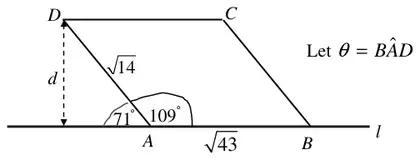
| \(\cos\theta = \dfrac{\overrightarrow{AB} \bullet \overrightarrow{AD}}{\left|\overrightarrow{AB}\right|.\left|\overrightarrow{AD}\right|} = \dfrac{\begin{pmatrix} 3 \\ 3 \\ 5 \end{pmatrix} \bullet \begin{pmatrix} -3 \\ 2 \\ -1 \end{pmatrix}}{\sqrt{(3)^2 + (3)^2 + (5)^2}.\sqrt{(-3)^2 + (2)^2 + (-1)^2}}\) Applies dot product formula between their \(\left(\overrightarrow{AB}\text{ or } \overrightarrow{BA}\right)\) and their \(\left(\overrightarrow{AD}\text{ or } \overrightarrow{DA}\right)\). | M1 |
| \(\cos\theta = \pm\left(\dfrac{-9 + 6 - 5}{\sqrt{(3)^2 + (3)^2 + (5)^2}.\sqrt{(-3)^2 + (2)^2 + (-1)^2}}\right)\) Correct followed through expression or equation. | A1ft |
| \(\cos\theta = \dfrac{-8}{\sqrt{43}.\sqrt{14}} \Rightarrow \theta = 109.029544\ldots = 109\ (\text{nearest}^\circ)\) awrt 109 | A1 cso AG |
| (4) |
Notes
Let \(\theta = B\hat{A}D\). (corrected from the printed mark scheme: the note by the diagram is printed “Let \(d\) be the shortest distance from \(C\) to \(l\)”; the diagram and part (f) use \(D\))
M1: An attempt to find either the vector \(\overrightarrow{AD}\) or \(\overrightarrow{DA}\).
Can be implied by two out of three components correct in \(-3\mathbf{i} + 2\mathbf{j} - \mathbf{k}\) or \(3\mathbf{i} - 2\mathbf{j} + \mathbf{k}\), respectively.
M1: Applies dot product formula between their \(\left(\overrightarrow{AB}\text{ or } \overrightarrow{BA}\right)\) and their \(\left(\overrightarrow{AD}\text{ or } \overrightarrow{DA}\right)\).
A1ft: Correct followed through expression or equation. The dot product must be correctly followed through correctly and the square roots although they can be un-simplified must be followed through correctly.
A1: Obtains an angle of awrt 109 by correct solution only.
Award the final A1 mark if candidate achieves awrt 109 by either taking the dot product between:
(i) \(\begin{pmatrix} 3 \\ 3 \\ 5 \end{pmatrix} \text{ and } \begin{pmatrix} -3 \\ 2 \\ -1 \end{pmatrix}\) or (ii) \(\begin{pmatrix} -3 \\ -3 \\ -5 \end{pmatrix} \text{ and } \begin{pmatrix} 3 \\ -2 \\ 1 \end{pmatrix}\). Ignore if any of these vectors are labelled incorrectly.
Award A0, cso for those candidates who take the dot product between:
(iii) \(\begin{pmatrix} -3 \\ -3 \\ -5 \end{pmatrix} \text{ and } \begin{pmatrix} -3 \\ 2 \\ -1 \end{pmatrix}\) or (iv) \(\begin{pmatrix} 3 \\ 3 \\ 5 \end{pmatrix} \text{ and } \begin{pmatrix} 3 \\ -2 \\ 1 \end{pmatrix}\).
They will usually find awrt 71 and apply 180 – awrt 71 to give awrt 109. If these candidates give a convincing detailed explanation which must include reference to the direction of their vectors then this can be given A1 cso. If still in doubt, here, send to review.
Alternative method for part (c): Applying the cosine rule:
| Scheme | Marks |
|---|---|
| \(\overrightarrow{AD} = \overrightarrow{OD} - \overrightarrow{OA} = \begin{pmatrix} -1 \\ 1 \\ 4 \end{pmatrix} - \begin{pmatrix} 2 \\ -1 \\ 5 \end{pmatrix} = \begin{pmatrix} -3 \\ 2 \\ -1 \end{pmatrix}\) or \(\overrightarrow{DA} = \begin{pmatrix} 3 \\ -2 \\ 1 \end{pmatrix}\) \(\overrightarrow{DB} = \overrightarrow{OB} - \overrightarrow{OD} = \begin{pmatrix} 5 \\ 2 \\ 10 \end{pmatrix} - \begin{pmatrix} -1 \\ 1 \\ 4 \end{pmatrix} = \begin{pmatrix} 6 \\ 1 \\ 6 \end{pmatrix}\) or \(\overrightarrow{BD} = \begin{pmatrix} -6 \\ -1 \\ -6 \end{pmatrix}\) | M1: as above. |
| So \(\left|\overrightarrow{AB}\right| = \sqrt{43},\ \left|\overrightarrow{AD}\right| = \sqrt{14}\) and \(\left|\overrightarrow{DB}\right| = \sqrt{73}\) | |
| \(\cos\theta = \dfrac{\left(\sqrt{43}\right)^2 + \left(\sqrt{14}\right)^2 - \left(\sqrt{73}\right)^2}{2\sqrt{43}.\sqrt{14}}\) | M1 A1 |
| \(\left\{\cos\theta = \dfrac{-16}{2\sqrt{43}.\sqrt{14}} \Rightarrow \theta = 109.029544\ldots\right\} = 109\ (\text{nearest}^\circ)\) | A1 AG |
M1: Cosine rule structure of \(\cos\theta = \dfrac{a^2 + b^2 - c^2}{2ab}\) assigned each of \(\left|\overrightarrow{AB}\right|, \left|\overrightarrow{AD}\right|\) and \(\left|\overrightarrow{DB}\right|\) in any order as their \(a\), \(b\) and \(c\).
A1: Correct application of cosine rule.
A1: awrt 109 (no errors seen). AG
(corrected from the printed mark scheme: the second line is printed as \(\overrightarrow{DB} = \overrightarrow{OD} - \overrightarrow{OA}\); the vectors shown are \(\overrightarrow{OB} - \overrightarrow{OD}\))
| Scheme | Marks |
|---|---|
| \(\overrightarrow{OC} = \overrightarrow{OD} + \overrightarrow{DC} = \overrightarrow{OD} + \overrightarrow{AB} = (-\mathbf{i} + \mathbf{j} + 4\mathbf{k}) + (3\mathbf{i} + 3\mathbf{j} + 5\mathbf{k})\) \(\overrightarrow{OC} = \overrightarrow{OB} + \overrightarrow{BC} = \overrightarrow{OB} + \overrightarrow{AD} = (5\mathbf{i} + 2\mathbf{j} + 10\mathbf{k}) + (-3\mathbf{i} + 2\mathbf{j} - \mathbf{k})\) | M1 |
| So, \(\overrightarrow{OC} = 2\mathbf{i} + 4\mathbf{j} + 9\mathbf{k}\) | A1 |
| (2) |
Notes
M1: Applies either \(\overrightarrow{OD} + \text{their } \overrightarrow{AB}\) or \(\overrightarrow{OB} + \text{their } \overrightarrow{AD}\).
This mark can be implied by two out of three correctly followed through components in their \(\overrightarrow{OD}\).
A1: For \(2\mathbf{i} + 4\mathbf{j} + 9\mathbf{k}\).
| Scheme | Marks |
|---|---|
| Area \(ABCD = \left(\tfrac{1}{2}(\sqrt{43})(\sqrt{14})\sin 109^\circ\right); \times 2 = 23.19894905\) awrt 23.2 | M1; dM1 A1 |
| (3) |
Notes
M1: \(\tfrac{1}{2}(\text{their } AB)(\text{their } CB)\sin(\text{their } 109^\circ \text{ or } 71^\circ \text{ from (b)})\). Awrt 11.6 will usually imply this mark.
dM1: Multiplies this by 2 for the parallelogram. Can be implied.
Note: \(\tfrac{1}{2}\left((\text{their } AB + \text{their } AB)\right)(\text{their } CB)\sin(\text{their } 109^\circ \text{ or } 71^\circ \text{ from (b)})\)
A1: awrt 23.2
| Scheme | Marks |
|---|---|
| \(\dfrac{d}{\sqrt{14}} = \sin 71\) or \(\sqrt{43}\,d = 23.19894905\ldots\) | M1 |
| \(\therefore\ d = \sqrt{14}\sin 71^\circ = 3.537806563\ldots\) awrt 3.54 | A1 |
| (2) | |
| (15 marks) |
Notes
M1: \(\dfrac{d}{\text{their } AD} = \sin(\text{their } 109^\circ \text{ or } 71^\circ \text{ from (b)})\) or \((\text{their } AB)\,d = (\text{their Area } ABCD)\)
Award M0 for \((\text{their } AB)\) in part (f), if the area of their parallelogram in part (e) is \((\text{their } AB)(\text{their } CB)\).
Award M0 for \(\dfrac{d}{\text{their } \sqrt{43}} = \sin 71\) or \(\left(\text{their } \sqrt{14}\right)d = 23.19894905\ldots\)
A1: awrt 3.54
Note: Some candidates will use their answer to part (f) in order to answer part (e).
Alternative method for part (f):
| Scheme | Marks |
|---|---|
| \(\overrightarrow{OE} = \begin{pmatrix} 2 \\ -1 \\ 5 \end{pmatrix} + \lambda\begin{pmatrix} 3 \\ 3 \\ 5 \end{pmatrix}\) \(\overrightarrow{DE} = \begin{pmatrix} 2 + 3\lambda \\ -1 + 3\lambda \\ 5 + 5\lambda \end{pmatrix} - \begin{pmatrix} -1 \\ 1 \\ 4 \end{pmatrix} = \begin{pmatrix} 3 + 3\lambda \\ -2 + 3\lambda \\ 1 + 5\lambda \end{pmatrix}\) | |
| \(\overrightarrow{DE} \bullet \overrightarrow{AB} = 0 \Rightarrow \begin{pmatrix} 3 + 3\lambda \\ -2 + 3\lambda \\ 1 + 5\lambda \end{pmatrix} \bullet \begin{pmatrix} 3 \\ 3 \\ 5 \end{pmatrix} = 0\) \(9 + 9\lambda - 6 + 9\lambda + 5 + 25\lambda = 0 \Rightarrow \lambda = -\dfrac{8}{43}\) | M1 |
| \(\overrightarrow{DE} = \begin{pmatrix} 2 + 3\lambda \\ -1 + 3\lambda \\ 5 + 5\lambda \end{pmatrix} - \begin{pmatrix} -1 \\ 1 \\ 4 \end{pmatrix} = \begin{pmatrix} \frac{105}{43} \\ -\frac{110}{43} \\ \frac{3}{43} \end{pmatrix}\) | dM1 |
| Length DE \(= 3.537806563\ldots\) | A1 |
M1: Takes the dot product between \(\overrightarrow{DE}\) and \(\overrightarrow{AB}\) and progresses to find a value of \(\lambda\)
dM1: Uses their value of \(\lambda\) to find \(\overrightarrow{DE}\)
A1: awrt 3.54
(corrected from the printed mark scheme: this alternative is headed “part (d)” but is for part (f); the expanded dot product is printed with \(+ 3\lambda\) for \(+ 25\lambda\); and the first component of \(\overrightarrow{DE}\) is printed as \(\frac{103}{43}\) for \(\frac{105}{43}\))