
C4 January 2012 Q4
4.
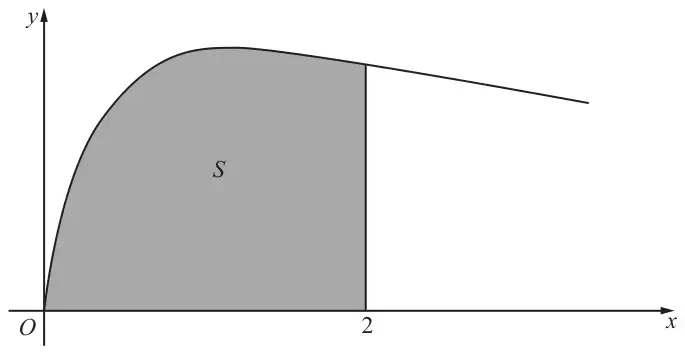
Figure 1 shows the curve with equation\[y = \sqrt{\left(\frac{2x}{3x^2 + 4}\right)}, \quad x \geqslant 0\]
The finite region \(S\), shown shaded in Figure 1, is bounded by the curve, the \(x\)-axis and the line \(x = 2\)
The region \(S\) is rotated \(360^\circ\) about the \(x\)-axis.
Use integration to find the exact value of the volume of the solid generated, giving your answer in the form \(k\ln a\), where \(k\) and \(a\) are constants. (5)
| Scheme | Marks |
|---|---|
| \(\text{Volume} = \underline{\pi\displaystyle\int_0^2 \left(\sqrt{\left(\frac{2x}{3x^2 + 4}\right)}\right)^2 \mathrm{d}x}\) Use of \(V = \underline{\pi\displaystyle\int y^2}\,\mathrm{d}x\). | B1 |
| \(= (\pi)\left[\dfrac{1}{3}\ln\left(3x^2 + 4\right)\right]_0^2\) \(\pm k\ln\left(3x^2 + 4\right)\) | M1 |
| \(\dfrac{1}{3}\ln\left(3x^2 + 4\right)\) | A1 |
| \(= (\pi)\left[\left(\dfrac{1}{3}\ln 16\right) - \left(\dfrac{1}{3}\ln 4\right)\right]\) Substitutes limits of 2 and 0 and subtracts the correct way round. | dM1 |
| So Volume \(= \underline{\dfrac{1}{3}\pi\ln 4}\) \(\underline{\dfrac{1}{3}\pi\ln 4}\) or \(\underline{\dfrac{2}{3}\pi\ln 2}\) | A1 oe isw |
| (5) | |
| (5 marks) |
Notes
NOTE: \(\pi\) is required for the B1 mark and the final A1 mark. It is not required for the 3 intermediate marks.
B1: For applying \(\pi\displaystyle\int y^2\). Ignore limits and \(\mathrm{d}x\). This can be implied by later working, but the pi and \(\displaystyle\int \frac{2x}{3x^2 + 4}\) must appear on one line somewhere in the candidate’s working.
B1 can also be implied by a correct final answer. Note: \(\pi\left(\displaystyle\int y\right)^2\) would be B0.
Working in x
M1: For \(\pm k\ln\left(3x^2 + 4\right)\) or \(\pm k\ln\left(x^2 + \dfrac{4}{3}\right)\) where \(k\) is a constant and \(k\) can be 1.
Note: M0 for \(\pm kx\ln\left(3x^2 + 4\right)\).
Note: M1 can also be given for \(\pm k\ln\left(p\left(3x^2 + 4\right)\right)\), where \(k\) and \(p\) are constants and \(k\) can be 1.
A1: For \(\dfrac{1}{3}\ln\left(3x^2 + 4\right)\) or \(\dfrac{1}{3}\ln\left(\dfrac{1}{3}\left(3x^2 + 4\right)\right)\) or \(\dfrac{1}{3}\ln\left(x^2 + \dfrac{4}{3}\right)\) or \(\dfrac{1}{3}\ln\left(p(3x^2 + 4)\right)\).
You may allow M1 A1 for \(\dfrac{1}{3}\left(\dfrac{x}{x}\right)\ln\left(3x^2 + 4\right)\) or \(\dfrac{1}{3}\left(\dfrac{2x}{6x}\right)\ln\left(3x^2 + 4\right)\)
dM1: Substitutes limits of 2 and 0 and subtracts the correct way round. Working in decimals is fine for dM1.
A1: For either \(\dfrac{1}{3}\pi\ln 4,\ \dfrac{1}{3}\ln 4^{\pi},\ \dfrac{2}{3}\pi\ln 2,\ \pi\ln 4^{\frac{1}{3}},\ \pi\ln 2^{\frac{2}{3}},\ \dfrac{1}{3}\pi\ln\left(\dfrac{16}{4}\right),\ 2\pi\ln\left(\dfrac{16^{\frac{1}{6}}}{4^{\frac{1}{6}}}\right)\), etc.
Note: \(\dfrac{1}{3}\pi(\ln 16 - \ln 4)\) would be A0.
Working in u: where \(u = 3x^2 + 4\),
M1: For \(\pm k\ln u\) where \(k\) is a constant and \(k\) can be 1.
Note: M1 can also be given for \(\pm k\ln(pu)\), where \(k\) and \(p\) are constants and \(k\) can be 1.
A1: For \(\dfrac{1}{3}\ln u\) or \(\dfrac{1}{3}\ln 3u\) or \(\dfrac{1}{3}\ln pu\).
dM1: Substitutes limits of 16 and 4 in u or limits of 2 and 0 in \(x\) and subtracts the correct way round.
A1: As above!