
C4 January 2009 Q5
5.
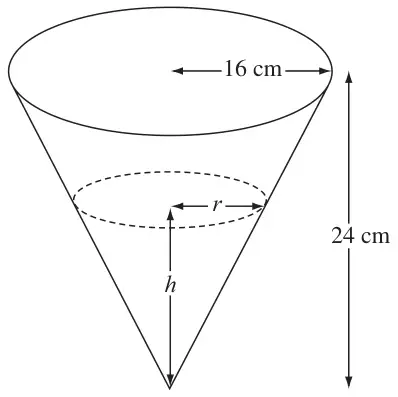
A container is made in the shape of a hollow inverted right circular cone. The height of the container is 24 cm and the radius is 16 cm, as shown in Figure 2. Water is flowing into the container. When the height of water is \(h\) cm, the surface of the water has radius \(r\) cm and the volume of water is \(V\) cm\(^3\).
[The volume \(V\) of a right circular cone with vertical height \(h\) and base radius \(r\) is given by the formula \(V = \dfrac{1}{3}\pi r^2 h\).]
Water flows into the container at a rate of 8 cm\(^3\) s\(^{-1}\).
| Scheme | Marks |
|---|---|
| Similar triangles \(\Rightarrow \underline{\dfrac{r}{h} = \dfrac{16}{24}} \Rightarrow \underline{r = \dfrac{2h}{3}}\) | M1 |
| \(V = \dfrac{1}{3}\pi r^2 h = \dfrac{1}{3}\pi\left(\dfrac{2h}{3}\right)^2 h = \dfrac{4\pi h^3}{27}\) AG | A1 |
| (2) |
Notes
M1: Uses similar triangles, ratios or trigonometry to find either one of these two expressions oe.
A1: Substitutes \(r = \tfrac{2h}{3}\) into the formula for the volume of water \(V\).
5. (a) (Appendix)
| Scheme | Marks |
|---|---|
| Similar shapes \(\Rightarrow\) either | |
| \(\underline{\dfrac{\frac{1}{3}\pi(16)^2 24}{V} = \left(\dfrac{24}{h}\right)^3}\) or \(\underline{\dfrac{V}{\frac{1}{3}\pi(16)^2 24} = \left(\dfrac{h}{24}\right)^3}\) \(\underline{\dfrac{\frac{1}{3}\pi r^2(24)}{V} = \left(\dfrac{24}{h}\right)^3}\) or \(\underline{\dfrac{V}{\frac{1}{3}\pi r^2(24)} = \left(\dfrac{h}{24}\right)^3}\) | M1 |
| \(V = 2048\pi \times \left(\dfrac{h}{24}\right)^3 = \dfrac{4\pi h^3}{27}\) AG | A1 |
| (2) |
M1: Uses similar shapes to find either one of these two expressions oe. A1: Substitutes their equation to give the correct formula for the volume of water \(V\).
5. (a) Candidates simply writing: \(V = \dfrac{4}{9} \times \dfrac{1}{3}\pi h^3\) or \(V = \dfrac{1}{3}\pi\left(\dfrac{16}{24}\right)^2 h^3\) would be awarded M0A0.
| Scheme | Marks |
|---|---|
| From the question, \(\dfrac{\mathrm{d}V}{\mathrm{d}t} = 8\) | B1 |
| \(\underline{\dfrac{\mathrm{d}V}{\mathrm{d}h} = \dfrac{12\pi h^2}{27}} = \underline{\dfrac{4\pi h^2}{9}}\) | B1 |
| \(\dfrac{\mathrm{d}h}{\mathrm{d}t} = \dfrac{\mathrm{d}V}{\mathrm{d}t} \div \dfrac{\mathrm{d}V}{\mathrm{d}h} = \underline{8 \times \dfrac{9}{4\pi h^2}} = \underline{\dfrac{18}{\pi h^2}}\) | M1; A1 |
| When \(h = 12\), \(\dfrac{\mathrm{d}h}{\mathrm{d}t} = \underline{\dfrac{18}{144\pi}} = \underline{\dfrac{1}{8\pi}}\) | A1 oe isw |
| (5) | |
| (7 marks) |
Notes
B1: \(\dfrac{\mathrm{d}V}{\mathrm{d}t} = 8\) B1: \(\underline{\dfrac{\mathrm{d}V}{\mathrm{d}h} = \dfrac{12\pi h^2}{27}}\) or \(\underline{\dfrac{4\pi h^2}{9}}\)
M1: Candidate’s \(\dfrac{\mathrm{d}V}{\mathrm{d}t} \div \dfrac{\mathrm{d}V}{\mathrm{d}h}\);
A1: \(\underline{8 \div \left(\dfrac{12\pi h^2}{27}\right)}\) or \(\underline{8 \times \dfrac{9}{4\pi h^2}}\) or \(\underline{\dfrac{18}{\pi h^2}}\) oe
A1 oe isw: \(\underline{\dfrac{18}{144\pi}}\) or \(\underline{\dfrac{1}{8\pi}}\)
Note the answer must be a one term exact value. Note, also you can ignore subsequent working after \(\underline{\dfrac{18}{144\pi}}\).
5. (b) (Appendix)
| Scheme | Marks |
|---|---|
| From question, \(\dfrac{\mathrm{d}V}{\mathrm{d}t} = 8 \Rightarrow V = 8t\ (+\,c)\) | B1 |
| \(h = \left(\dfrac{27V}{4\pi}\right)^{\frac{1}{3}} \Rightarrow h = \underline{\left(\dfrac{27(8t)}{4\pi}\right)^{\frac{1}{3}}} = \underline{\left(\dfrac{54t}{\pi}\right)^{\frac{1}{3}}} = \underline{3\left(\dfrac{2t}{\pi}\right)^{\frac{1}{3}}}\) | B1 |
| \(\dfrac{\mathrm{d}h}{\mathrm{d}t} = 3\left(\dfrac{2}{\pi}\right)^{\frac{1}{3}}\dfrac{1}{3}t^{-\frac{2}{3}}\) | M1; A1 oe |
| When \(h = 12\), \(t = \left(\dfrac{12}{3}\right)^3 \times \dfrac{\pi}{2} = 32\pi\) | |
| So when \(h = 12\), \(\dfrac{\mathrm{d}h}{\mathrm{d}t} = \left(\dfrac{2}{\pi}\right)^{\frac{1}{3}}\left(\dfrac{1}{32\pi}\right)^{\frac{2}{3}} = \left(\dfrac{2}{1024\pi^3}\right)^{\frac{1}{3}} = \underline{\dfrac{1}{8\pi}}\) | A1 oe |
| (5) |
B1: \(\dfrac{\mathrm{d}V}{\mathrm{d}t} = 8\) or \(V = 8t\) B1: \(\underline{\left(\dfrac{27(8t)}{4\pi}\right)^{\frac{1}{3}}}\) or \(\underline{\left(\dfrac{54t}{\pi}\right)^{\frac{1}{3}}}\) or \(\underline{3\left(\dfrac{2t}{\pi}\right)^{\frac{1}{3}}}\)
M1: \(\dfrac{\mathrm{d}h}{\mathrm{d}t} = \pm kt^{-\frac{2}{3}}\); A1 oe: \(\dfrac{\mathrm{d}h}{\mathrm{d}t} = 3\left(\dfrac{2}{\pi}\right)^{\frac{1}{3}}\dfrac{1}{3}t^{-\frac{2}{3}}\) A1 oe: \(\underline{\dfrac{1}{8\pi}}\)