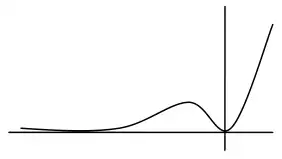
C3 June 2007 Q3
3. A curve \(C\) has equation\[y = x^2\mathrm{e}^x.\]
| Scheme | Marks |
|---|---|
| \(\dfrac{\mathrm{d}y}{\mathrm{d}x} = x^2\mathrm{e}^x + 2x\mathrm{e}^x\) | M1,A1,A1 |
| (3) |
Notes
Generous M for attempt at \(f(x)g^{\prime}(x) + f^{\prime}(x)g(x)\)
1st A1 for one correct, 2nd A1 for the other correct.
Note that \(x^2e^x\) on its own scores no marks
| Scheme | Marks |
|---|---|
| If \(\dfrac{\mathrm{d}y}{\mathrm{d}x} = 0\), \(\mathrm{e}^x(x^2 + 2x) = 0\) setting (a) \(= 0\) | M1 |
| \([\mathrm{e}^x \neq 0]\) \(x(x + 2) = 0\) \((x = 0)\) or \(x = -2\) | A1 |
| \(x = 0,\ y = 0\) and \(x = -2,\ y = 4\mathrm{e}^{-2}\ (= 0.54\ldots)\) | A1ft |
| (3) |
Notes
1st A1 (\(x = 0\)) may be omitted, but for
2nd A1 both sets of coordinates needed; f.t only on candidate’s \(x = -2\)
| Scheme | Marks |
|---|---|
| \(\dfrac{\mathrm{d}^2y}{\mathrm{d}x^2} = x^2\mathrm{e}^x + 2x\mathrm{e}^x + 2x\mathrm{e}^x + 2\mathrm{e}^x\) \(\left[= (x^2 + 4x + 2)\mathrm{e}^x\right]\) | M1, A1 |
| (2) |
Notes
M1 requires complete method for candidate’s (a), result may be unsimplified for A1
| Scheme | Marks |
|---|---|
| \(x = 0,\ \dfrac{\mathrm{d}^2y}{\mathrm{d}x^2} > 0\ (=2)\) \(x = -2,\ \dfrac{\mathrm{d}^2y}{\mathrm{d}x^2} < 0\ \left[= -2\mathrm{e}^{-2}\ (= -0.270\ldots)\right]\) M1: Evaluate, or state sign of, candidate’s (c) for at least one of candidate’s \(x\) value(s) from (b) | M1 |
| \(\therefore\) minimum \(\therefore\) maximum | A1 (cso) |
| (2) | |
| (10 marks) |
Notes
A1 is cso; \(x = 0\), min, and \(x = -2\), max and no incorrect working seen., or (in alternative) sign of \(\frac{dy}{dx}\) either side correct, or values of \(y\) appropriate to t.p.
Need only consider the quadratic, as may assume \(\mathrm{e}^x > 0\).
If all marks gained in (a) and (c), and correct x values, give M1A1 for correct statements with no workingAlternative
For M1:
Evaluate, or state sign of, \(\dfrac{\mathrm{d}y}{\mathrm{d}x}\) at two appropriate values – on either side of at least one of their answers from (b) or
Evaluate \(y\) at two appropriate values – on either side of at least one of their answers from (b) or
Sketch curve