
C2 June 2009 Q4
4.
| \(x\) | 0 | 0.5 | 1 | 1.5 | 2 | 2.5 | 3 |
|---|---|---|---|---|---|---|---|
| \(\sqrt{(2^x + 1)}\) | 1.414 | 1.554 | 1.732 | 1.957 | 3 |
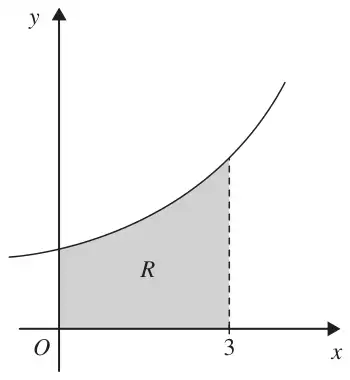
Figure 1 shows the region \(R\) which is bounded by the curve with equation \(y = \sqrt{(2^x + 1)}\), the \(x\)-axis and the lines \(x = 0\) and \(x = 3\)
| Scheme | Marks |
|---|---|
| \(x = 2\) gives 2.236 (allow AWRT) Accept \(\sqrt{5}\) | B1 |
| \(x = 2.5\) gives 2.580 (allow AWRT) Accept 2.58 | B1 |
| (2) |
| Scheme | Marks |
|---|---|
| \(\left(\dfrac{1}{2} \times \dfrac{1}{2}\right),\quad \left[(1.414 + 3) + 2(1.554 + 1.732 + 1.957 + 2.236 + 2.580)\right]\) | B1,[M1A1ft] |
| \(= 6.133\) (AWRT 6.13, even following minor slips) | A1 |
| (4) |
Notes
B1 for \(\dfrac{1}{2} \times \dfrac{1}{2}\) or equivalent.
For the M mark, the first bracket must contain the 'first and last' values, and the second bracket (which must be multiplied by 2) must have no additional values. If the only mistake is to omit one of the values from the second bracket, this can be considered as a slip and the M mark can be allowed.
Bracketing mistake: i.e. \(\left(\dfrac{1}{2} \times \dfrac{1}{2}\right)(1.414 + 3) + 2(1.554 + 1.732 + 1.957 + 2.236 + 2.580)\)
scores B1 M1 A0 A0 unless the final answer implies that the calculation has been done correctly (then full marks can be given).
Alternative:
Separate trapezia may be used, and this can be marked equivalently.\[\left[\frac{1}{4}(1.414 + 1.554) + \frac{1}{4}(1.554 + 1.732) + \ldots\ldots\ldots\ldots + \frac{1}{4}(2.580 + 3)\right]\]1st A1ft for correct expression, ft their 2.236 and their 2.580
| Scheme | Marks |
|---|---|
| Overestimate | B1 |
| 'Since the trapezia lie above the curve', or an equivalent explanation, or sketch of (one or more) trapezia above the curve on a diagram (or on the given diagram, in which case there should be reference to this). (Note that there must be some reference to a trapezium or trapezia in the explanation or diagram). | dB1 |
| (2) | |
| [8] |
Notes
1st B1 for 'overestimate', ignoring earlier mistakes and ignoring any reasons given.
2nd B1 is dependent upon the 1st B1 (overestimate).