
C2 January 2013 Q9
9.
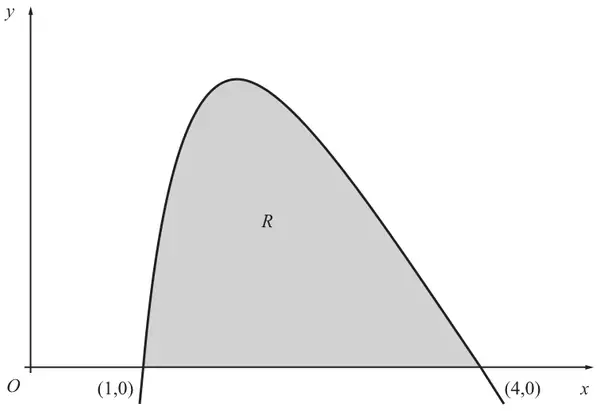
The finite region \(R\), as shown in Figure 2, is bounded by the \(x\)-axis and the curve with equation\[y = 27 - 2x - 9\sqrt{x} - \frac{16}{x^2}, \qquad x > 0\]The curve crosses the \(x\)-axis at the points \((1, 0)\) and \((4, 0)\).
(a) Complete the table below, by giving your values of \(y\) to 3 decimal places.
(2)
| \(x\) | 1 | 1.5 | 2 | 2.5 | 3 | 3.5 | 4 |
|---|---|---|---|---|---|---|---|
| \(y\) | 0 | 5.866 | 5.210 | 1.856 | 0 |
(b) Use the trapezium rule with all the values in the completed table to find an approximate value for the area of \(R\), giving your answer to 2 decimal places. (4)
(c) Use integration to find the exact value for the area of \(R\). (6)
| Scheme | Marks |
|---|---|
| \(y = 27 - 2x - 9\sqrt{x} - \dfrac{16}{x^2}\) | |
| 6.272 , 3.634 | B1, B1 |
| (2) |
| Scheme | Marks |
|---|---|
| \(\dfrac{1}{2} \times \dfrac{1}{2}\) or \(\dfrac{1}{4}\) | B1 |
| \(\ldots.\left\{(0 + 0) + 2\left(5.866 + \text{"}6.272\text{"} + 5.210 + \text{"}3.634\text{"} + 1.856\right)\right\}\) | M1A1ft |
| \(\dfrac{1}{2} \times 0.5\left\{(0 + 0) + 2\left(5.866 + \text{"}6.272\text{"} + 5.210 + \text{"}3.634\text{"} + 1.856\right)\right\}\) \(= \dfrac{1}{4} \times 45.676\) | |
| \(= 11.42\) | A1 |
| (4) |
Notes
M1A1ft: Need {} or implied later for A1ft
A1: cao
| Scheme | Marks |
|---|---|
| \(\displaystyle\int y\,\mathrm{d}x = 27x - x^2 - 6x^{\frac{3}{2}} + 16x^{-1}\ (+c)\) | M1A1A1A1 |
| \(\left(27(4) - (4)^2 - 6(4)^{\frac{3}{2}} + 16(4)^{-1}\right)\) \(-\left(27(1) - (1)^2 - 6(1)^{\frac{3}{2}} + 16(1)^{-1}\right)\) | dM1 |
| \(= (48 - 36)\) | |
| 12 | A1 |
| (6) | |
| [12] |
Notes
M1: \(x^n \to x^{n+1}\) on any term
A1: \(27x - x^2\)
A1: \(-6x^{\frac{3}{2}}\)
A1: \(+16x^{-1}\)
dM1: Attempt to subtract either way round using the limits 4 and 1. Dependent on the previous M1
A1: Cao