
C1 June 2009 Q8
8.
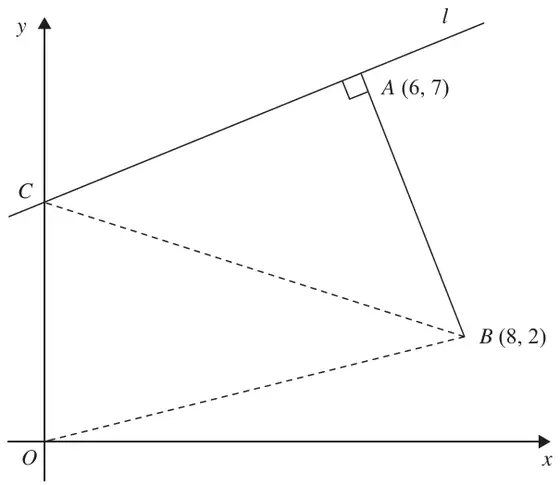
The points \(A\) and \(B\) have coordinates \((6, 7)\) and \((8, 2)\) respectively.
The line \(l\) passes through the point \(A\) and is perpendicular to the line \(AB\), as shown in Figure 1.
Given that \(l\) intersects the \(y\)-axis at the point \(C\), find
| Scheme | Marks |
|---|---|
| \(AB\colon\ m = \dfrac{2 - 7}{8 - 6}, \ \left(= -\dfrac{5}{2}\right)\) | B1 |
| Using \(m_1m_2 = -1\colon\ m_2 = \dfrac{2}{5}\) | M1 |
| \(y - 7 = \dfrac{2}{5}(x - 6), \qquad 2x - 5y + 23 = 0 \quad\) (o.e. with integer coefficients) | M1, A1 |
| (4) |
Notes
B1: for an expression for the gradient of \(AB\). Does not need the \(= -2.5\)
1st M1: for use of the perpendicular gradient rule. Follow through their \(m\)
2nd M1: for the use of \((6, 7)\) and their changed gradient to form an equation for \(l\).
Can be awarded for \(\dfrac{y - 7}{x - 6} = \dfrac{2}{5}\) o.e.
Alternative is to use \((6, 7)\) in \(y = mx + c\) to find a value for \(c\). Score when \(c = \ldots\) is reached.
A1: for a correct equation in the required form and must have “\(= 0\)” and integer coefficients
| Scheme | Marks |
|---|---|
| Using \(x = 0\) in the answer to (a), \(y = \dfrac{23}{5}\) or 4.6 | M1, A1ft |
| (2) |
Notes
M1: for using \(x = 0\) in their answer to part (a) e.g. \(-5y + 23 = 0\)
A1ft: for \(y = \dfrac{23}{5}\) provided that \(x = 0\) clearly seen or \(C\,(0, 4.6)\). Follow through their equation in (a)
If \(x = 0,\ y = 4.6\) are clearly seen but \(C\) is given as \((4.6, 0)\) apply ISW and award the mark.
This A mark requires a simplified fraction or an exact decimal
Accept their 4.6 marked on diagram next to \(C\) for M1A1ft
| Scheme | Marks |
|---|---|
| Area of triangle \(= \dfrac{1}{2}\times 8\times\dfrac{23}{5} = \dfrac{92}{5}\) (o.e) e.g. \(\left(18\dfrac{2}{5},\ 18.4,\ \dfrac{184}{10}\right)\) | M1 A1 |
| (2) | |
| (8 marks) |
Notes
M1: for \(\tfrac{1}{2}\times 8\times y_C\) so can follow through their \(y\) coordinate of \(C\).
A1: for 18.4 (o.e.) but their \(y\) coordinate of \(C\) must be positive
Use of 2 triangles or trapezium and triangle
Award M1 when an expression for area of \(OCB\) only is seen
Determinant approach
Award M1 when an expression containing \(\tfrac{1}{2}\times 8\times y_C\) is seen