
C1 January 2012 Q6
6.
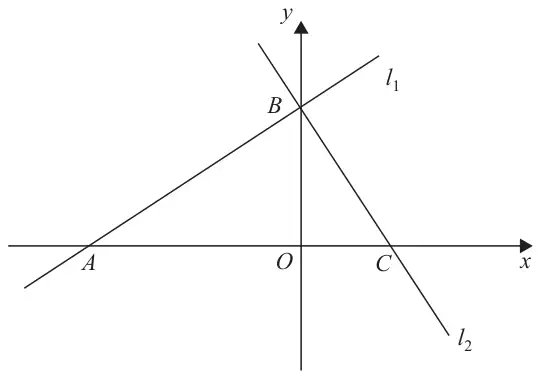
The line \(l_1\) has equation \(2x - 3y + 12 = 0\)
The line \(l_1\) crosses the \(x\)-axis at the point \(A\) and the \(y\)-axis at the point \(B\), as shown in Figure 1.
The line \(l_2\) is perpendicular to \(l_1\) and passes through \(B\).
The line \(l_2\) crosses the \(x\)-axis at the point \(C\).
| Scheme | Marks |
|---|---|
| \((m =)\dfrac{2}{3}\) (or exact equivalent) | B1 |
| (1) |
Notes
B1: for \(\dfrac{2}{3}\) seen. Do not award for \(\dfrac{2}{3}x\) and must be in part (a)
| Scheme | Marks |
|---|---|
| \(B\): \((0, 4)\) [award when first seen – may be in (c)] | B1 |
| Gradient: \(\dfrac{-1}{m} = -\dfrac{3}{2}\) | M1 |
| \(y - 4 = -\dfrac{3x}{2}\) or equiv. e.g. \(\left(y = -\dfrac{3x}{2} + 4,\quad 3x + 2y - 8 = 0\right)\) | A1 |
| (3) |
Notes
B1: for coordinates of \(B\). Accept 4 marked on \(y\)-axis (clearly labelled)
M1: for use of perpendicular gradient rule. Follow through their value for \(m\)
A1: for a correct equation (any form, need not be simplified). Answer only 3/3
| Scheme | Marks |
|---|---|
| \(A\): \((-6, 0)\) [award when first seen – may be in (b)] | B1 |
| \(C\): \(\dfrac{3x}{2} = 4 \ \Rightarrow\ x = \dfrac{8}{3}\) [award when first seen – may be in (b)] | B1ft |
| Area: Using \(\dfrac{1}{2}(x_C - x_A)y_B\) | M1 |
| \(= \dfrac{1}{2}\left(\dfrac{8}{3} + 6\right)4 = \dfrac{52}{3}\ \left(= 17\dfrac{1}{3}\right)\) | A1 cso |
| (4) | |
| (8 marks) |
Notes
ALT
| Scheme | Marks |
|---|---|
| \(BC = \dfrac{4}{6}\sqrt{52}\) (from similar triangles) (or possibly using \(C\)) | 2nd B1ft |
| Area: Using \(\dfrac{1}{2}(AB\times BC)\) N.B. \(AB = \sqrt{6^2 + 4^2} = \sqrt{52}\) | M1 |
| \(= \dfrac{1}{2}\times\sqrt{52}\times\left(\dfrac{2}{3}\sqrt{52}\right) = \dfrac{52}{3}\ \left(= 17\dfrac{1}{3}\right)\) | A1 |
Notes
1st B1: for the coordinates of \(A\) (clearly labelled). Accept \(-6\) marked on \(x\)-axis
2nd B1ft: for the coordinates of \(C\) (clearly labelled) or \(AC = \tfrac{26}{3}\).
Accept \(x = \dfrac{8}{3}\) marked on \(x\)-axis. Follow through from \(l_2\) if \(>0\)
M1: for an expression for the area of the triangle (all lengths \(> 0\)). Ft their 4, \(-6\) and \(\dfrac{8}{3}\)
A1 cso: for \(\dfrac{52}{3}\) or exact equivalent seen but must be a single fraction or \(17\tfrac{1}{3}\) or \(17\tfrac{2}{6}\) etc
\(17\tfrac{1}{3}\) on its own can only score full marks if \(A\), \(B\) and \(C\) are all correct.