
Higher November 2020 Paper 2R Q26
26 \(A\), \(B\), \(D\) and \(E\) are points on a circle.
\(ABC\) and \(EDC\) are straight lines.
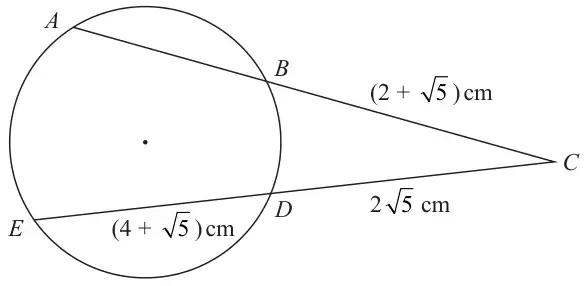
Diagram NOT accurately drawn
\(BC = (2 + \sqrt{5})\) cm
\(ED = (4 + \sqrt{5})\) cm
\(DC = 2\sqrt{5}\) cm
Show that the length of \(AB\) is \((p\sqrt{5} + q)\) cm, where \(p\) and \(q\) are integers whose values are to be found.
Show your working clearly.
(5)
| Scheme | Marks |
|---|---|
\((2 + \sqrt{5}) \times AC = (2\sqrt{5}) \times (2\sqrt{5} + 4 + \sqrt{5})\) or \((2 + \sqrt{5}) \times AC = (2\sqrt{5}) \times (3\sqrt{5} + 4)\) or \((2 + \sqrt{5}) \times (AB + 2 + \sqrt{5}) = (2\sqrt{5}) \times (2\sqrt{5} + 4 + \sqrt{5})\) | M1 |
| \((AC =)\; \dfrac{(2\sqrt{5}) \times (2\sqrt{5} + 4 + \sqrt{5})}{(2 + \sqrt{5})}\) or \((AC =)\; \dfrac{(30 + 8\sqrt{5})}{(2 + \sqrt{5})}\) | M1 |
\((AC =)\; \dfrac{(30 + 8\sqrt{5})}{(2 + \sqrt{5})} \times \dfrac{(2 - \sqrt{5})}{(2 - \sqrt{5})}\) or \((AB =)\; \dfrac{(21 + 4\sqrt{5})}{(2 + \sqrt{5})} \times \dfrac{(2 - \sqrt{5})}{(2 - \sqrt{5})}\) | M1 |
\((AC =)\; \dfrac{60 - 30\sqrt{5} + 16\sqrt{5} - 40}{4 - 5}\;\left(= 14\sqrt{5} - 20\right)\) or \((AB =)\; \dfrac{42 - 21\sqrt{5} + 8\sqrt{5} - 20}{4 - 5}\) | M1 |
\((AB =)\; \dfrac{20 - 14\sqrt{5}}{-1} - (2 + \sqrt{5})\) Working required Answer: \(13\sqrt{5} - 22\) | A1 |
| (5) | |
| (5 marks) |
Notes
M1: for using the intersecting chord theorem correctly
eg may label \(AB = x\) or \(AC = x\) oe
M1: dep 1st M1 for rearranging for \(AC\)
may use \(AB + 2 + \sqrt{5}\) on LHS
M1: indep for multiplying by the conjugate of the denominator of their fraction, so long as fraction in the form \(\dfrac{a + b\sqrt{5}}{c + d\sqrt{5}}\)
M1: dep 3rd M1 for multiplying out the numerator
A1: allow \(p = 13\) and \(q = -22\)