
Higher June 2019 Paper 1 Q20
20
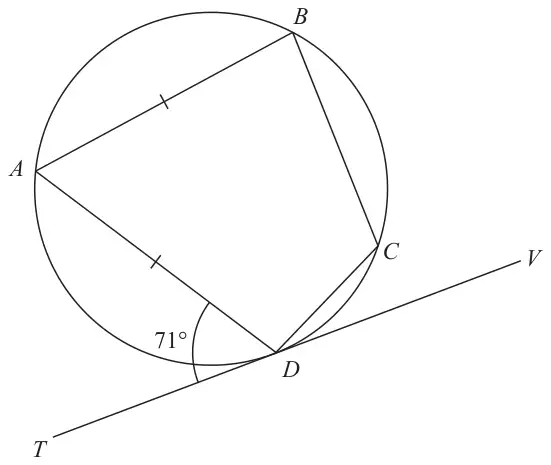
Diagram NOT accurately drawn
\(A\), \(B\), \(C\) and \(D\) are points on a circle.
\(TDV\) is the tangent to the circle at \(D\).
\(AB = AD\)
Angle \(ADT = 71^\circ\)
Work out the size of angle \(BCD\).
Give a reason for each stage of your working.
(5)
| Scheme | Marks |
|---|---|
| Students can use other methods to gain the correct answer angle \(ABD = 71\) or angle \(ACD = 71\) or using \(O\) as centre of circle, angle \(ADO\) = 90 – 71 (=19) | M1 |
| angle \(ADB = 71\) or angle \(ACB = 71\) or angle \(BAD\) = 19 × 2 (=38) or reflex angle \(BOD\) = 2 × 142 (=284) | M1 |
| angle \(BCD = 142\) Answer: 142 | A1 |
| B2 | |
| (5) | |
| (5 marks) |
Notes
M1: clearly labelled or stated
M1: dep clearly labelled or stated
A1: Clearly labelled or stated, from no incorrect working for their method
B2: dep on A1 for fully correct reasons for each stage of working, repeated if used more than once.
eg alternate segment theorem,
base angles in an isosceles triangle are equal,
angles in a triangle sum to 180°,
angle between tangent and radius(diameter) is 90°
congruent triangles (equal triangles) oe
opposite angles of a cyclic quadrilateral sum to 180°
angles in the same segment
angle at the centre is 2 × angle at circumference oe
equal chords subtend equal angles at the circumference
If not B2 then award B1 dep on M1 for any one correct circle theorem reason associated with angle(s) found