
Higher January 2020 Paper 2 Q13
13
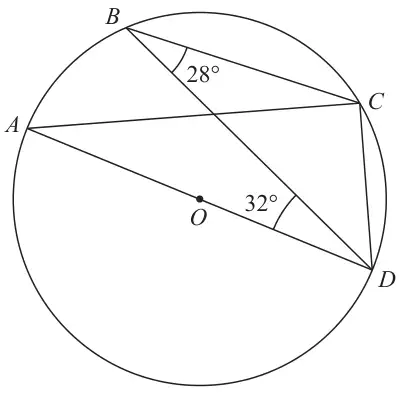
Diagram NOT accurately drawn
\(A\), \(B\), \(C\) and \(D\) are points on a circle, centre \(O\).
\(AOD\) is a diameter of the circle.
Angle \(CBD = 28^\circ\)
Angle \(BDA = 32^\circ\)
Find the size of angle \(BDC\).
Give a reason for each stage of your working.
(4)
| Scheme | Marks |
|---|---|
| Angle \(CAD = 28^\circ\) or angle \(ACB = 32^\circ\) or angle \(ACD = 90^\circ\) or angle \(ABD = 90^\circ\) | M1 |
| 30° | A1 |
| Angles in the same segment are equal, angle in a semicircle is 90° (or angle at centre is double angle at circumference oe) angles in a triangle add up to 180°/angles in a triangle isosceles triangle alternate angles vertically opposite angles (or vertically opposite) angles at a point opposite angles in a cyclic quadrilateral angle between tangent and radius (diameter) alternate segment theorem angles subtended by the same arc (or chord) at the circumference (or on the circle) | B2 |
| (4) | |
| (4 marks) |
Notes
A1: For a correct answer of 30
B2: Dep on M1 for all correct reasons for their method used
(if not B2 then award B1 (dep on M1) for a correct circle theorem reason)