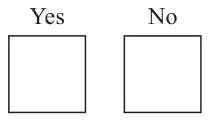
(b) Is it true that \(\;B \cap C = \varnothing\;\)?
Tick (✓) one of the boxes below.Give a reason for your answer. (1)
The set \(D\) has 4 members and is such that \(\;D \cap (A \cup C) = \varnothing\)
(c) List the members of set \(D\) (2)
Mark scheme (a)
Scheme
Marks
(i) Answer: 23, 24, 27, 29, 30, 31, 33
B1
(ii) Answer: 27, 33
B1
(2)
Notes
B1: in any order with no repeats
B1: in any order with no repeats
Mark scheme (b)
Scheme
Marks
eg 1. Yes, no members/numbers/values in common 2. Yes, nothing in common 3. Yes, no common members/numbers/values 4. Yes, they share no common members/numbers/values 5. Yes, there is not the same members/numbers/values in both sets 6. Yes, there is no intersection or there is nothing in B and C 7. Yes, as there are no members/numbers/values the same (in B and C) 8. Yes, no members/numbers/values in B are in C or vice versa 9. Yes, there are no members/numbers in B that are multiples of 3 10. Yes, there are no members/numbers/values in that empty set 11. Yes, 23, 29, 31 not in C 12. Yes, 24, 27, 30, 33 are not in B Allow sector for set This is not an exhaustive list Allow element(s) for members/numbers/values Answer: Yes, there are no multiples of 3 in set \(B\)
B1
(1)
Notes
B1: for Yes and a statement which indicates correct meanings of intersection and empty set.
If no box is ticked, then the ‘Yes’ must be stated in the answer
Mark scheme (c)
Scheme
Marks
23, 25, 29, 31
B2
(2)
(5 marks)
Notes
B2: for the four correct numbers and no additions (B1 for three correct values with no more than one incorrect or for four correct values with no more than one incorrect)