
A2 October 2021 Q5
5. The point \(P\) in the complex plane represents a complex number \(z\) such that
\[|z + 9| = 4|z - 12\mathrm{i}|\]Given that, as \(z\) varies, the locus of \(P\) is a circle,
| Scheme | Marks | AO |
|---|---|---|
| \(z = x + \mathrm{i}y \Rightarrow |x + 9 + \mathrm{i}y| = 4|x + (y - 12)\mathrm{i}|\) | M1 | 1.1b |
| \(\Rightarrow (x + 9)^2 + y^2 = 16\left(x^2 + (y - 12)^2\right)\) | M1 A1 | 1.1b 1.1b |
| \(\Rightarrow 15x^2 + 15y^2 - 18x - 384y = 81 - 16 \times 12^2\) \(\Rightarrow x^2 + y^2 - \dfrac{6}{5}x - \dfrac{128}{5}y = -\dfrac{741}{5}\) | ||
| \(\Rightarrow \left(x - \dfrac{3}{5}\right)^2 - \left(\dfrac{3}{5}\right)^2 + \left(y - \dfrac{64}{5}\right)^2 - \left(\dfrac{64}{5}\right)^2 = -\dfrac{741}{5}\) \(\left(\Rightarrow \left(x - \dfrac{3}{5}\right)^2 + \left(y - \dfrac{64}{5}\right)^2 = 16\right)\) | M1 | 2.1 |
| centre \(\dfrac{3}{5} + \dfrac{64}{5}\mathrm{i}\) or radius 4 | A1 | 2.2a |
| centre \(\dfrac{3}{5} + \dfrac{64}{5}\mathrm{i}\) and radius 4 | A1 | 2.2a |
| (6) |
Notes
M1: Applies \(z = x + \mathrm{i}y\) to the given equation. Use of other letters, eg \(z = u + \mathrm{i}v\) is fine.
M1: Squares and uses modulus to achieve \((x + a)^2 + y^2 = K\left(x^2 + (y + b)^2\right)\)
A1: Correct equation, need not be expanded. Award when first seen.
M1: Expands, gathers terms and completes the square.
A1: Either centre or radius correct. Accept coordinates for centre.
A1: Correct centre and radius. Accept coordinates for centre.
| Scheme | Marks | AO |
|---|---|---|
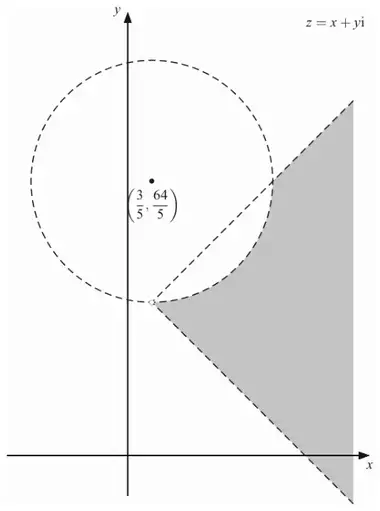 | M1 | 1.1b |
| Pair of rays at roughly 45° to horizontal, with source in first quadrant OR on the circle. | M1 | 1.1b |
| Correct circle and rays, circle with centre in first quadrant and spanning only quadrant 1 and 2 and pair of rays at roughly 45° to horizontal, meeting at the bottom point of the circle | A1 | 3.1a |
| Region between rays and outside circle shaded | B1ft | 3.1a |
| (4) | ||
| (10 marks) |
Notes
M1: Sketches their circle on an Argand diagram. Look for the centre being in the correct quadrant for their answer to (a).
M1: Pair of rays added to the sketch, at angles \(\frac{\pi}{4}\) above and below the horizontal with vertex in the first quadrant OR somewhere on the circle. Need not stem from base of circle for this mark if it stems from the first quadrant, but if not in the first quadrant it must stem from the circle.
A1: Circle (or arc) in correct position, centre in first quadrant that would span quadrants 1 and 2, with pair of rays at roughly 45° to horizontal, meeting at the bottom point of the circle.
B1ft: Area outside the circle and between the rays (minor sector) shaded provided the rays span approximately a 90° sector.
NB Only the region is asked for, so allow the marks above if only the relevant part of the circle is shown.