
A2 June 2025 Q3
3. The circle \(C\) has equation\[|z - 5 + 4\mathrm{i}| = 2|z - 2 + \mathrm{i}|\]where \(z = x + \mathrm{i}y\)
The half-line with equation\[\arg(z - a) = -\frac{3\pi}{4}\]where \(a\) is a real constant, is a tangent to \(C\)
| Scheme | Marks | AO |
|---|---|---|
| \((x-5)^2 + (y+4)^2 = 4\left[(x-2)^2 + (y+1)^2\right]\) or \(\sqrt{(x-5)^2 + (y+4)^2} = 2\sqrt{(x-2)^2 + (y+1)^2}\) | M1 | 1.1b |
| \((x-5)^2 + (y+4)^2 = 4\left[(x-2)^2 + (y+1)^2\right]\) | A1 | 1.1b |
| \(3x^2 - 6x + 3y^2 - 21 = 0\) \(x^2 - 2x + y^2 - 7 = 0\ *\) | A1* | 2.1 |
| (3) |
Notes
M1: Obtains an equation in terms of \(x\) and \(y\) using the given information. Condone \((x-5)^2 + (y+4)^2 = 2\left[(x-2)^2 + (y+1)^2\right]\) for this mark and condone e.g \((y \pm 4)^2\) as s slip but must be + between the brackets.
A1: Obtains any correct equation without the square root.
A1*: Obtains printed answer, including the “=0”, with no errors via an expanded intermediate step.
| Scheme | Marks | AO |
|---|---|---|
| \(y = x - a\) | B1 | 2.2a |
| \(x^2 - 2x + (x-a)^2 - 7 = 0\) leading to a 3TQ | M1 | 2.1 |
| \(2x^2 - (2+2a)x + a^2 - 7 = 0\) | A1 | 1.1b |
| \(b^2 - 4ac = (2+2a)^2 - 4(2)(a^2 - 7) = 0\) | M1 | 3.1a |
| Solve 3TQ \(4a^2 - 8a - 60 = 0 \Rightarrow a = \ldots\) | dM1 | 1.1b |
| \(a = 5\) only \([a = -3 \text{ must be clearly rejected}]\) | A1 | 3.2a |
| (6) | ||
| (9 marks) |
Notes
B1: Deduces the equation of the tangent. Allow for \(y = x + \mathrm{c}\) used (ie correct gradient identified). Note an incorrect tangent \(y = -x + a\) will give the same answers as below but must lose the A marks as from incorrect working.
M1: Substitutes their equation of the tangent into the circle to form a 3TQ. This may be in terms of \(y = \pm x + c\) for this mark.
A1: Correct quadratic equation in \(x\) (or \(y\)) (may have \(c\) instead of \(-a\)), e.g. \(2x^2 - (2 - 2c)x + c^2 - 7 = 0\)
M1: Uses the discriminant equal to 0 to produce a quadratic in \(a\) or \(c\)
M1: Solves their 3TQ in \(a\). If working with \(c\) they must return to find a value of \(a\) for this mark.
A1cso: Deduces the correct value \(a = 5\), the solution \(a = -3\) must clearly be rejected – e.g. accept underling 5 as the answer. Must be from correct work.
Alternative
| Scheme | Marks | AO |
|---|---|---|
| \(x^2 - 2x + y^2 - 7 = 0 \Rightarrow (x-1)^2 + y^2 = 8\) | B1 | 2.2a |
| Centre (1, 0) & radius \(= \sqrt{8}\) | M1 A1 | 2.1 1.1b |
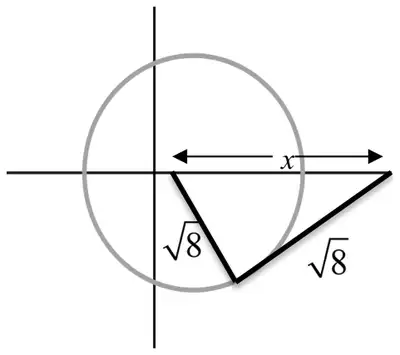 | ||
| E.g. \(x^2 = \text{‘}8\text{’} + \text{‘}8\text{’} \Rightarrow x = \ldots\{4\}\) | M1 | 3.1a |
| \(a = \text{‘}1\text{’} + \text{‘}4\text{’}\) | dM1 | 1.1b |
| \(a = 5\) | A1 | 3.2a |
| (6) |
B1: Correct completion of the square seen or implied.
M1: Finds the centre and radius of the circle
A1: Correct centre and radius
M1: Uses a right-angled triangle with their radius and tangent to find the length \(x\) shown in the diagram. E.g. recognises the tangent length has the same length as the radius and uses Pythagoras to find the length \(x\), or uses trigonometry in the right-angled triangle such as \(\sin\dfrac{\pi}{4} = \dfrac{\text{“}\sqrt{8}\text{”}}{x}\) leading to \(x\)
M1: Finds the value of \(a\) by adding their \(x\)-coordinate of the centre to their value of \(x\)
A1cso: \(a = 5\) Must be from correct work.
(b) Alt II
Use of Differentiation may also be seen.
B1: \(2x - 2 + 2y\dfrac{\mathrm{d}y}{\mathrm{d}x} = 0\) Correct derivative statement.
M1A1: \(\dfrac{\mathrm{d}y}{\mathrm{d}x} = \tan\left(-\dfrac{3}{4}\pi\right) = 1 \Rightarrow\) radial equation is \(2x - 2 + 2y = 0\) Any correct equation.
M1: \(y = 1 - x \Rightarrow x^2 - 2x + (1-x)^2 - 7 = 0 \Rightarrow x = \ldots, y = \ldots\) substitutions into the circle equation (either variable) and solves to find the points of intersection of tangent and circle \([(3, -2)\) and/or \((-1, 2)]\)
dM1: Tangent is \(y - (-2) = x - 3 \Rightarrow y = x - 5 \Rightarrow a = \ldots\) Correct process to find \(a\) including selecting the correct point (below the \(x\)-ais) to use.
A1cso: Correct \(a\) Must be from correct work.