
AS October 2020 Q4
4.
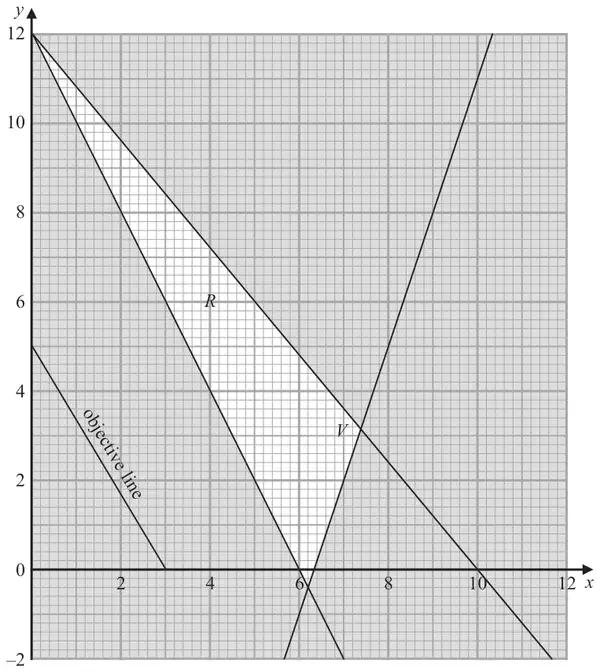
Figure 3 shows the constraints of a linear programming problem in \(x\) and \(y\), where \(R\) is the feasible region. Figure 3 also shows an objective line for the problem and the optimal vertex, which is labelled as \(V\).
The value of the objective at \(V\) is 556
Express the linear programming problem in algebraic form. List the constraints as simplified inequalities with integer coefficients and determine the objective. (9)
| Scheme | Marks | AO |
|---|---|---|
| Line through (0, 12) and (6, 0) is \(2x + y = 12\) Line through (0, 12) and (10, 0) is \(6x + 5y = 60\) Line through (7, 2) and (9, 8) is \(3x - y = 19\) | M1 | 1.1b |
| \(2x + y \geqslant 12\) | A1 | 3.4 |
| \(6x + 5y \leqslant 60\) | A1 | 1.1b |
| \(3x - y \leqslant 19\) | A1 | 1.1b |
| Solving correct two equations to find \(V\) | M1 | 1.1b |
| \(V\left(\dfrac{155}{21},\ \dfrac{22}{7}\right)\) | A1 | 2.2a |
| \(P = k(5x + 3y)\) and substituting \(P = 556\) and their \(V\) | M1dep | 3.4 |
| Maximise \(P = 60x + 36y\) | B1 A1 | 2.5 2.2a |
| (9) | ||
| (9 marks) |
Notes
M1: Correct method for finding the equation of one of the three lines
A1: CAO (with correct inequality sign from shading) \(2x + y \geqslant 12\) (allow a positive multiple but must have integer coefficients)
A1: CAO \(6x + 5y \leqslant 60\) (allow a positive multiple but must have integer coefficients)
A1: CAO \(3x - y \leqslant 19\) (allow a positive multiple but must have integer coefficients)
If A0A0A0 then award A1A0A0 only for one ‘correct’ strict inequality and/or non-integer coefficients e.g. \(x + 0.5y > 6\)
M1: Attempt to find \(V\) by solving the correct pair of simultaneous equations – for this mark either the correct method for solving the simultaneous equations must be seen or if no method seen then this mark can be implied by correctly stating the exact coordinates of \(V\) (or correct to at least 3 sf)
A1: Correct deduction of the exact coordinates for \(V\)
M1dep: Uses the model to write down a suitable objective and substitutes \(P = 556\) and their \(V\) into \(P = k(5x + 3y)\). Dependent on previous M mark.
Or this mark can be awarded for forming both equations \(\dfrac{155}{21}x + \dfrac{22}{7}y = 556\) and \(3x - 5y = 0\)
B1: Maximise (oe) e.g. allow ‘max’ – this mark is independent of all other marks
A1: Correct objective function (this mark cannot be awarded for \(5x + 3y\))
Note that the complete LP formulation is
Maximise \(P = 60x + 36y\)
Subject to \(2x + y \geqslant 12\)
\(\qquad\qquad\ \ 6x + 5y \leqslant 60\)
\(\qquad\qquad\ \ 3x - y \leqslant 19\)