
A2 October 2020 Q4
4.
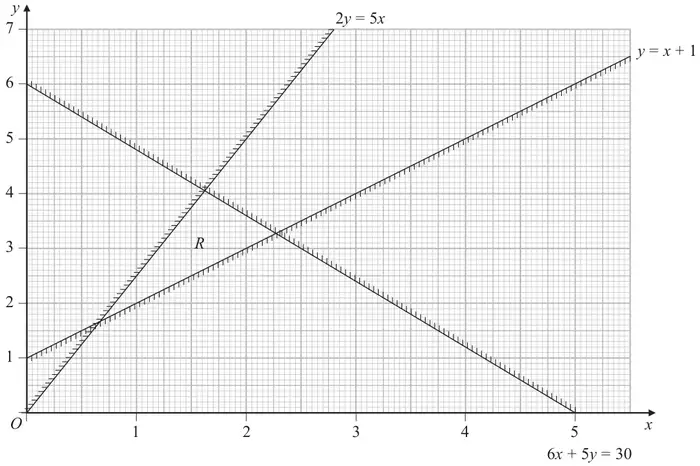
Figure 3 shows the constraints of a linear programming problem in \(x\) and \(y\), where \(R\) is the feasible region.
The objective is to maximise \(P\), where \(P = 3x + y\)
The objective is changed to maximise \(Q\), where \(Q = 3x + ay\). Given that \(a\) is a constant and the optimal vertex is still \(V\),
| Scheme | Marks | AO |
|---|---|---|
| \(2y \leqslant 5x,\ y \geqslant x + 1,\ 6x + 5y \leqslant 30\) | B2,1,0 | 1.1b 2.5 |
| (2) |
Notes
(a) B1: Any two correct (accept strict inequalities) – accept equivalent inequalities
B1: CAO (accept equivalent inequalities but inequalities must not be strict)
| Scheme | Marks | AO |
|---|---|---|
| \(\left(\frac{2}{3}, \frac{5}{3}\right), \left(\frac{60}{37}, \frac{150}{37}\right), \left(\frac{25}{11}, \frac{36}{11}\right)\) | B1 B1 | 1.1b 1.1b |
| \(\left(\frac{2}{3}, \frac{5}{3}\right) \to P = \frac{11}{3}\) \(\left(\frac{60}{37}, \frac{150}{37}\right) \to P = \frac{330}{37}\) \(\left(\frac{25}{11}, \frac{36}{11}\right) \to P = \frac{111}{11}\) so optimal vertex is \(\left(\frac{25}{11}, \frac{36}{11}\right)\) | M1 A1 | 2.1 2.2a |
| (4) |
Notes
(b) B1: One correct vertex (must be exact)
B1: All three correct vertices (must be exact)
M1: Testing all three of their vertices in the correct objective function
A1: Correct three values of \(P\) and correct optimal vertex either stated or clearly indicated on the graph
| Scheme | Marks | AO |
|---|---|---|
| \(Q = 3x + ay\) | ||
| \(3\left(\frac{25}{11}\right) + \frac{36a}{11} \gt 3\left(\frac{60}{37}\right) + \frac{150a}{37}\) | M1 | 3.1a |
| \(\Rightarrow a \lt \frac{5}{2}\) | A1 | 2.2a |
| \(3\left(\frac{25}{11}\right) + \frac{36a}{11} \gt 3\left(\frac{2}{3}\right) + \frac{5a}{3}\) | M1 | 1.1b |
| \(\Rightarrow a \gt -3\) | A1 | 2.2a |
| (4) | ||
| (10 marks) |
Notes
(c) M1: Their optimal point from (b) evaluated in \(Q\) compared to their \(\left(\frac{60}{37}, \frac{150}{37}\right)\) evaluated in \(Q\) (with correct inequality)
A1: \(a \lt \frac{5}{2}\)
M1: Their optimal point from (b) evaluated in \(Q\) compared to their \(\left(\frac{2}{3}, \frac{5}{3}\right)\) evaluated in \(Q\) (with correct inequality)
A1: \(a \gt -3\)