
June 2025 Paper 2 Q14
14.
In this question you must show detailed reasoning.
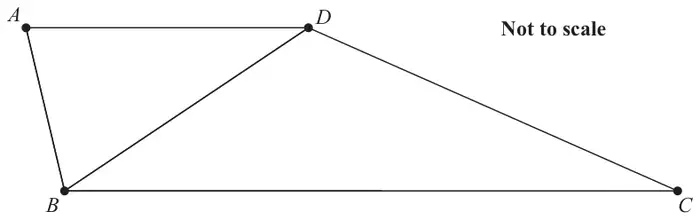
Figure 4 shows a trapezium \(ABCD\) where \(AD\) is parallel to \(BC\)
Given that
- \(\overrightarrow{AB} = 2\mathbf{a} + 3\mathbf{b}\)
- \(\overrightarrow{BC} = 15\mathbf{a} - 5\mathbf{b}\)
- \(\overrightarrow{DB} = -4\mathbf{a} + k\mathbf{b}\) where \(k\) is an integer
Given also that
- the point \(N\) lies on \(BC\) such that \(BN : NC = 1 : 4\)
- \(AN\) intersects \(BD\) at \(X\)
| Scheme | Marks | AO |
|---|---|---|
| \(\left(\overrightarrow{AD} = \overrightarrow{AB} - \overrightarrow{DB} =\right)\ 2\mathbf{a} + 3\mathbf{b} - \left(-4\mathbf{a} + k\mathbf{b}\right)\ \ \left(= 6\mathbf{a} + (3 - k)\mathbf{b}\right)\) | M1 | 1.1b |
| \(\dfrac{15}{6} = 2.5 \Rightarrow \dfrac{-5}{3 - k} = 2.5 \rightarrow k = \ldots\) | dM1 | 1.1b |
| \(k = 5\) * | A1* | 2.1 |
| (3) |
Notes
Note: Condone the use of column vectors throughout this question.
There may be working on the diagram that can be awarded marks.
M1: Attempts either \(\left(\overrightarrow{AD} = \overrightarrow{AB} - \overrightarrow{DB} =\right)\ 2\mathbf{a} + 3\mathbf{b} - \left(-4\mathbf{a} + k\mathbf{b}\right)\) or \(\left(\overrightarrow{DA} =\right)\ -4\mathbf{a} + k\mathbf{b} - \left(2\mathbf{a} + 3\mathbf{b}\right)\) or \(\left(\overrightarrow{DB} = \overrightarrow{DA} + \overrightarrow{AB} =\right)\ \alpha\left(15\mathbf{a} - 5\mathbf{b}\right) + 2\mathbf{a} + 3\mathbf{b}\)
Allow subtraction either way round and may be implied by one correct component or by e.g. \(2\mathbf{a} + 3\mathbf{b} = \overrightarrow{AD} - 4\mathbf{a} + k\mathbf{b}\)
For reference: \(\overrightarrow{AD} = 6\mathbf{a} + (3 - k)\mathbf{b}\) and \(\overrightarrow{DA} = -6\mathbf{a} + (k - 3)\mathbf{b}\)
Allow e.g. \(\left(\overrightarrow{AD} =\right) \begin{pmatrix} 6\mathbf{a} \\ (3 - k)\mathbf{b} \end{pmatrix}\) or \(\left(\overrightarrow{AD} =\right) \begin{pmatrix} 6 \\ 3 - k \end{pmatrix}\) including without the brackets \(\begin{matrix} 6 \\ 3 - k \end{matrix}\)
Condone the use of gradients or ratios for \(\overrightarrow{AD}\) e.g. \(\dfrac{6}{3 - k}\) or “\(6 : 3 - k\)” to imply this mark (either way round).
There are alternatives using e.g. \(\overrightarrow{DC}\) but, in these cases, we require two expressions for the same vector, of which one expression must use \(\overrightarrow{DB}\).
dM1: A full method to solve the problem. Some possible approaches:
- attempts to find a scale factor and uses it to find \(k\)
- sets up equivalent fractions e.g. \(\dfrac{15}{6} = -\dfrac{5}{3 - k}\) or e.g. \(\dfrac{2 - -4}{3 - k} = \dfrac{15}{-5}\) and solves for \(k\)
- sets up equivalent ratios e.g. \(6 : 15 = 3 - k : -5\) and solves for \(k\)
- sets up simultaneous equations and solves for \(k\) e.g. \(2\mathbf{a} + 3\mathbf{b} + 4\mathbf{a} - k\mathbf{b} = \alpha\left(15\mathbf{a} - 5\mathbf{b}\right)\) o.e. or \(\left(\overrightarrow{DB} = \overrightarrow{DA} + \overrightarrow{AB} =\right)\ \alpha\left(-15\mathbf{a} + 5\mathbf{b}\right) + 2\mathbf{a} + 3\mathbf{b} = -4\mathbf{a} + k\mathbf{b}\) leading to \(6 = 15\alpha\) \(\left(\alpha = \dfrac{2}{5}\right)\) and \(3 - k = -5\alpha\) hence \(k = \ldots\)
Note that their coefficient might be the reciprocal, from e.g. \(\beta\left(2\mathbf{a} + 3\mathbf{b} + 4\mathbf{a} - k\mathbf{b}\right) = 15\mathbf{a} - 5\mathbf{b}\) \((\beta = 2.5)\) and directions might be reversed in which case \(\alpha = -0.4\) or \(\beta = -2.5\) can be used.
A1*: Arrives at \(k = 5\) via a correct method. Usually this will be following:
- A correct expression for \(\overrightarrow{AD}\) (e.g. \(2\mathbf{a} + 3\mathbf{b} - \left(-4\mathbf{a} + k\mathbf{b}\right)\)) or \(\overrightarrow{DA}\) or \(\overrightarrow{BD}\) or \(\overrightarrow{DB}\) which may be mislabelled.
- Correct scale factor stated (\(\pm 2.5\) or \(\pm 0.4\)) or implied (e.g., by \(\dfrac{-5}{3 - k} = \dfrac{15}{6}\) or \(3(3 - k) = -6\))
- A correct intermediate equation that leads to \(k = 5\)
An example minimal response might look like:
e.g. \(\alpha\left(15\mathbf{a} - 5\mathbf{b}\right) = 6\mathbf{a} + (3 - k)\mathbf{b} \rightarrow 6 = 15\alpha \rightarrow \alpha = \dfrac{2}{5} \rightarrow -5\left(\dfrac{2}{5}\right) = 3 - k \rightarrow k = 5\)
or e.g. \(6\mathbf{a} + (3 - k)\mathbf{b} \rightarrow \dfrac{15}{6} = -\dfrac{5}{3 - k} \rightarrow k = 5\)
Condone missing/invisible brackets if recovered.
Alternative by verification
M1: Sets \(k = 5\), substitutes into \(\overrightarrow{DB}\) and attempts \(\left(\overrightarrow{AD} = \overrightarrow{AB} - \overrightarrow{DB} =\right)\ 2\mathbf{a} + 3\mathbf{b} - \left(-4\mathbf{a} + 5\mathbf{b}\right)\) o.e.
dM1: Attempts to compare \(\overrightarrow{AD}\) o.e. with \(\overrightarrow{BC}\) (usually \(6\mathbf{a} - 2\mathbf{b} = \alpha\left(15\mathbf{a} - 5\mathbf{b}\right)\)) and finds \(\alpha\)
A1*: Requires:
- Correct \(\overrightarrow{AD}\) o.e. e.g. \(\overrightarrow{DA}\)
- Correct scale factor \(\alpha = \pm\dfrac{2}{5}\) or \(\beta = \pm 2.5\) (sign dependent on their approach)
- Conclusion referencing the lines being parallel e.g. “hence \(\overrightarrow{AD}\) and \(\overrightarrow{BC}\) are parallel.”
| Scheme | Marks | AO |
|---|---|---|
| e.g., \(\left(\overrightarrow{BN} =\right)\ \dfrac{1}{5}\overrightarrow{BC}\ \ \left(= 3\mathbf{a} - \mathbf{b}\right)\) | B1 | 2.2a |
| e.g., \(\left(\overrightarrow{BX} = \lambda\overrightarrow{BD} =\right)\ \lambda\left(4\mathbf{a} - 5\mathbf{b}\right)\) | M1 | 2.1 |
| e.g., \(\left(\overrightarrow{BX} = \lambda\overrightarrow{BD} =\right)\ \lambda\left(4\mathbf{a} - 5\mathbf{b}\right)\) and e.g. \(\left(\overrightarrow{BX} = \overrightarrow{BA} + \mu\overrightarrow{AN} =\right)\ \left(-2\mathbf{a} - 3\mathbf{b}\right) + \mu\left(2\mathbf{a} + 3\mathbf{b} + \text{``}3\mathbf{a} - \mathbf{b}\text{''}\right)\) | dM1 | 3.1a |
| \(\begin{aligned}4\lambda &= -2 + 5\mu\\ -5\lambda &= -3 + 2\mu\end{aligned} \Rightarrow \lambda = \ldots\left(\dfrac{1}{3}\right)\) or \(\mu = \ldots\left(\dfrac{2}{3}\right)\) | ddM1 | 1.1b |
| \(1 : 2\) | A1 | 2.2a |
| (5) | ||
| (8 marks) |
Notes
Note: Condone the use of column vectors throughout this question.
There may be working on the diagram that can be awarded marks.
B1: Deduces a correct interpretation of the ratio \(BN : NC = 1 : 4\) that enables a start to a solution.
i.e., progresses to a correct statement that is at least as far as \(\left(\overrightarrow{BN} =\right)\ \dfrac{1}{5}\overrightarrow{BC}\) (or e.g. \(3\mathbf{a} - \mathbf{b}\)) or \(\left(\overrightarrow{CN} =\right)\ \dfrac{4}{5}\overrightarrow{CB}\) (or e.g. \(4\mathbf{b} - 12\mathbf{a}\)). May be embedded in e.g. \(\left(\overrightarrow{AN} =\right)\ 2\mathbf{a} + 3\mathbf{b} + \dfrac{1}{5}\overrightarrow{BC}\)
Allow e.g. \(\dfrac{1}{5}\begin{pmatrix} 15 \\ -5 \end{pmatrix}\) or \(\begin{pmatrix} 3 \\ -1 \end{pmatrix}\) or \(\begin{pmatrix} 3a \\ -b \end{pmatrix}\) for this mark.
M1: For the key step in attempting a valid expression for \(\overrightarrow{BX}\) (or \(\overrightarrow{AX}\) or \(\overrightarrow{DX}\) or \(\overrightarrow{CX}\) or \(\overrightarrow{NX}\)) in terms of \(\mathbf{a}\) and \(\mathbf{b}\). See diagram/notes below for helpful vectors.
Condone slips provided their intention is clear.
Note that they might be using \(\lambda\) and \(\mu\) the other way round or alternative variables.
Note: May be seen as a single expression such as \(\overrightarrow{AB} = \overrightarrow{AX} + \overrightarrow{XB}\) \(\left(\text{i.e. } \overrightarrow{AB} = p\overrightarrow{AN} + q\overrightarrow{DB}\right)\) or \(\overrightarrow{BN} = \overrightarrow{BX} + \overrightarrow{XN}\) \(\left(\text{i.e. } \overrightarrow{BN} = p\overrightarrow{BD} + q\overrightarrow{AN}\right)\) either of which scores M1dM1 simultaneously.
dM1: For the key step in attempting a second valid expression for their \(\overrightarrow{BX}\) (or \(\overrightarrow{AX}\) or \(\overrightarrow{DX}\) or \(\overrightarrow{CX}\) or \(\overrightarrow{NX}\)) in terms of \(\mathbf{a}\) and \(\mathbf{b}\) which enables the problem to be solved, i.e., it must not be parallel in approach to the first. See diagram/notes below for helpful vectors.
One expression should involve \(\text{``}\lambda\text{''}\left(4\mathbf{a} - 5\mathbf{b}\right)\) and the other should involve \(\text{``}\mu\text{''}\left(\text{``}5\mathbf{a} + 2\mathbf{b}\text{''}\right)\)
Condone slips provided their intention is clear.
They must use different parameters in their approaches, e.g., \(\lambda\) and \(\mu\).
If using e.g. \(\overrightarrow{DX} = -6\mathbf{a} + 2\mathbf{b} + \mu\left(5\mathbf{a} + 2\mathbf{b}\right)\) and \(\overrightarrow{XB} = \lambda\left(-4\mathbf{a} + 5\mathbf{b}\right)\) this mark is not scored until they set \(\overrightarrow{DX} + \overrightarrow{XB} = \overrightarrow{DB}\) as \(-6\mathbf{a} + 2\mathbf{b} + \mu\left(5\mathbf{a} + 2\mathbf{b}\right) + \lambda\left(-4\mathbf{a} + 5\mathbf{b}\right) = -4\mathbf{a} + 5\mathbf{b}\)
Dependent on the previous method mark.
ddM1: Compares coefficients of \(\mathbf{a}\) and \(\mathbf{b}\) to create simultaneous equations in their parameters and attempts to solve (which may be by calculator) leading to a value for one of their parameters.
Condone slips provided the intention is clear.
This mark may be implied by a correct value for e.g. \(\lambda\) following their two correct expressions for e.g. \(\overrightarrow{BX}\)
Dependent on both previous method marks.
A1: \(1 : 2\) o.e. Must follow a correct value for their parameter.
The correct ratio seen does not imply full marks. Candidates must show detailed reasoning.
Allow equivalent ratios e.g. \(\dfrac{1}{3} : \dfrac{2}{3}\) and ISW (e.g. \(1 : 3\)) but they must be the correct way round.
There may be attempts using similar triangles. Send to review.
Helpful Diagram:
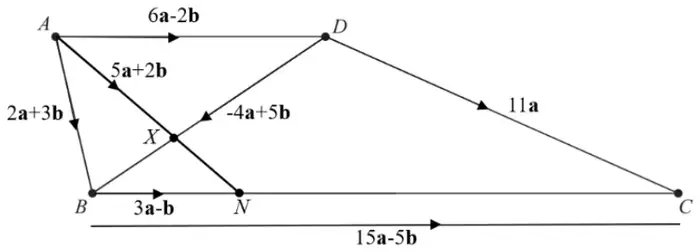
Note: Some examples of valid expressions for the M and dM marks for part (b) are:
In each expression they may use different parameters and e.g. \(1 - \lambda\) might just be e.g. \(\phi\).
- \(\overrightarrow{BX} = \lambda\overrightarrow{BD} = \lambda\left(4\mathbf{a} - 5\mathbf{b}\right)\)
- \(\overrightarrow{BX} = \overrightarrow{BA} + \mu\overrightarrow{AN} = \left(-2\mathbf{a} - 3\mathbf{b}\right) + \mu\left(2\mathbf{a} + 3\mathbf{b} + \text{``}3\mathbf{a} - \mathbf{b}\text{''}\right)\)
- \(\overrightarrow{BX} = \overrightarrow{BN} + (1 - \mu)\overrightarrow{NA} = \left(\text{``}3\mathbf{a} - \mathbf{b}\text{''}\right) + (1 - \mu)\left(-2\mathbf{a} - 3\mathbf{b} + \text{``}{-}3\mathbf{a} + \mathbf{b}\text{''}\right)\)
- \(\overrightarrow{DX} = (1 - \lambda)\overrightarrow{DB} = (1 - \lambda)\left(-4\mathbf{a} + 5\mathbf{b}\right)\)
- \(\overrightarrow{DX} = \overrightarrow{DA} + \mu\overrightarrow{AN} = \left(\text{``}{-}6\mathbf{a} + 2\mathbf{b}\text{''}\right) + \mu\left(2\mathbf{a} + 3\mathbf{b} + \text{``}3\mathbf{a} - \mathbf{b}\text{''}\right)\)
- \(\overrightarrow{DX} = \overrightarrow{DN} + (1 - \mu)\overrightarrow{NA} = \left(\text{``}{-}\mathbf{a} + 4\mathbf{b}\text{''}\right) + (1 - \mu)\left(-2\mathbf{a} - 3\mathbf{b} + \text{``}{-}3\mathbf{a} + \mathbf{b}\text{''}\right)\)
- \(\overrightarrow{AX} = \mu\overrightarrow{AN} = \mu\left(2\mathbf{a} + 3\mathbf{b} + \text{``}3\mathbf{a} - \mathbf{b}\text{''}\right)\)
- \(\overrightarrow{AX} = \overrightarrow{AB} + \lambda\overrightarrow{BD} = \left(2\mathbf{a} + 3\mathbf{b}\right) + \lambda\left(4\mathbf{a} - 5\mathbf{b}\right)\)
- \(\overrightarrow{AX} = \overrightarrow{AD} + (1 - \lambda)\overrightarrow{DB} = \left(\text{``}6\mathbf{a} - 2\mathbf{b}\text{''}\right) + (1 - \lambda)\left(-4\mathbf{a} + 5\mathbf{b}\right)\)
- \(\overrightarrow{XN} = \mu\overrightarrow{AN} = \mu\left(2\mathbf{a} + 3\mathbf{b} + \text{``}3\mathbf{a} - \mathbf{b}\text{''}\right)\)
- \(\overrightarrow{XN} = \lambda\overrightarrow{DB} + \overrightarrow{BN} = \lambda\left(-4\mathbf{a} + 5\mathbf{b}\right) + \left(\text{``}3\mathbf{a} - \mathbf{b}\text{''}\right)\)
- \(\overrightarrow{XN} = (1 - \lambda)\overrightarrow{BD} + \overrightarrow{DN} = (1 - \lambda)\left(4\mathbf{a} - 5\mathbf{b}\right) + \left(\text{``}{-}\mathbf{a} + 4\mathbf{b}\text{''}\right)\)
or alternatives using \(C\) or \(N\) as starting points, but these are unlikely.