
June 2022 Paper 2 Q1
1.
In this question you must show all stages of your working.
Solutions relying entirely on calculator technology are not acceptable.
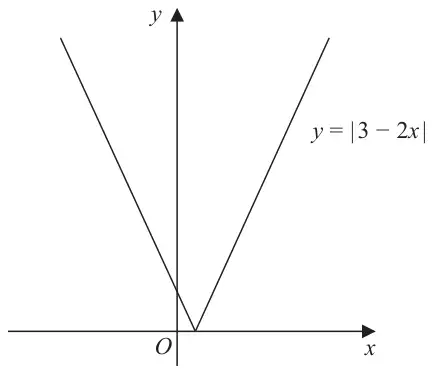
Figure 1 shows a sketch of the graph with equation \(y = \lvert 3 - 2x\rvert\)
Solve\[\lvert 3 - 2x\rvert = 7 + x\](4)
| Scheme | Marks | AO |
|---|---|---|
| For an attempt to solve Either \(3 - 2x = 7 + x \Rightarrow x = \ldots\) or \(2x - 3 = 7 + x \Rightarrow x = \ldots\) | M1 | 1.1b |
| Either \(x = -\dfrac{4}{3}\) or \(x = 10\) | A1 | 1.1b |
| For an attempt to solve Both \(3 - 2x = 7 + x \Rightarrow x = \ldots\) and \(2x - 3 = 7 + x \Rightarrow x = \ldots\) | dM1 | 1.1b |
| For both \(x = -\dfrac{4}{3}\) and \(x = 10\) with no extra solutions | A1 | 1.1b |
| (4) | ||
| (4 marks) |
Notes
ALT
| Scheme | Marks | AO |
|---|---|---|
| Alternative by squaring: | ||
| \((3 - 2x)^2 = (7 + x)^2 \Rightarrow 9 - 12x + 4x^2 = 49 + 14x + x^2\) | M1 | 1.1b |
| \(3x^2 - 26x - 40 = 0\) | A1 | 1.1b |
| \(3x^2 - 26x - 40 = 0 \Rightarrow x = \ldots\) | dM1 | 1.1b |
| For both \(x = -\dfrac{4}{3}\) and \(x = 10\) with no extra solutions | A1 | 1.1b |
Note this question requires working to be shown not just answers written down. But correct equations seen followed by the correct answers can score full marks.
M1: Attempts to solve either correct equation.
Allow equivalent equations e.g. \(3 - 2x = -7 - x \Rightarrow x = \ldots\)
A1: One correct solution. Allow exact equivalents for \(-\dfrac{4}{3}\) e.g. \(-1\dfrac{1}{3}\) or \(-1.\dot{3}\) but not e.g. \(-1.33\)
dM1: Attempts to solve both correct equations.
Allow equivalent equations e.g. \(3 - 2x = -7 - x \Rightarrow x = \ldots\) Depends on the first method mark.
A1: For both \(x = -\dfrac{4}{3}\) and \(x = 10\) with no extra solutions and neither clearly rejected but ignore any attempts to find the \(y\) coordinates whether correct or otherwise and ignore reference to e.g. \(x = -7\) (from where \(y = 7 + x\) intersects the \(x\)-axis) or \(x = 1.5\) (from finding the value of \(x\) at the vertex) as “extras”. Allow exact equivalents for \(-\dfrac{4}{3}\) e.g. \(-1\dfrac{1}{3}\) or \(-1.\dot{3}\) but not rounded e.g. \(-1.33\)
Isw if necessary e.g. ignore subsequent attempts to put the values in an inequality e.g. \(-\dfrac{4}{3} \lt x \lt 10\)
But if e.g. \(x = -\dfrac{4}{3}\) is obtained and a candidate states \(x = \left\lvert -\dfrac{4}{3}\right\rvert\) then score A0
Alternative solution via squaring
M1: Attempts to square both sides. Condone poor squaring e.g. \((3 - 2x)^2 = 9 \pm 4x^2\) or \(9 \pm 2x^2\)
A1: Correct quadratic equation \(3x^2 - 26x - 40 = 0\). The “\(= 0\)” may be implied by their attempt to solve. Terms must be collected but not necessarily all on one side so allow e.g. \(3x^2 - 26x = 40\)
dM1: Correct attempt to solve a 3 term quadratic. See general guidance for solving a quadratic equation. The roots can be written down from a calculator so the method may be implied by their values. Depends on the first method mark.
A1: For both \(x = -\dfrac{4}{3}\) and \(x = 10\) with no extra solutions and neither clearly rejected but ignore any attempts to find the \(y\) coordinates and do not count e.g. \(x = -7\) (from where \(y = 7 + x\) intersects the \(x\)-axis) or \(x = 1.5\) (from finding the value of \(x\) at the vertex) as “extras”. Allow exact equivalents for \(-\dfrac{4}{3}\) e.g. \(-1\dfrac{1}{3}\) or \(-1.\dot{3}\) but not e.g. \(-1.33\)
Isw if necessary e.g. ignore subsequent attempts to put the values in an inequality e.g. \(-\dfrac{4}{3} \lt x \lt 10\)
But if e.g. \(x = -\dfrac{4}{3}\) is obtained and a candidate states \(x = \left\lvert -\dfrac{4}{3}\right\rvert\) then score A0