
June 2018 Paper 3 Q10
10.
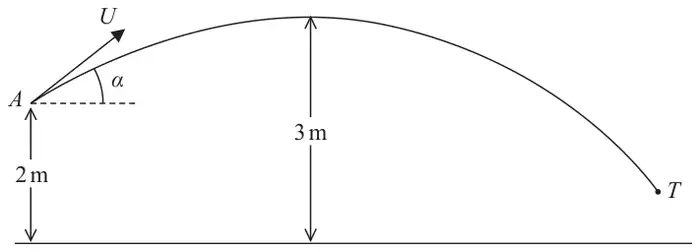
A boy throws a ball at a target. At the instant when the ball leaves the boy’s hand at the point \(A\), the ball is 2 m above horizontal ground and is moving with speed \(U\) at an angle \(\alpha\) above the horizontal.
In the subsequent motion, the highest point reached by the ball is 3 m above the ground.
The target is modelled as being the point \(T\), as shown in Figure 4.
The ball is modelled as a particle moving freely under gravity.
Using the model,
The point \(T\) is at a horizontal distance of 20 m from \(A\) and is at a height of 0.75 m above the ground. The ball reaches \(T\) without hitting the ground.
| Scheme | Marks | AO |
|---|---|---|
| Using the model and vertical motion: \(0^2 = (U\sin\alpha)^2 - 2g \times (3 - 2)\) | M1 | 3.3 |
| \(U^2 = \dfrac{2g}{\sin^2\alpha}\) * GIVEN ANSWER | A1* | 2.2a |
| (2) |
Notes
M1: Or any other complete method to obtain an equation in \(U\), \(g\) and \(\alpha\) only
A1*: Correct GIVEN ANSWER
| Scheme | Marks | AO |
|---|---|---|
| Using the model and horizontal motion: \(s = ut\) | M1 | 3.4 |
| \(20 = Ut\cos\alpha\) | A1 | 1.1b |
| Using the model and vertical motion: \(s = ut + \dfrac{1}{2}at^2\) | M1 | 3.4 |
| \(-\dfrac{5}{4} = Ut\sin\alpha - \dfrac{1}{2}gt^2\) | A1 | 1.1b |
| sub for \(t\): \(-\dfrac{5}{4} = U\sin\alpha\left(\dfrac{20}{U\cos\alpha}\right) - \dfrac{1}{2}g\left(\dfrac{20}{U\cos\alpha}\right)^2\) | M1 (I) | 3.1b |
| sub for \(U^2\) | M1(II) | 3.1b |
| \(-\dfrac{5}{4} = 20\tan\alpha - 100\tan^2\alpha\) | A1(I) | 1.1b |
| \((4\tan\alpha - 1)(100\tan\alpha + 5) = 0\) | M1(III) | 1.1b |
| \(\tan\alpha = \dfrac{1}{4} \Rightarrow \alpha = 14^\circ\) or better | A1(II) | 2.2a |
| (9) |
Notes
N.B. For the last 5 marks, they may set up a quadratic in \(t\), by substituting for \(U\sin\alpha\) first, then solve the quadratic to find the value of \(t\), then use \(20 = Ut\cos\alpha\) to find \(\alpha\). The marks are the same but earned in a different order. Enter on ePen in the corresponding M and A boxes above, as indicated below.
| Scheme | Marks |
|---|---|
| Sub for \(U\sin\alpha\) to give equation in \(t\) only | M1(II) |
| \(-\dfrac{5}{4} = \sqrt{2g}\,t - \dfrac{1}{2}gt^2\) | A1(I) |
| Solve for \(t\) | M1(III) |
| \(t = \dfrac{5}{\sqrt{2g}}\) or 1.1 or 1.13 and use \(20 = Ut\cos\alpha\) | M1(I) |
| \(\alpha = 14^\circ\) or better | A1(II) |
(b) ALTERNATIVE
| Scheme | Marks | AO |
|---|---|---|
| Using the model and horizontal motion: \(s = ut\) | M1 | 3.4 |
| \(20 = Ut\cos\alpha\) | A1 | 1.1b |
| \(A\) to top: \(s = vt - \dfrac{1}{2}at^2\) and top to \(T\): \(s = ut + \dfrac{1}{2}at^2\) | ||
| \(1 = \dfrac{1}{2}gt_1^2 \Rightarrow t_1 = \sqrt{\dfrac{2}{g}}\) and \(\dfrac{9}{4} = \dfrac{1}{2}gt_2^2 \Rightarrow t_2 = \dfrac{3}{\sqrt{2g}}\) Total time \(t = t_1 + t_2\) | M1 | 3.4 |
| \(= \sqrt{\dfrac{2}{g}} + \dfrac{3}{\sqrt{2g}}\ \left(= \dfrac{5}{\sqrt{2g}}\right)\) | A1 | 1.1b |
| \(20 = U\dfrac{5}{\sqrt{2g}}\cos\alpha\) (sub. for \(t\)) | M1 | 3.1b |
| \(20 = \sqrt{\dfrac{2g}{\sin^2\alpha}}\,\dfrac{5}{\sqrt{2g}}\cos\alpha\) (sub. for \(U\)) | M1 | 3.1b |
| \(\tan\alpha = \dfrac{1}{4}\) | A1 | 1.1b |
| Solve for \(\alpha\) | M1 | 1.1b |
| \(\Rightarrow \alpha = 14^\circ\) or better | A1 | 2.2a |
| (9) |
(b)
M1: Using horizontal motion
A1: Correct equation
M1: Using vertical motion. N.B. M0 if they use \(s = \pm 2\) or \(\pm 3\), but allow \(s = \pm 1.25\) or \(\pm 0.75\) or \(\pm 2.25\) or \(\pm 2.75\)
A1: Correct equation
M1: Using \(20 = Ut\cos\alpha\) to sub. for \(t\)
M1: Substituting for \(U^2\) using (a)
A1: Correct quadratic equation (in \(\tan\alpha\) or \(\cot\alpha\))
M1: Solve a 3 term quadratic, either by factorisation or formula (or by calculator (implied) if answer is correct) and find \(\alpha\)
A1: \(\alpha = 14^\circ\) or better (No restriction on accuracy since \(g\)’s cancel)
N.B. If answer is correct, previous M mark can be implied, but if answer is incorrect, an explicit attempt to solve must be seen to earn the previous M mark.
(b) ALTERNATIVE
M1: Using the model with the usual rules applying to the equation
A1: Correct equation
M1: Using the model to obtain the total time from \(A\) to \(T\)
A1: Correct total time \(t\)
M1: Substitute for \(t\) in \(20 = Ut\cos\alpha\)
M1: Substitute for \(U\) in \(20 = Ut\cos\alpha\), using part (a)
A1: Correct equation in \(\tan\alpha\) only
M1: Solve equation for \(\alpha\)
A1: \(\alpha = 14^\circ\) or better (No restriction on accuracy since \(g\)’s cancel)
N.B. If they quote the equation of the trajectory \(y = x\tan\alpha - \dfrac{gx^2}{2U^2\cos^2\alpha}\) oe AND put in values for \(x\) and \(y\), could score first 5 marks, M1A1M1A1M1 (nothing for the equation only); wrong \(x\) value loses first A mark and wrong \(y\) value loses second A mark
| Scheme | Marks | AO |
|---|---|---|
| The target will have dimensions so in practice there would be a range of possible values of \(\alpha\) Or There will be air resistance Or The ball will have dimensions Or Wind effects Or Spin of the ball | B1 | 3.5b |
| (1) |
Notes
B1: Give one limitation of the model e.g. the ball will have dimensions, or there will be air resistance or wind effects or spin
N.B. B0 if any incorrect extra(s) but ignore extra consequences.
| Scheme | Marks | AO |
|---|---|---|
| Find \(U\) using their \(\alpha\) e.g. \(U = \sqrt{\dfrac{2g}{\sin^2\alpha}}\) | M1 | 3.1b |
| Use \(20 = Ut\cos\alpha\) (or use vertical motion equation) | A1 M1 | 1.1b |
| \(t = \dfrac{5}{\sqrt{2g}}\) or 1.1 or 1.13 | B1 A1 | 1.1b |
| (3) | ||
| (15 marks) |
Notes
(d) ALTERNATIVE
| Scheme | Marks | AO |
|---|---|---|
| \(A\) to top: \(s = vt - \dfrac{1}{2}at^2\) and top to \(T\): \(s = ut + \dfrac{1}{2}at^2\) | M1 | 3.1b |
| \(1 = \dfrac{1}{2}gt_1^2 \Rightarrow t_1 = \sqrt{\dfrac{2}{g}}\) and \(\dfrac{9}{4} = \dfrac{1}{2}gt_2^2 \Rightarrow t_2 = \dfrac{3}{\sqrt{2g}}\) Total time \(t = t_1 + t_2\) | A1 M1 | 1.1b |
| \(= \sqrt{\dfrac{2}{g}} + \dfrac{3}{\sqrt{2g}}\ \left(= \dfrac{5}{\sqrt{2g}}\right) = 1.1\) or \(1.13\) (s) | B1 A1 | 1.1b |
| (3) |
M1: Using their \(\alpha\) to find a value for \(U\)
A1: Treat as M1: Using their \(U\) to find a value for \(t\)
B1: Treat as A1 : \(t = 1.1\) or \(1.10\) (since depends on \(g = 9.8\))
(d) ALTERNATIVE
M1: Using their \(\alpha\) to find a value for \(U\)
A1: Treat as M1: Using their \(U\) to find a value for \(t\)
B1: Treat as A1 : \(t = 1.1\) or \(1.10\) (since depends on \(g = 9.8\))