
June 2020 Paper 1 Q9
9 The diagram below shows a circle and four triangles.
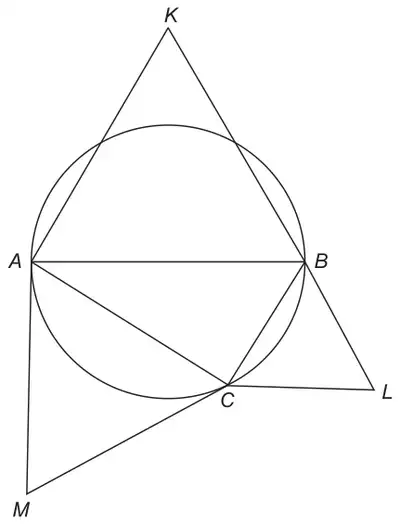
\(AB\) is a diameter of the circle. \(C\) is a point on the circumference of the circle.
Triangles \(ABK\), \(BCL\) and \(CAM\) are equilateral.
Prove that the area of triangle \(ABK\) is equal to the sum of the areas of triangle \(BCL\) and triangle \(CAM\). [5 marks]
| Scheme | Marks | AO |
|---|---|---|
| Uses ‘angle in a semicircle’ to justify \(ACB = 90^\circ\) | E1 | 2.4 |
| Deduces that \(AB^2 = AC^2 + BC^2\) | B1 | 2.2a |
| Applies area formula to one triangle | M1 | 1.1a |
| Applies area formula to all three triangles | A1 | 1.1b |
| Forms a correct equation involving \(BCL + CAM\) and completes reasoned proof. | R1 | 2.1 |
| (5 marks) |
Typical solution
Angle \(ACB = 90^\circ\) (Angle in a semicircle)
\(AB^2 = BC^2 + AC^2\) (Pythagoras)
\[\text{Area of } ABK = \frac{1}{2}AB^2 \sin 60^\circ\]\[\text{Area of } BCL = \frac{1}{2}BC^2 \sin 60^\circ\]\[\text{Area of } CAM = \frac{1}{2}AC^2 \sin 60^\circ\]\[BCL + CAM = \frac{1}{2}\sin 60^\circ\,(BC^2 + AC^2)\]\[= \frac{1}{2}\sin 60^\circ\,(AB^2)\]\[= ABK\]