
June 2022 Paper 2 Q7
7 The curve \(y = 15 - x^2\) and the isosceles triangle \(OPQ\) are shown on the diagram below.
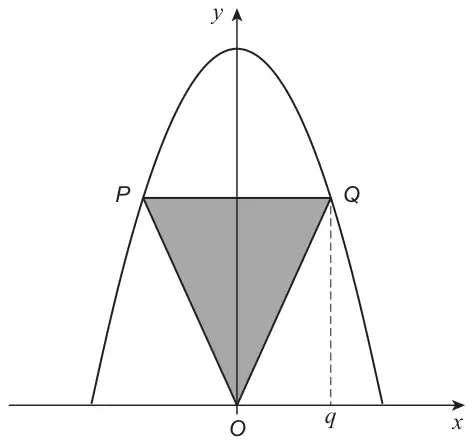
Vertices \(P\) and \(Q\) lie on the curve such that \(Q\) lies vertically above some point \((q, 0)\)
The line \(PQ\) is parallel to the \(x\)-axis.
(a) Show that the area, \(A\), of the triangle \(OPQ\) is given by\[A = 15q - q^3 \quad \text{for } 0 \lt q \lt c\]where \(c\) is a constant to be found. [3 marks]
(b) Find the exact maximum area of triangle \(OPQ\).
Fully justify your answer. [6 marks]
| Scheme | Marks | AO |
|---|---|---|
| Identifies the height of the triangle or rectangle as \(15 - q^2\) PI by \((q, 15 - q^2)\), \(h = 15 - q^2\) or \(y = 15 - q^2\) may be indicated on diagram | M1 | 3.1a |
| Completes rigorous argument to show the given result. It must be clear how they have defined the base and height with use of \(\dfrac{1}{2} \times 2q(15 - q^2)\) for whole triangle Or \(\left[\dfrac{1}{2}q(15 - q^2)\right] \times 2\) for two half triangles Or Explains why the area of the triangle is given by \(q(15 - q^2)\) with reference to the rectangle on either side of \(y\)-axis | R1 | 2.1 |
| Deduces \(c = \sqrt{15}\) ACF | B1 | 2.2a |
| (3) |
Typical solution
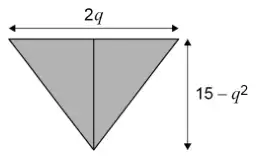
Since \(A = q(15 - q^2) \gt 0\)
then \(q\)’s upper limit \(c = \sqrt{15}\)
| Scheme | Marks | AO |
|---|---|---|
| Explains that maximum occurs when derivative equals 0 Condone incorrect variables in their derivative | E1 | 2.4 |
| Differentiates w.r.t. \(q\) At least one term correct | M1 | 3.1a |
| Obtains \(15 - 3q^2\) | A1 | 1.1b |
| Solves ‘their \(\dfrac{\mathrm{d}A}{\mathrm{d}q}\)’ = 0 to find \(q\) and substitutes to find maximum area | M1 | 1.1a |
| Obtains correct maximum area ACF | A1 | 1.1b |
| Gives justification for maximum Could be evaluation of second derivative as \(-13.42\ldots \lt 0\) Or Test of gradient either side, Or Explanation, for example: This must be a max value as only turning point in the interval \(0 \lt q \lt \sqrt{15}\) and the area is 0 at the endpoints | E1 | 2.4 |
| (6) | ||
| (9 marks) |
Typical solution
\[\frac{\mathrm{d}A}{\mathrm{d}q} = 15 - 3q^2\]Max occurs at \(\dfrac{\mathrm{d}A}{\mathrm{d}q} = 0\)
\[15 - 3q^2 = 0\]\[q = \sqrt{5}\]\[\frac{\mathrm{d}^2A}{\mathrm{d}q^2} = -6\sqrt{5} \lt 0 \text{ so local maximum}\]\[\therefore \text{Max area} = 15\sqrt{5} - 5\sqrt{5} = 10\sqrt{5}\]