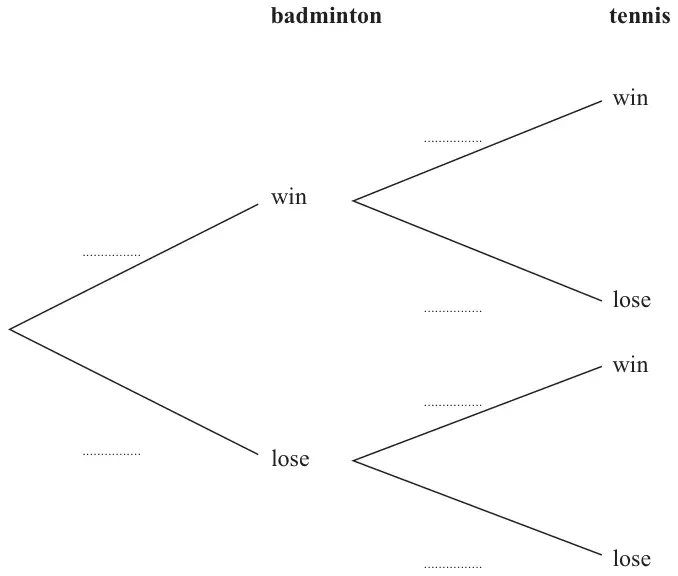
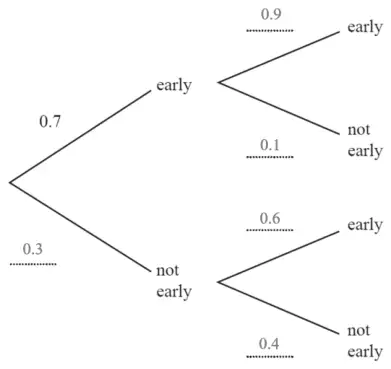
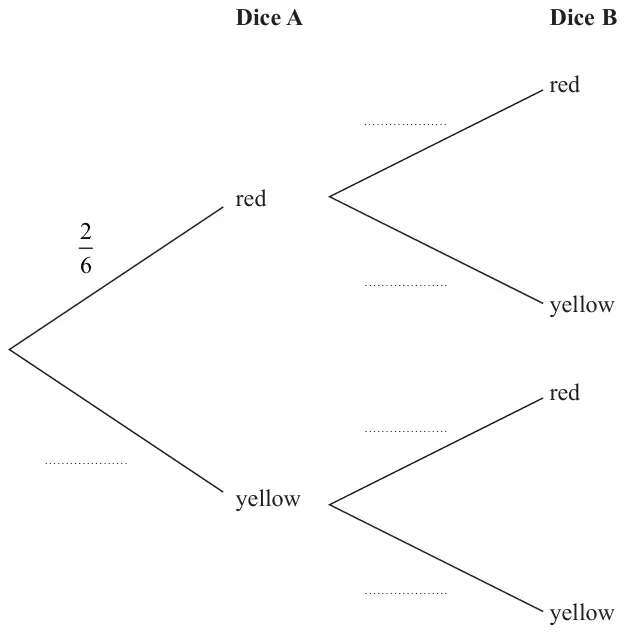
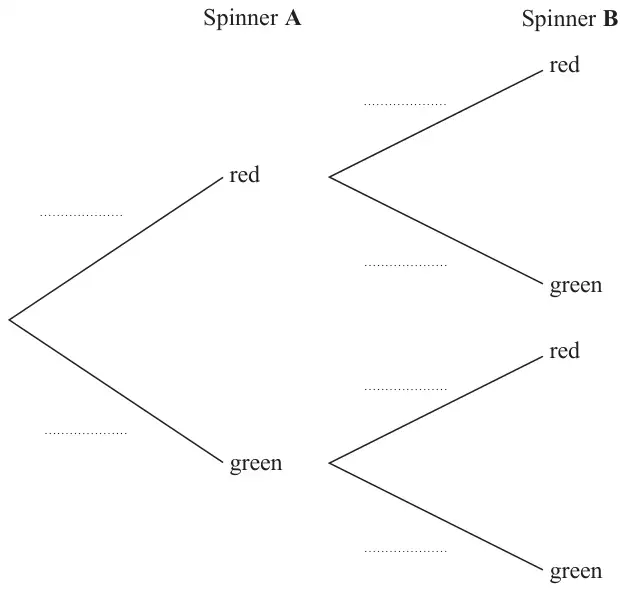
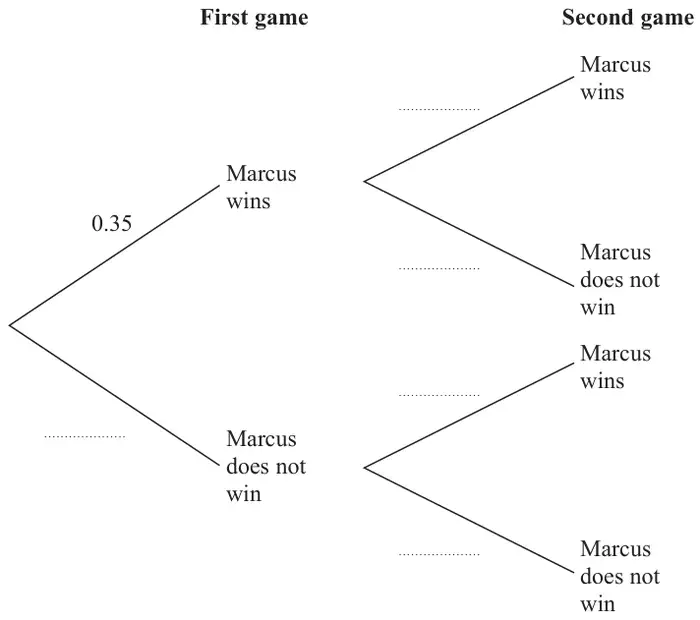
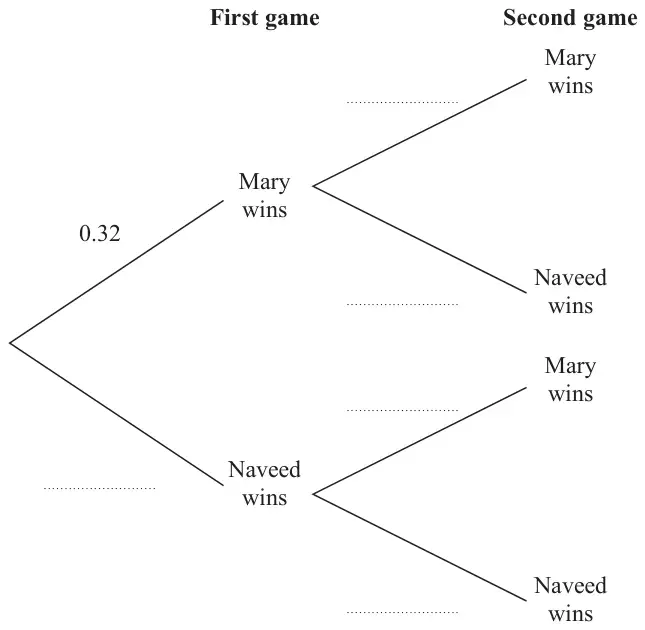
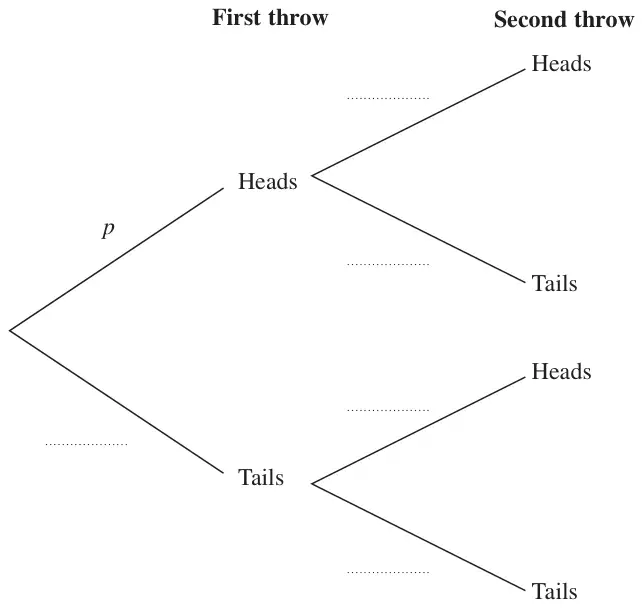
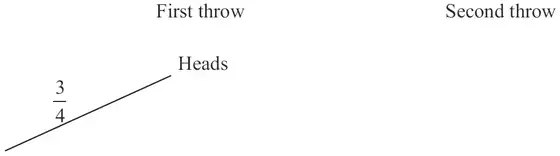
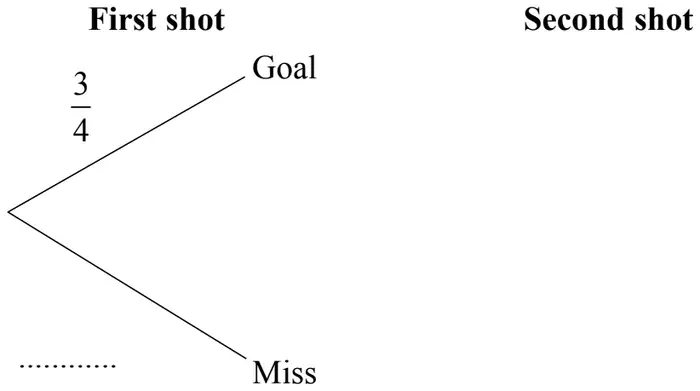
14 Ricardo is going to play one game of badminton and one game of tennis.
He can either win or lose each game.
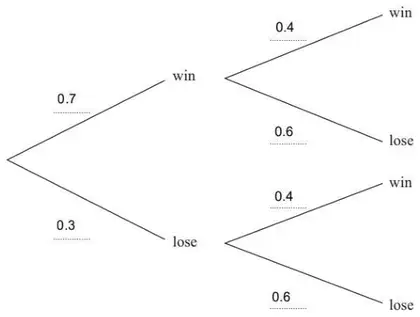
The probability that he will win the game of badminton is 0.7 The probability that he will win the game of tennis is 0.4
(a) Complete the probability tree diagram. (2)
(b) Work out the probability that Ricardo loses both games. (2)
Mark scheme (a)
Scheme
Marks
Answer: Correct probabilities
B2
(2)
Notes
B2: for all 3 correct pairs of probabilities on the correct branches
(B1 for 1 or 2 correct pairs of probabilities on the correct branches) Allow equivalent fractions or percentages
Mark scheme (b)
Scheme
Marks
“0.3” × “0.6”
M1ft
Correct answer scores full marks (unless from obvious incorrect working) Answer: 0.18
A1ft
(2)
(4 marks)
Notes
M1ft: (Both probabilities must be less than 1)
A1ft: oe eg \(\dfrac{18}{100}\) or \(\dfrac{9}{50}\) or \(\dfrac{0.18}{1}\) or 18%
The printed mark scheme gives the total for this question as 3 marks; the parts are worth 2 + 2 = 4 marks (corrected from the printed mark scheme: “Total 3 marks”).
Correct answer only scores full marks (unless from obviously incorrect working)
Answer: \(\dfrac{7}{18}\)
A1ft
(2)
Notes
M1ft: ft diagram, oe
A1ft: ft diagram, oe fraction, decimal or percentage.
NB \(\dfrac{7}{18} = \dfrac{35}{90} = 0.38(88\ldots)\)
Allow ft their tree diagram provided the relevant probabilities are less than 1 in each case
For A1, allow decimals or percentages that round or truncate correctly to at least 2sf. ISW any attempt to convert to other form once correct probability seen
where \(\left[\dfrac{7}{18}\right]\) is their answer to part (b) and must be less than 1
M1ft: ft diagram, for a method to find the probability required. Condone one error in one of the four relevant outcomes or omission of one outcome
Note P(\(RR\)) = P(\(RRR\)) + P(\(RRG\)), so may see \(\dfrac{5}{9} \times \dfrac{7}{10}\left(= \dfrac{7}{18}\right)\) in place of \(\text{``}{\dfrac{7}{22}}\text{''} + \text{``}{\dfrac{7}{99}}\text{''}\) for this mark (similar with P(\(GG\)))
A1ft: ft diagram, correct probability oe fraction, decimal or percentage
NB \(\dfrac{386}{495} = \dfrac{772}{990} = 0.77(979\ldots)\)
Allow ft their tree diagram provided the relevant probabilities are less than 1 in each case
For A1, allow decimals or percentages that round or truncate correctly to at least 2sf. ISW any attempt to convert to other form once correct probability seen
\(\text{``}{\dfrac{3}{10}}\text{''} \times \text{``}{\dfrac{5}{9}}\text{''}\) oe or \(\text{``}{\dfrac{7}{10}}\text{''} \times \text{``}{\dfrac{4}{9}}\text{''}\) oe or
\(\text{``}{\dfrac{3}{10}}\text{''} \times \text{``}{\dfrac{4}{9}}\text{''}\) oe or \(\text{``}{\dfrac{7}{10}}\text{''} \times \text{``}{\dfrac{5}{9}}\text{''}\) oe or
M1ft
\(\text{``}{\dfrac{3}{10}}\text{''} \times \text{``}{\dfrac{5}{9}}\text{''} + \text{``}{\dfrac{7}{10}}\text{''} \times \text{``}{\dfrac{4}{9}}\text{''}\) oe or
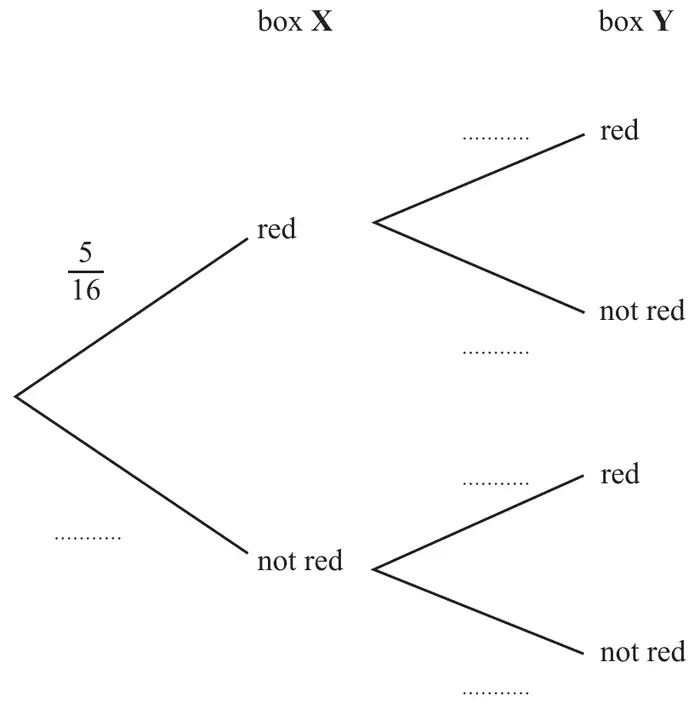
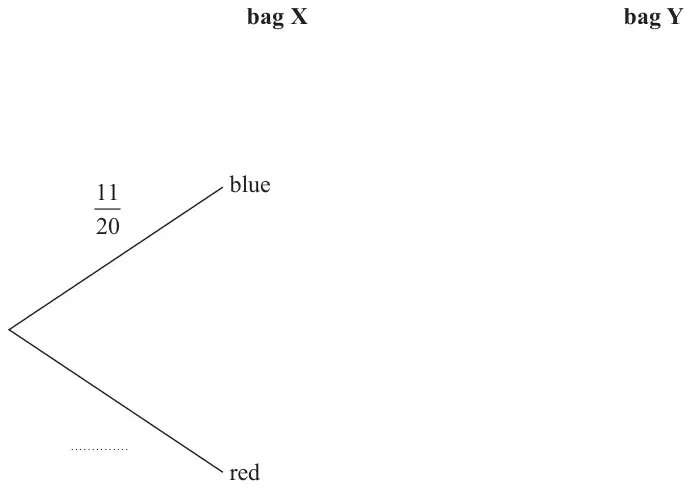
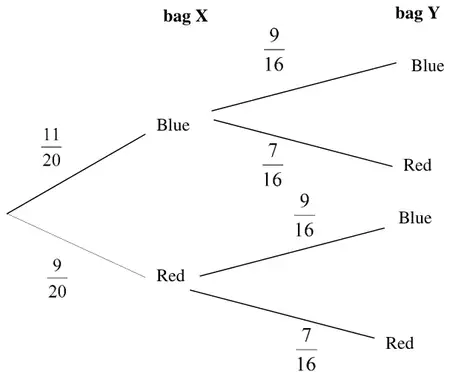
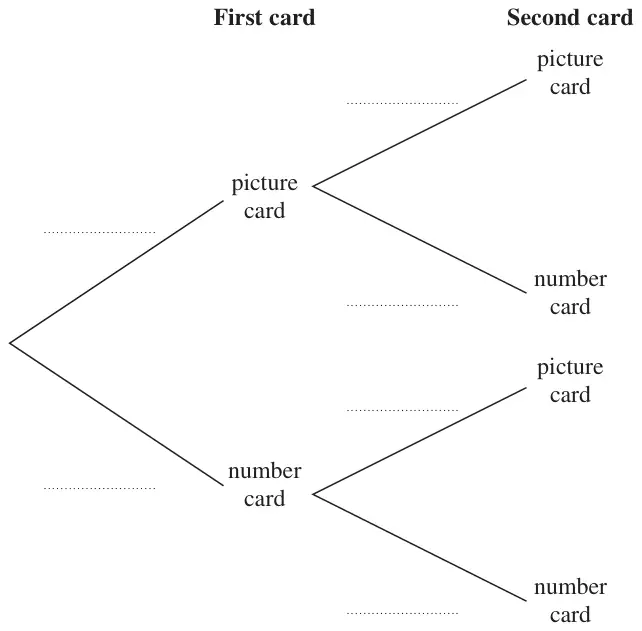
5 of the 16 crayons in box X are red. 7 of the 20 crayons in box Y are red. Sid takes at random one crayon from box X and one crayon from box Y
(a) Complete the probability tree diagram. (2)
(b) Work out the probability that Sid takes two crayons that are red or two crayons that are not red. (3)
Mark scheme (a)
Scheme
Marks
\(\dfrac{11}{16}\) on the box X “not red” branch
B1
\(\dfrac{7}{20}\), \(\dfrac{13}{20}\), \(\dfrac{7}{20}\), \(\dfrac{13}{20}\) on the box Y branches
B1
(2)
Notes
B1: (first) for \(\dfrac{11}{16}\) oe (0.68(75)) on LH bottom branch (decimals to at least 2 dp truncated or rounded)
B1: (second) for \(\dfrac{7}{20}, \dfrac{13}{20}, \dfrac{7}{20}, \dfrac{13}{20}\) on RH branches (0.35, 0.65, 0.35, 0.65)
Mark scheme (b)
Scheme
Marks
\(\dfrac{5}{16} \times \text{“}\dfrac{7}{20}\text{”}\) or \(\text{“}\dfrac{11}{16}\text{”} \times \text{“}\dfrac{13}{20}\text{”}\) or \(\dfrac{5}{16} \times \text{“}\dfrac{13}{20}\text{”}\) or \(\text{“}\dfrac{11}{16}\text{”} \times \text{“}\dfrac{7}{20}\text{”}\)
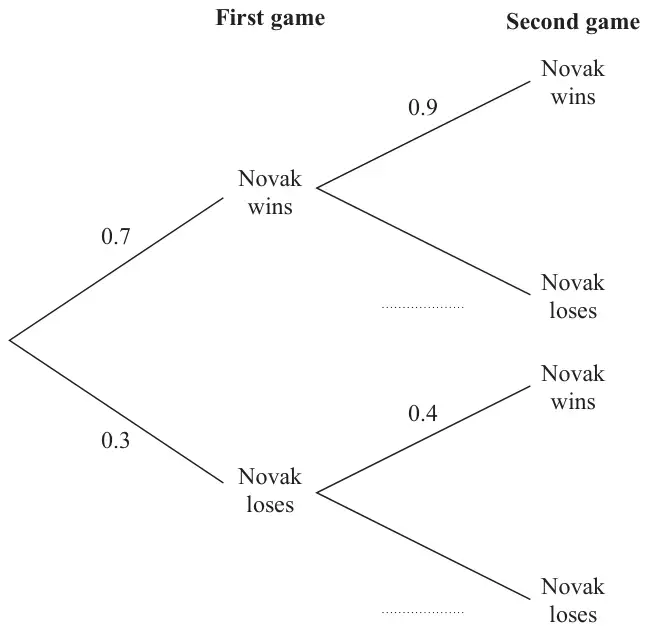
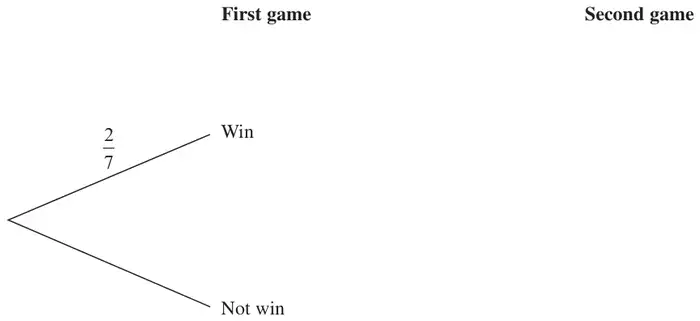
The probability that he wins the first game is 0.7
If he wins the first game, the probability that he wins the second game is 0.9 If he loses the first game, the probability that he wins the second game is 0.4
(a) Complete the probability tree diagram. (1)
(b) Work out the probability that Novak wins both games of tennis. (2)
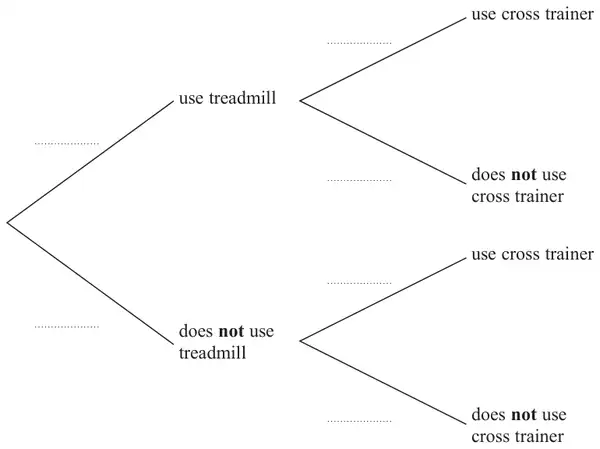
The probability that he will use the treadmill is 0.8
When he uses the treadmill, the probability that he will use the cross trainer is 0.3 When he does not use the treadmill, the probability that he will use the cross trainer is 0.6
(a) Complete the probability tree diagram for this information. (2)
(b) Work out the probability that Rudolf uses both the treadmill and the cross trainer. (2)
Mark scheme (a)
Scheme
Marks
0.8 and 0.2 0.3 and 0.7 0.6 and 0.4
B2
(2)
Notes
B2: for all 3 correct pairs of probabilities on the correct branches (B1 for 2 correct pairs of probabilities on the correct branches) Allow equivalent fractions
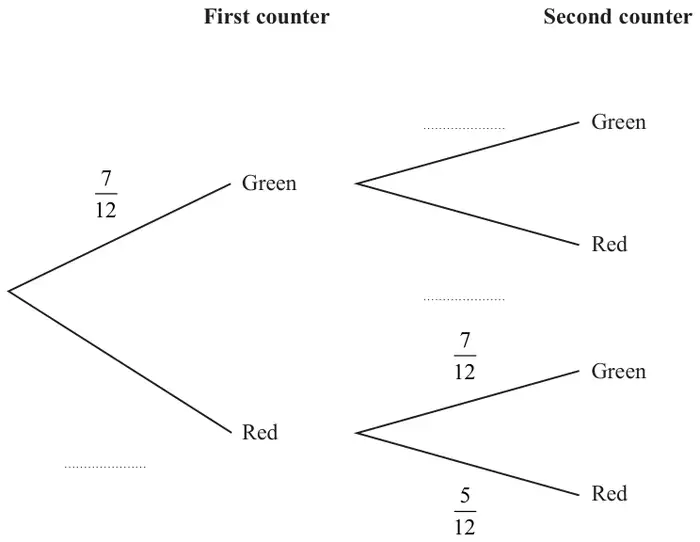
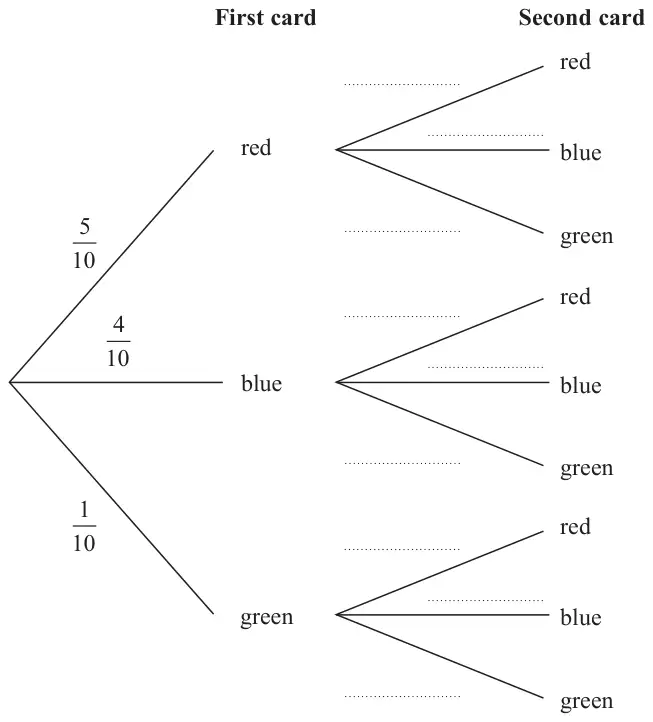
13 Hector has a bag that contains 12 counters. There are 7 green counters and 5 red counters in the bag.
Hector takes at random a counter from the bag. He looks at the counter and puts the counter back into the bag.
Hector then takes at random a second counter from the bag. He looks at the counter and puts the counter back into the bag.
(a) Complete the probability tree diagram. (2)
(b) Work out the probability that both counters are red. (2)
Meghan has a jar containing 15 counters. There are only blue counters, green counters and red counters in the jar.
Hector is going to take at random one of the counters from his bag of 12 counters. He will look at the counter and put the counter back into the bag.
Hector is then going to take at random a second counter from his bag. He will look at the counter and put the counter back into the bag.
Meghan is then going to take at random one of the counters from her jar of counters. She will look at the counter and put the counter back into the jar.
The probability that the 3 counters each have a different colour is \(\dfrac{7}{24}\)
(c) Work out how many blue counters there are in the jar. (3)
Mark scheme (a)
Scheme
Marks
\(\dfrac{5}{12}\)
B1
\(\dfrac{7}{12}\), \(\dfrac{5}{12}\)
B1
(2)
Notes
B1: for first choice correct 0.41(666…) to 2 dp truncated or rounded
B1: for second choice correct 0.58(333…) to 2 dp truncated or rounded 0.41(666…) to 2 dp truncated or rounded
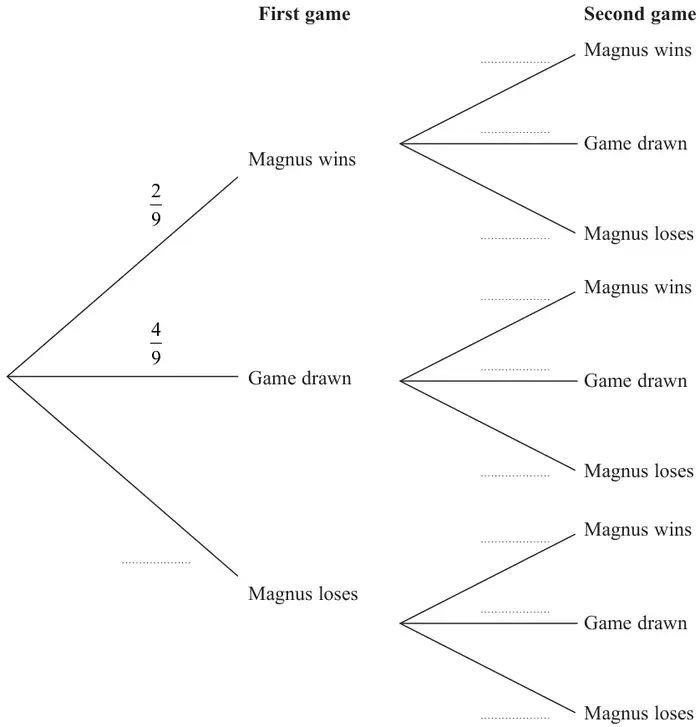
15 Magnus and Garry play 2 games of chess against each other.
The probability that Magnus beats Garry in any game is \(\dfrac{2}{9}\) The probability that any game between Magnus and Garry is drawn is \(\dfrac{4}{9}\)
The result of any game is independent of the result of any other game.
(a) Complete the probability tree diagram.(2)
For each game of chess,
the winner gets 2 points and the loser gets 0 points, when the game is drawn, each player gets 1 point.
(b) Work out the probability that, after 2 games, Magnus and Garry have the same number of points. (3)
Magnus and Garry now play a third game of chess.
(c) Work out the probability that, after 3 games, Magnus and Garry have the same number of points. (3)
Mark scheme (a)
Scheme
Marks
\(\dfrac{3}{9}\)
B1
\(\dfrac{2}{9},\ \dfrac{4}{9},\ \dfrac{3}{9}\)
B1ft
(2)
Notes
B1: for lower 1st game branch probability
B1ft: for all values correct on 2nd game branches
Mark scheme (b)
Scheme
Marks
\(\left(\dfrac{2}{9} \times \dfrac{3}{9}\right)\) or \(\left(\dfrac{3}{9} \times \dfrac{2}{9}\right)\) or \(\left(\dfrac{4}{9} \times \dfrac{4}{9}\right)\) oe or
Correct answer scores full marks (unless from obvious incorrect working)
Answer: \(\dfrac{208}{729}\)
A1
(3)
(8 marks)
Notes
M1ft: from their tree diagram for any combination of WLD or DDD (allow probabilities to 2 dp truncated or rounded)
M1ft: for a fully correct method
A1: Allow 0.285 ... (2 dp truncated or rounded) or 28.5% (2 sf truncated or rounded)
Mark scheme (ALT)
Scheme
Marks
(a)
Answer: \(\dfrac{3}{9}\)
B1
\(\dfrac{2}{9},\ \dfrac{4}{9},\ \dfrac{3}{9}\)
B1ft
(b)
1 and \(\left(\dfrac{2}{9} \times \dfrac{2}{9}\right)\) or \(\left(\dfrac{4}{9} \times \dfrac{2}{9}\right)\) or \(\left(\dfrac{4}{9} \times \dfrac{3}{9}\right)\) or \(\left(\dfrac{3}{9} \times \dfrac{3}{9}\right)\) oe
Correct answer scores full marks (unless from obvious incorrect working)
Answer: \(\dfrac{208}{729}\)
A1
Notes
B1: (a) for lower 1st game branch probability
B1ft: (a) for all values correct on 2nd game branches
M1ft: (b) from their tree diagram for 1 and one correct product from WW, DW, DL or LL (allow probabilities to 2 dp truncated or rounded)
M1ft: (b) for a fully correct method
A1: (b) Allow 0.345 ... (2 dp truncated or rounded) or 34.5% (2 sf truncated or rounded)
M1ft: (c) from their tree diagram for 1 and one correct product from WWW or WWD or WWL or WDD or WLL or DDL or DLL or LLL (allow probabilities to 2 dp truncated or rounded)
M1ft: (c) for a fully correct method
A1: (c) Allow 0.285 ... (2 dp truncated or rounded) or 28.5% (2 sf truncated or rounded)
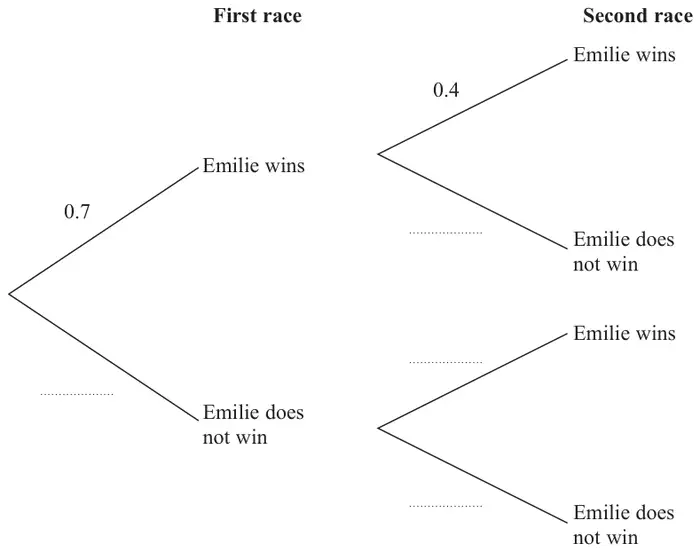
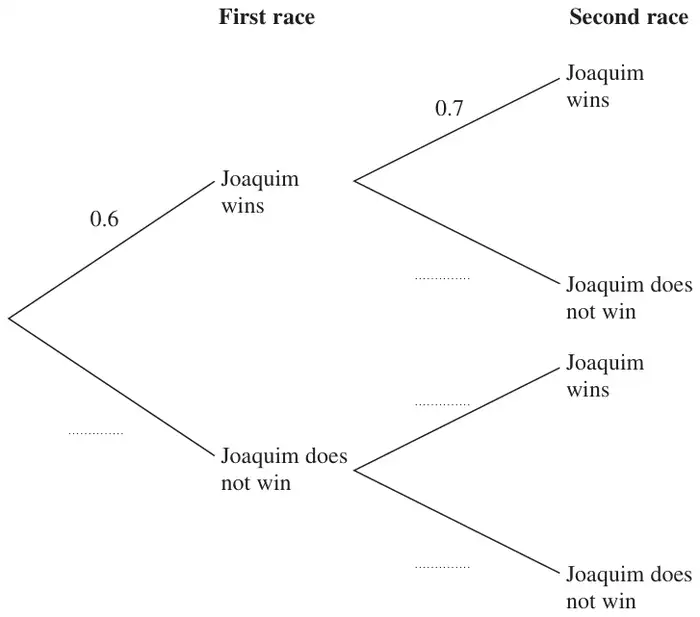
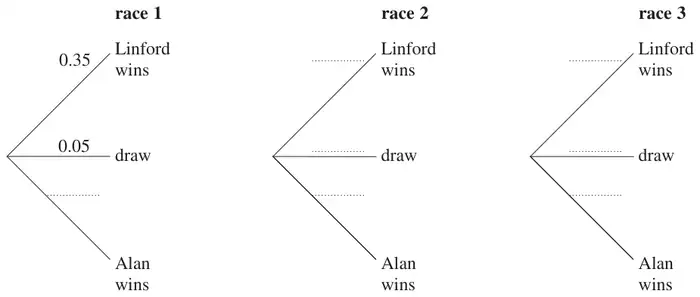
The probability that she wins the first race is 0.7 The probability that she wins the second race is 0.4
The outcomes of the two races are independent.
(a) Complete the probability tree diagram. (2)
(b) Work out the probability that Emilie wins exactly one of the two races. (3)
Emilie is going to take part in a third race.
If she wins both of the first two races, the probability that she will win the third race is 0.6 If she wins exactly one of the first two races, the probability that she will win the third race is 0.3
(c) Work out the probability that Emilie will win exactly two of the three races. (3)
Mark scheme (a)
Scheme
Marks
0.3
B1
0.6, 0.4, 0.6
B1
(2)
Notes
B1: oe first race branch correct
B1: oe second race branches correct
Mark scheme (b)
Scheme
Marks
\(0.7 \times \text{``}{0.6}\text{''}\ (= 0.42)\) oe or \(\text{``}{0.3}\text{''} \times \text{``}{0.4}\text{''}\ (= 0.12)\) oe or \(0.7 \times 0.4\ (= 0.28)\) oe or \(\text{``}{0.3}\text{''} \times \text{``}{0.6}\text{''}\ (= 0.18)\) oe
Working not required, so correct answer scores full marks (unless from obvious incorrect working) NB: allow decimals, fractions or percentages with % as oe for probability Answer: 0.274
\(\text{‘}\dfrac{2}{5}\text{’} \times \text{‘}\dfrac{4}{5}\text{’}\left(= \dfrac{8}{25}\right)\) or \(\text{‘}\dfrac{2}{5}\text{’} \times \text{‘}\dfrac{1}{5}\text{’}\left(= \dfrac{2}{25}\right)\) or
\(\text{‘}\dfrac{3}{5}\text{’} \times \text{‘}\dfrac{4}{5}\text{’}\left(= \dfrac{12}{25}\right)\) or \(\text{‘}\dfrac{3}{5}\text{’} \times \text{‘}\dfrac{1}{5}\text{’}\left(= \dfrac{3}{25}\right)\) oe
M1
\(1 - \text{‘}\dfrac{8}{25}\text{’}\) or \(\text{‘}\dfrac{2}{25}\text{’} + \text{‘}\dfrac{12}{25}\text{’} + \text{‘}\dfrac{3}{25}\text{’}\) or \(\text{‘}\dfrac{2}{25}\text{’} + \text{‘}\dfrac{3}{5}\text{’}\) oe
M1
Correct answer scores full marks (unless from obvious incorrect working)
Answer: \(\dfrac{17}{25}\)
A1
(3)
(5 marks)
Notes
M1: ft from (a) provided \(0 \lt\) probability \(\lt 1\)
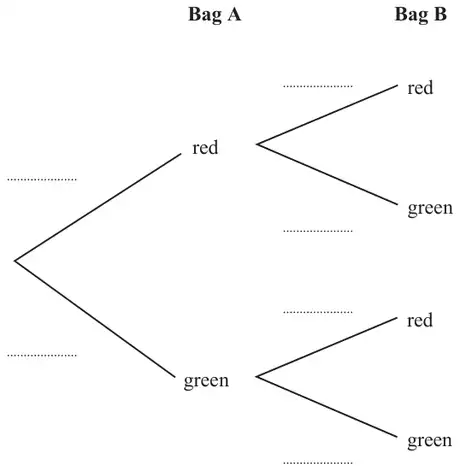
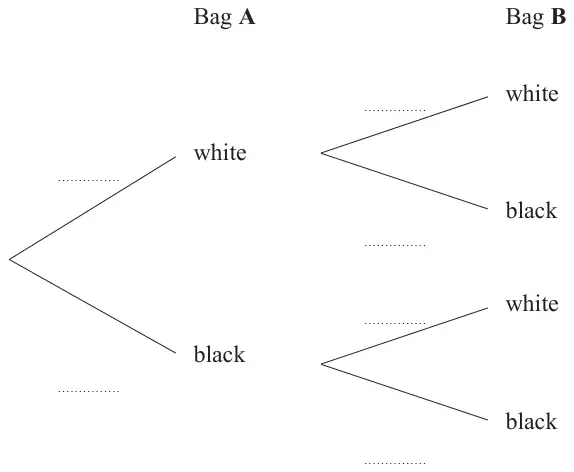
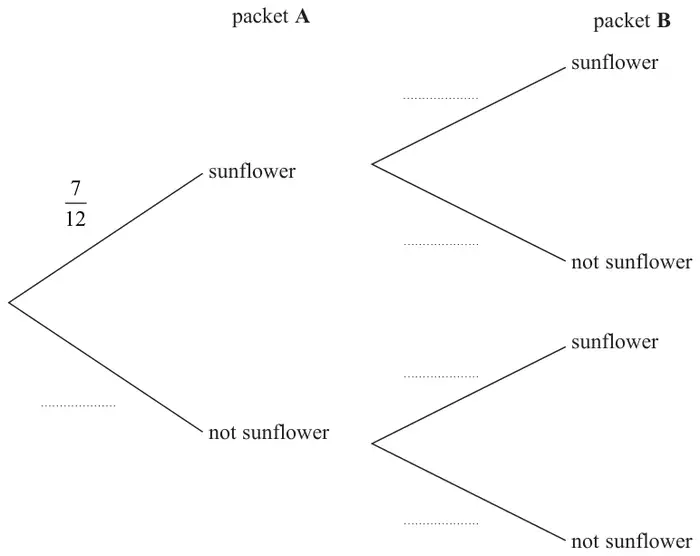
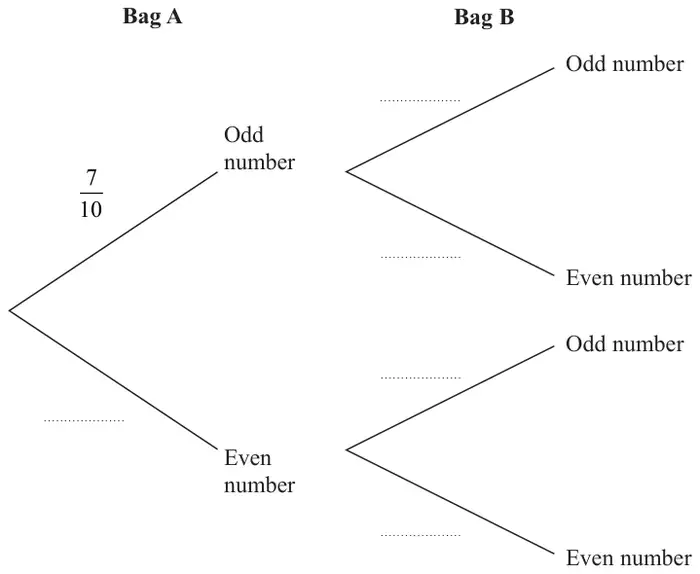
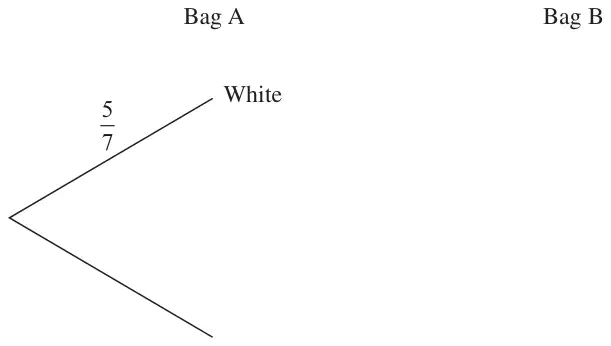
16 Cody has two bags of counters, bag A and bag B.
Each of the counters has either an odd number or an even number written on it.
There are 10 counters in bag A and 7 of these counters have an odd number written on them. There are 12 counters in bag B and 7 of these counters have an odd number written on them.
Cody is going to take at random a counter from bag A and a counter from bag B.
(a) Complete the probability tree diagram. (2)
(b) Calculate the probability that the total of the numbers on the two counters will be an odd number. (3)
Harriet also has a bag of counters. Each of her counters also has either an odd number or an even number written on it.
Harriet is going to take at random a counter from her bag of counters.
The probability that the number on each of Cody’s two counters and the number on Harriet’s counter will all be even is \(\dfrac{3}{100}\)
(c) Find the least number of counters that Harriet has in her bag. Show your working clearly. (3)
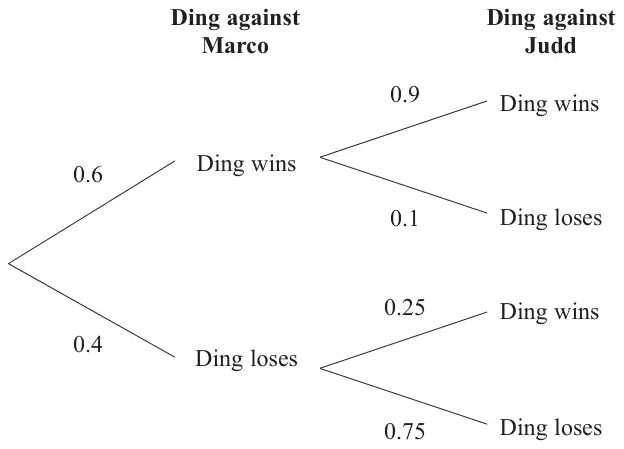
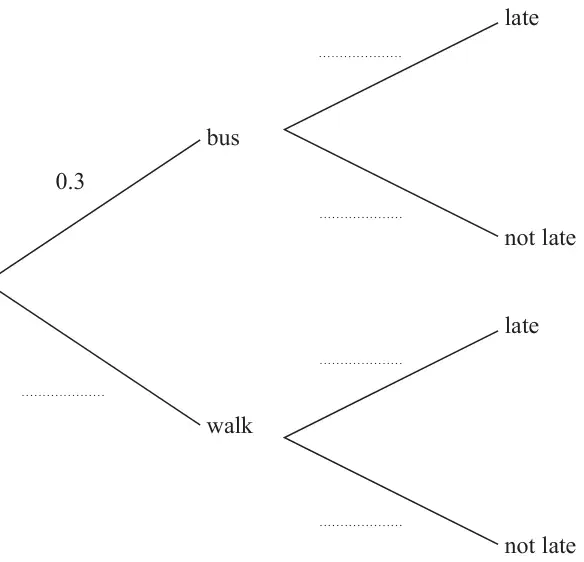
14 Each day that Barney goes to college, he either goes by bus or he walks. The probability that Barney will go to college by bus on any day is 0.3 When Barney goes to college by bus, the probability that he will be late is 0.2 When Barney walks to college, the probability that he will be late is 0.1
(a) Complete the probability tree diagram. (2)
Barney will go to college on 200 days next year.
(b) Work out an estimate for the number of days Barney will be late for college next year. (4)
Mark scheme (a)
Scheme
Marks
0.7, 0.2, 0.8, 0.1, 0.9
B2
(2)
Notes
B2: oe, all correct (B1 for 2 or 3 or 4 correct probabilities)
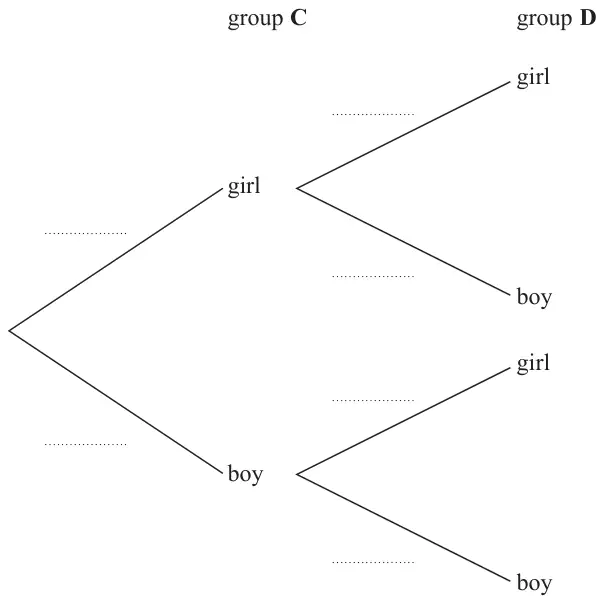
13 In group C, there are 6 girls and 8 boys. In group D, there are 3 girls and 7 boys.
A team is made by picking at random one child from group C and one child from group D.
(a) Complete the probability tree diagram. (2)
(b) Work out the probability that there are two boys in the team. (2)
After the first team has been picked, a second team is picked. One child is picked at random from the children left in group C and one child is picked at random from the children left in group D.
(c) Work out the probability that there are two boys in each of the two teams. (3)
B1: for \(\dfrac{6}{14}\left(\dfrac{3}{7}\right), \dfrac{8}{14}\left(\dfrac{4}{7}\right)\) in correct positions. Allow decimals of 2dp or better (0.43, 0.57)
B1oe: for \(\dfrac{3}{10}, \dfrac{7}{10}, \dfrac{3}{10}, \dfrac{7}{10}\) in correct positions.
Mark scheme (b)
Scheme
Marks
\(\dfrac{8}{14} \times \dfrac{7}{10}\)
M1
\(\dfrac{2}{5}\) oe
A1
(2)
Notes
M1: ft from (a)
Mark scheme (c)
Scheme
Marks
\(\dfrac{7}{13} \times \dfrac{6}{9}\left(= \dfrac{42}{117} = \dfrac{14}{39} = 0.35(897\ldots)\right)\) or
\(\dfrac{8}{14} \times \dfrac{7}{13}\left(= \dfrac{56}{182}\text{ oe}\right)\) or \(\dfrac{7}{10} \times \dfrac{6}{9}\left(= \dfrac{42}{90}\right)\)
Answer: Labels and correct probabilities on all second branches
B1
(3)
Notes
B1:Correction: the printed scheme lists these as \(\dfrac{9}{20}, \dfrac{7}{16}, \dfrac{9}{20}, \dfrac{7}{16}\); bag Y has 9 blue counters out of 16, so the blue branches are \(\dfrac{9}{16}\), as the scheme’s own tree diagram and part (c) show.
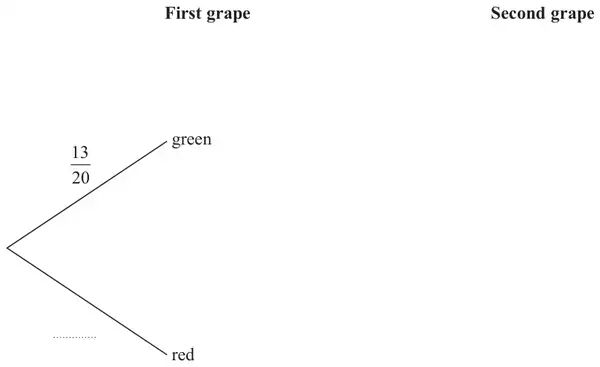
12 In a bowl, there are 20 grapes. 13 of these grapes are green and 7 of these grapes are red.
Jayesh takes at random a grape from the bowl and eats the grape. He then takes at random another grape from the bowl and eats the grape.
(a) Complete the probability tree diagram.(3)
(b) Work out the probability that Jayesh eats two green grapes. (2)
Jayesh takes at random a third grape from the bowl and eats this grape.
(c) Work out the probability that there are now 11 green grapes in the bowl. (3)
Mark scheme (a)
Scheme
Marks
B1
B1
Fully correct tree diagram
B1
(3)
Notes
B1: For \(\dfrac{7}{20}\) on lower LH branch
B1: Correct binary structure with 4 branches needed on RHS
B1: For fully correct tree diagram with all probabilities (\(\dfrac{7}{20}\), \(\dfrac{12}{19}\), \(\dfrac{7}{19}\), \(\dfrac{13}{19}\) and \(\dfrac{6}{19}\)) and labels.
Mark scheme (b)
Scheme
Marks
\(\dfrac{13}{20} \times \dfrac{12}{19}\)
M1
\(\dfrac{156}{380}\)
A1
(2)
Notes
M1: ft from their tree diagram in (a)
A1: oe
eg \(\dfrac{78}{190}\) or \(\dfrac{39}{95}\)
Accept 0.41(0526….) rounded or truncated to at least 2dp.
Mark scheme (c)
Scheme
Marks
\(\dfrac{13}{20} \times \dfrac{12}{19} \times \dfrac{7}{18}\) or \(\dfrac{91}{570}\) or 0.15(9649...) oe
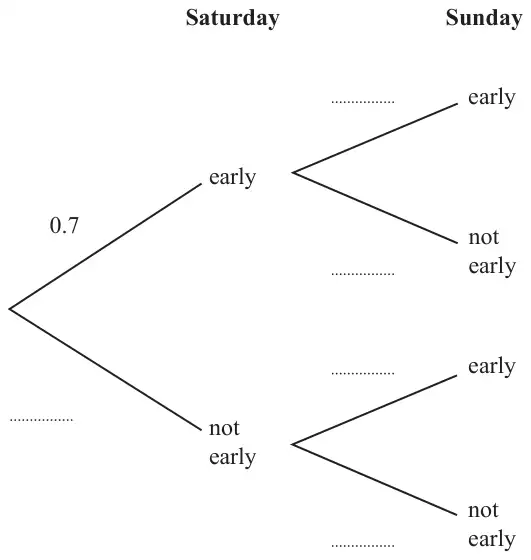
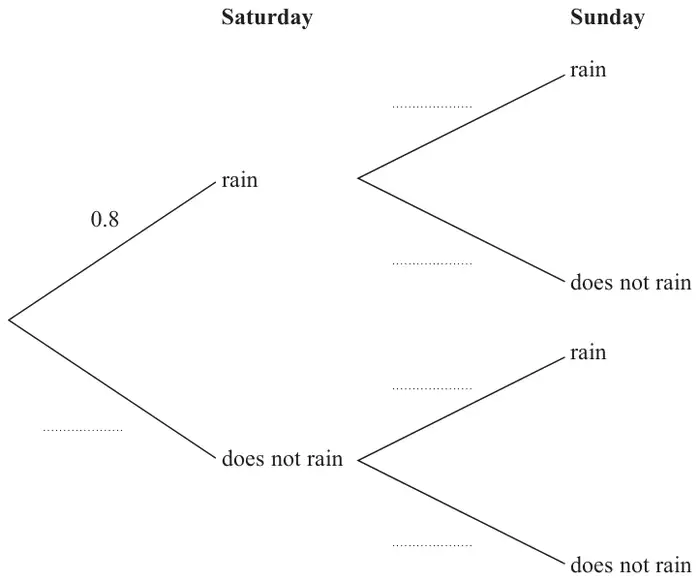
16 The probability that it will rain on Saturday is 0.8
If it rains on Saturday, the probability that it will rain on Sunday is 0.65 If it does not rain on Saturday, the probability that it will rain on Sunday is 0.4
(a) Use this information to complete the probability tree diagram.(2)
(b) Work out the probability that it will rain on just one of these two days. (3)
Mark scheme (a)
Scheme
Marks
0.2, 0.65, 0.35, 0.4, 0.6
B2oe
(2)
Notes
B2oe: B1 for any 2 correct probabilities (in correct position)
Mark scheme (b)
Scheme
Marks
0.8 × “0.35”(=0.28) or “0.2” × “0.4”(=0.08)
M1
0.8 × “0.35” + “0.2” × “0.4”
M1
0.36 oe
A1
(3)
(5 marks)
Notes
M1: ft from (a)
M1: ft from (a)
A1: eg \(\dfrac{9}{25}\), 36%
M2 ft from (a) for 1 – (0.8 × ‘0.65’ + ‘0.2’ × ‘0.6’) M1 for 1 – (0.8 × ‘0.65’) or 1 – (‘0.2’ × ‘0.6’)
(corrected from the printed mark scheme: 1 – (0.8 × ‘0.6’ + ‘0.2’ × ‘0.6’))
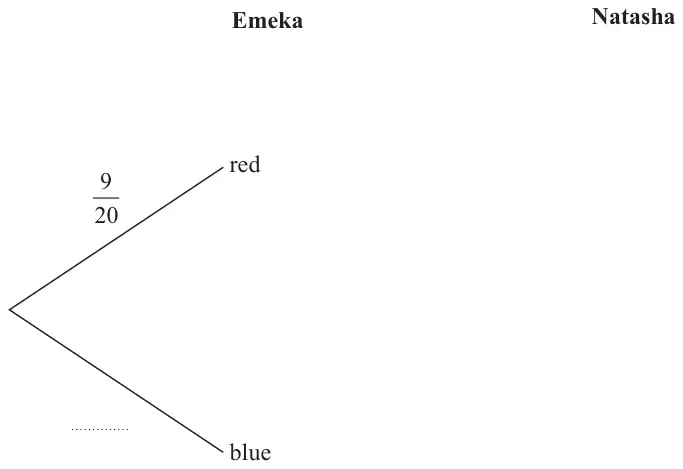
11 There are 9 red counters and 11 blue counters in a bag. There are no other counters in the bag.
Emeka takes at random a counter from the bag and writes down the colour of the counter. He puts the counter back in the bag. Natasha takes at random a counter from the bag and writes down the colour of the counter.
(a) Complete the probability tree diagram. (2)
(b) Work out the probability that Emeka takes a red counter from the bag and Natasha takes a blue counter from the bag. (2)
(c) Work out the probability that both counters taken from the bag are the same colour. (3)
Mark scheme (a)
Scheme
Marks
Complete correct binary structure for selection of two counters
OR
At least one additional red branch labelled \(\dfrac{9}{20}\) and at least two blue branches labelled \(\dfrac{11}{20}\)
M1
Correct probability tree diagram
A1
(2)
Mark scheme (b)
Scheme
Marks
\(\dfrac{9}{20} \times \dfrac{11}{20}\)
M1
\(\dfrac{99}{400}\)
A1
(2)
Notes
M1: for \(\text{‘}\dfrac{9}{20}\text{’} \times \text{‘}\dfrac{11}{20}\text{’}\)
A1: (ft diagram) for \(\dfrac{99}{400}\) or 0.2475 or 24.75%
Mark scheme (c)
Scheme
Marks
\(\text{‘}\dfrac{9}{20}\text{’} \times \text{‘}\dfrac{9}{20}\text{’}\) or \(\text{‘}\dfrac{11}{20}\text{’} \times \text{‘}\dfrac{11}{20}\text{’}\)
M1ft for 0.6 × “0.3” × “0.8” or 0.144 \(\left(\dfrac{18}{125}\right)\) or “0.4” × 0.7 × “0.8” or 0.224 \(\left(\dfrac{28}{125}\right)\) or “0.4” × “0.3” × 0.2 or 0.024 \(\left(\dfrac{3}{125}\right)\)
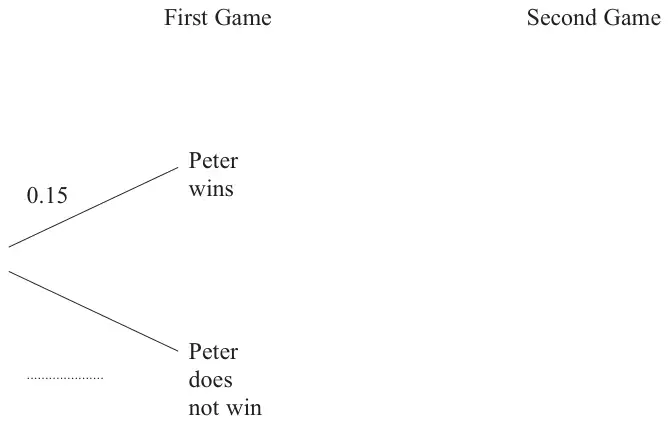
21 Peter travels to work either by bus or by bike.
The probability that Peter will travel to work by bus on any one day is 0.7
Whenever Peter travels to work by bus, the probability that he will be late is 0.1 Whenever Peter travels to work by bike, the probability that he will be late is 0.05
Peter is going to go to work on Monday and on Tuesday.
Work out the probability that he will be late for work on at least one of these days.
(5)
Mark scheme
Scheme 1 P(L,L) + P(L, NL) + P(NL, L)
Bus L = 0.07 ; BusNL = 0.63 BikeL = 0.015; BikeNL = 0.285 correct products may be seen instead of these values
Scheme
Marks
1 − 0.1 (=0.9) or 1 − 0.05 (=0.95) or 1 – 0.7 (=0.3)
M1
P(not late for work)
= 0.7×0.9 + 0.3×0.95 (= 0.915 or \(\dfrac{183}{200}\) )
M1
P(late for work)
= 0.7×0.1 + 0.3×0.05 (= 0.085 or \(\dfrac{17}{200}\) ) OR
1 – “0.915” (=0.085)
M1
P(late on at least one day) = 2 × "0.085"×"0.915" + "0.085"×"0.085"
M1
0.162775
or \(\dfrac{6511}{40000}\) oe
A1
(5)
Notes
M1: or at least 4 correct products from (addition not needed) \(0.07^2 + 2 \times 0.07 \times 0.63 + 2 \times 0.07 \times 0.015 + 2 \times 0.07 \times 0.285 + 2 \times 0.63 \times 0.015 + 0.015^2 + 2 \times 0.015 \times 0.285\)
M1: or at least 8 correct products from (addition not needed) \(0.07^2 + 2 \times 0.07 \times 0.63 + 2 \times 0.07 \times 0.015 + 2 \times 0.07 \times 0.285 + 2 \times 0.63 \times 0.015 + 0.015^2 + 2 \times 0.015 \times 0.285\)
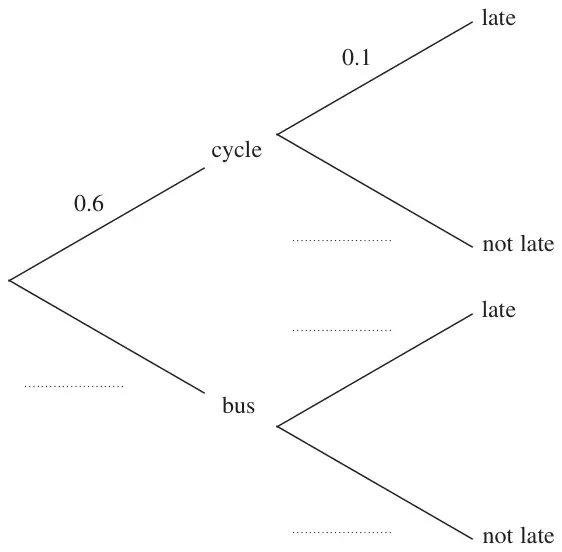
17 Chaiwat either cycles to work or goes by bus. On any day that he goes to work, the probability that he cycles is 0.6 When he cycles, the probability that he is late is 0.1 When he goes by bus, the probability that he is late is 0.3
(a) Complete the probability tree diagram.(2)
(b) Calculate the probability that on a day Chaiwat goes to work, he cycles and is late for work. (2)
(c) Calculate the probability that on a day Chaiwat goes to work, he is not late for work. (3)
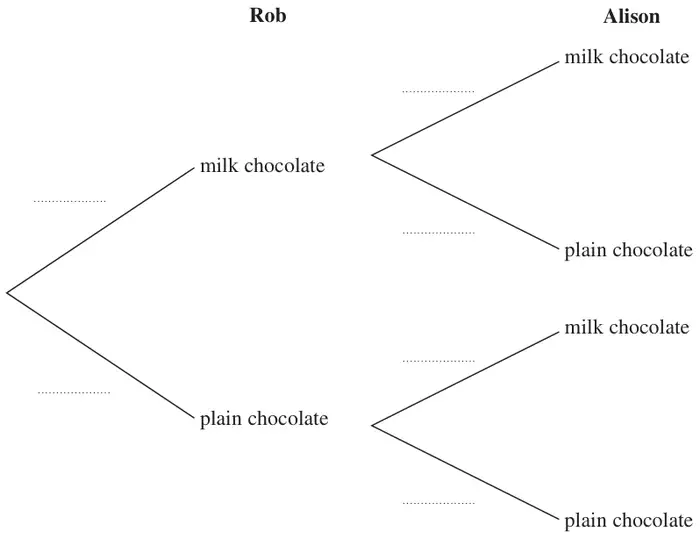
15 There are 6 milk chocolates and 4 plain chocolates in a box. Rob takes at random a chocolate from the box and eats it. Then Alison takes at random a chocolate from the box and eats it.
(a) Complete the probability tree diagram.(3)
(b) Work out the probability that there are now exactly 3 plain chocolates in the box. (3)
A1: Allow 0.53(33…) Note: If all 4 probability products are seen at the ends of the branches on the tree diagram or in lists in the working space for (b), marks can only be awarded in (b) if it is clear which product(s) they are intending to use.
M1: ft for any "correct" product; allow decimals only ft probabilities < 1
M1: ft for full method
A1: ft ; allow for decimal answer, accept 0.4897959… truncated or rounded to 3 or more sig figs; only accept 0.49 if preceded by more accurate answer or M2 awarded
or M2 for \(1 - \left(\text{“}\tfrac{5}{7}\text{”}\right)^2\)
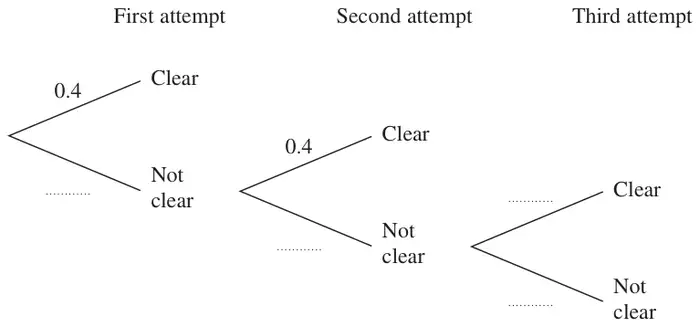
17 Hugo competes in the high jump at a school athletics competition. He has up to 3 attempts to clear the bar at each height. When he clears the bar, he does not have another attempt at that height.
When the bar is set at a height of 1.60 metres, the probability that Hugo will clear the bar on any attempt is 0.4
The probability tree diagram shows the possible outcomes of Hugo’s attempts at 1.60 metres.
(a) Complete the probability tree diagram to show the four missing probabilities. (1)
(b) Work out the probability that Hugo does not clear the bar on his first two attempts and then does clear the bar on his third attempt at 1.60 metres. (2)
Hugo clears the bar at 1.60 metres and the height is raised to 1.65 metres. He has up to three attempts to clear the bar at 1.65 metres.
When the bar is set at a height of 1.65 metres, the probability that Hugo will clear the bar on any attempt is 0.3
(c) Find the probability that Hugo clears the bar at 1.65 metres. (3)
Mark scheme (a)
Scheme
Marks
0.6, 0.6, 0.4, 0.6
B1
(1)
Notes
B1: For probabilities shown correctly on tree diagram.
Mark scheme (b)
Scheme
Marks
0.6 × 0.6 × 0.4
M1
0.144oe
A1
(2)
Notes
A1: Accept 18/125
Mark scheme (c)
Scheme
Marks
0.3 + (0.7 × 0.3) + (0.7 × 0.7 × 0.3)
M2
0.657
A1
(3)
(6 marks)
Notes
M2: Accept 1 – 0.7 x 0.7 x 0.7 If not M2 then M1 for 0.7 × 0.3 or 0.7 × 0.7 × 0.3 or 0.21 or 0.147
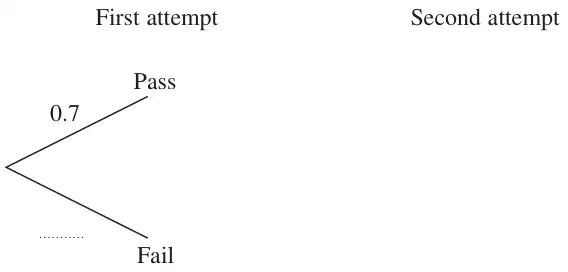
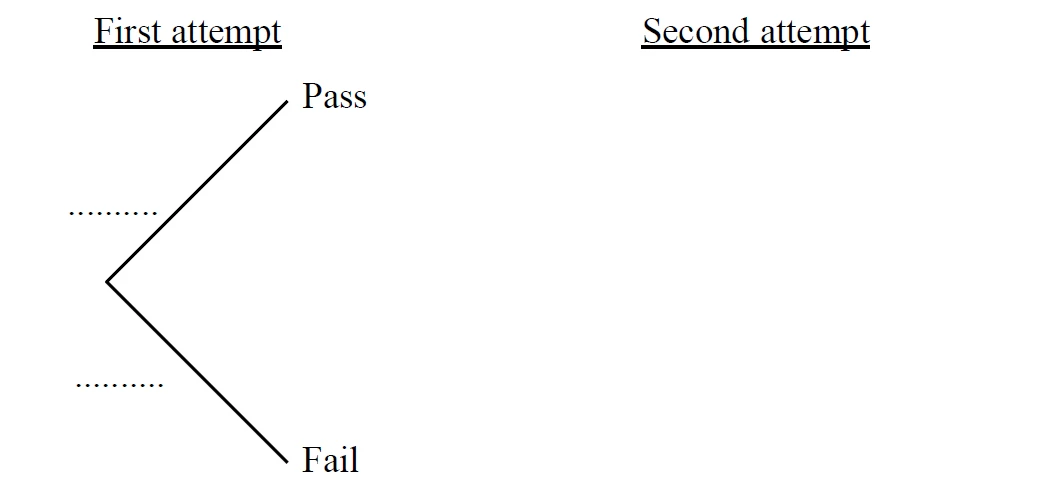
14 Peter wants to pass his driving test. The probability that he passes at his first attempt is 0.7 When Peter passes his driving test, he does not take it again. If he fails, the probability that he passes at the next attempt is 0.8
(a) Complete the probability tree diagram for Peter’s first two attempts.(2)
(b) Calculate the probability that Peter needs exactly two attempts to pass his driving test. (2)
(c) Calculate the probability that Peter passes his driving test at his third or fourth attempt. (3)
Mark scheme (a)
Scheme
Marks
0.3 in first fail branch
B1
0.8, 0.2 in second attempt pass, fail branches
B1
(2)
Notes
B1: Branches must be labelled. Ignore extra branches leading from “pass”.
Mark scheme (b)
Scheme
Marks
“0.3” x 0.8
M1ft
0.24 oe
A1
(2)
Mark scheme (c)
Scheme
Marks
(“0.3” x “0.2” x 0.8) + (“0.3” x “0.2” x “0.2” x 0.8) oe
M2ft
0.0576 oe
A1
(3)
(7 marks)
Notes
M2ft: M1ft for “0.3” x “0.2” x 0.8 (=0.048) or “0.3” x “0.2” x “0.2” x 0.8 (=0.0096)
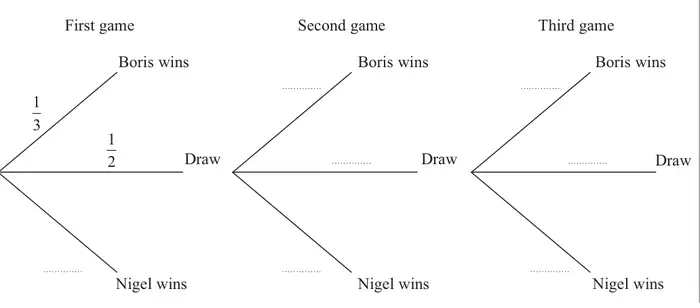
18 Boris and Nigel play games of chess against each other in a match. In each game, Boris wins or Nigel wins or the game is a draw.
When a player wins a game, he wins the match. When a game is a draw, the players play another game against each other. Boris and Nigel play a maximum of 3 games.
The probability that Boris wins a game is \(\dfrac{1}{3}\)
The probability that a game is a draw is \(\dfrac{1}{2}\)
(a) Complete the probability tree diagram.(3)
(b) Calculate the probability that Boris wins the match. (3)
Note: (simplest form of fractions is not necessary) (accept \(\dfrac{1}{6}\) and/or \(\dfrac{1}{3}\) rounded or truncated to 2 or more decimal places eg 0.16 , 0.17 , 0.33 etc)
SC : If M1 cannot be awarded then award B1 if top two branches in 2nd and 3rd games are correct
17 Parveen travels to school either by bicycle or by bus. The probability that, on any day, she will travel by bicycle is 0.7 When she travels by bicycle, the probability that she will be late for school is 0.2 When she travels by bus, the probability that she will be late for school is 0.1
(a) Calculate the probability that, on a randomly chosen day, Parveen will travel by bus and be late for school. (2)
(b) Calculate the probability that, on a randomly chosen day, Parveen will not be late for school. (3)
Mark scheme (a)
Scheme
Marks
0.3 × 0.1 or (1 − 0.7) × 0.1 and no other terms
M1
0.03 oe
A1
(2)
Mark scheme (b)
Scheme
Marks
0.7 × 0.8 or 0.7 × (1 − 0.2) or 0.3 × 0.9 or (1 − 0.7) × (1 − 0.1)
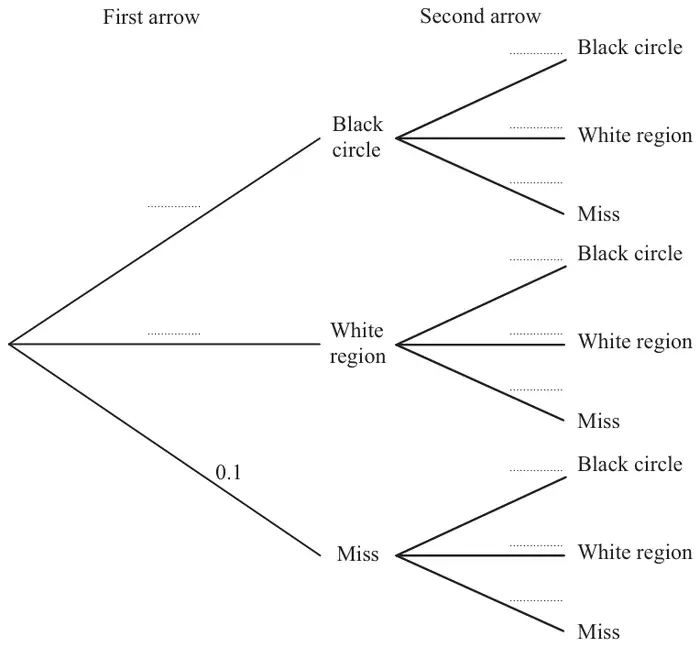
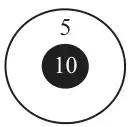
14 A target has a black circle and a white region. Arrows can hit the black circle, the white region or miss the target.
Peter shoots two arrows at the target. On each shot, the probability that Peter’s arrow misses the target is 0.1 On each shot, the probability that Peter’s arrow hits the white region is twice the probability that it hits the black circle.
(a) Complete the probability tree diagram for Peter’s two arrows.(3)
(b) An arrow which hits the black circle scores 10 points. An arrow which hits the white region scores 5 points. An arrow which misses the target scores 0 points.Calculate the probability that Peter scores exactly 10 points with his 2 arrows. (3)
Mark scheme (a)
Scheme
Marks
Black circle = 0.3 White region = 0.6
B1 B1
All values “correct” for second shot
B1ft
(3)
Notes
B1ft: Allow ft if each group of 3 branches on second arrow all sum to 1 and are consistent with first arrow branches
Mark scheme (b)
Scheme
Marks
Any one correct product in numerical form e.g. (“0.3” x 0.1) or (0.1 x “0.3”) or (“0.6” x “0.6”)
M1ft
(“0.3” x 0.1) + (0.1x “0.3”) + (“0.6” x “0.6”)
M1ft
0.42oe
A1
(3)
Notes
M1ft: e.g. (Black, Miss) or (Miss, Black) or (White, White)
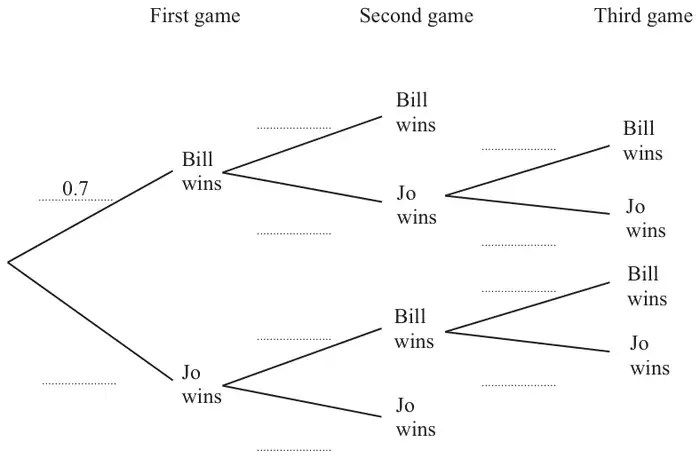
18 Bill and Jo play some games of table tennis. The probability that Bill wins the first game is 0.7 When Bill wins a game, the probability that he wins the next game is 0.8 When Jo wins a game, the probability that she wins the next game is 0.5 The first person to win two games wins the match.
(a) Complete the probability tree diagram.(3)
(b) Calculate the probability that Bill wins the match. (3)
Mark scheme (a)
Scheme
Marks
0.3 on bottom LH branch
B1
0.8, 0.2, 0.5, 0.5
B1
0.5, 0.5, 0.8, 0.2
B1
(3)
Notes
B1: Second game branches correct
B1: Third game branches correct
Apart from questions 5, 7, 13c, 16b, 20, 21 and 22 (where the mark scheme states otherwise) the correct answer, unless clearly obtained by an incorrect method, should be taken to imply a correct method.
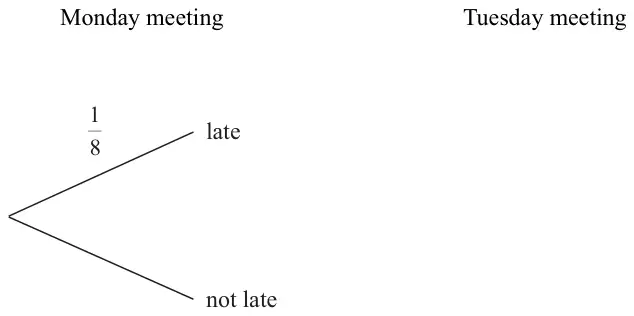
17 Alan has to attend a meeting on Monday and on Tuesday. The probability that he is late for a meeting is \(\dfrac{1}{8}\)
(a) Complete the probability tree diagram.(3)
(b) Calculate the probability that Alan is late for at least one of these meetings. (3)
Mark scheme (a)
Scheme
Marks
\(\frac{7}{8}\) for not late
B1
Correct binary structure
B1
ALL labels and values correct
B1
(3)
Notes
B1: on lower first branch
B1: 4 branches needed on RHS
Apart from questions 5b, 8, 15d, 20b, 21b, 23, 24b (where the mark scheme states otherwise) the correct answer, unless clearly obtained by an incorrect method, should be taken to imply correct working.
Mark scheme (b)
Scheme
Marks
(1/8) × “(7/8)” or “(7/8)” × (1/8) or (1/8) × (1/8)
M1 ft
(1/8) × “(7/8)” + “(7/8)” × (1/8) +(1/8) × (1/8)
M1 ft
\(\dfrac{15}{64}\)
A1
(3)
(Total 6 marks)
Notes
M1 ft: Any 1 “correct” product
M1 ft: 3 “correct” products with intention to add. Only ft probabilities < 1 or M2 for 1 −“\((\frac{7}{8})^2\)”
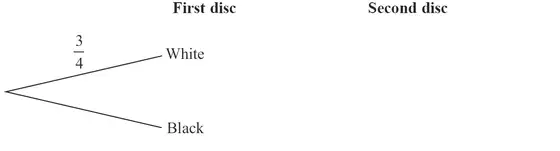
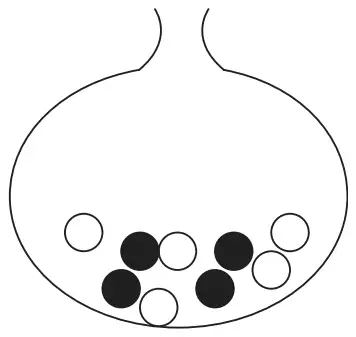
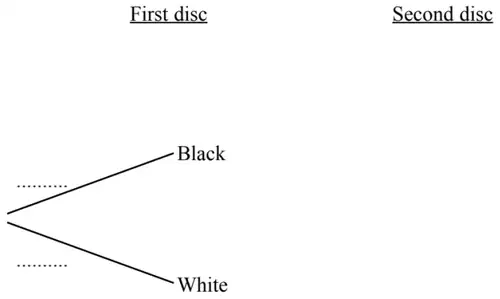
16 A bag contains 3 white discs and 1 black disc. John takes at random 2 discs from the bag without replacement.
(a) Complete the probability tree diagram.(3)
(b) Find the probability that both discs are white. (2)
(c) All the discs are now replaced in the bag. Pradeep takes at random 3 discs from the bag without replacement. Find the probability that the disc left in the bag is white. (3)
Mark scheme (a)
Scheme
Marks
\(\frac{1}{4}\) on Black branch
B1
Correct tree structure
B1
Labels and values correct
B1
(3)
Notes
B1:
Mark scheme (b)
Scheme
Marks
\(\frac{3}{4} \times \frac{2}{3}\)
M1 ft
\(\frac{1}{2}\)
A1
(2)
Notes
M1 ft: Allow ft if ww selected from tree diagram or \(\frac{3}{4} \times \frac{3}{4}\)
A1: cao
Mark scheme (c)
Scheme
Marks
\(\frac{3}{4} \times \frac{2}{3} \times \frac{1}{2}\) or \(\frac{3}{4} \times \frac{1}{3}\) or \(\frac{1}{4}\)
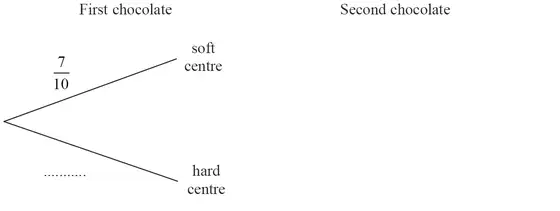
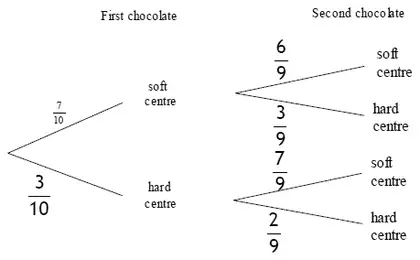
16 There are 10 chocolates in a box. 7 of the chocolates have soft centres and 3 of the chocolates have hard centres. Kyla takes at random a chocolate from the box and eats it. She then takes at random another chocolate from the box and eats it.
(a) Complete the probability tree diagram.(2)
(b) Calculate the probability that at least one of the chocolates Kyla eats has a hard centre. (3)
Mark scheme (a)
Scheme
Marks
Correct tree diagram (as above)
B2
(2)
Notes
B2: for completely correct diagram, inc labels (accept clear abbreviations eg S and H) (B1 for branches with at least 3 correct probabilities in the correct place)
or \(\dfrac{7}{10} \times \dfrac{3}{9} + \dfrac{3}{10}\) \(\left(= \dfrac{21}{90} + \dfrac{3}{10}\right)\)
M1
M1
\(\dfrac{48}{90}\)
A1
(3)
(5 marks)
Notes
M1: for one correct product
M1: for completely correct expression
A1: for \(\frac{48}{90}\) oe inc \(\frac{8}{15}\) or for 0.53 or for answer rounding to 0.53
Alternative: M2 for \(1 - \frac{7}{10} \times \frac{6}{9}\) SC M2 for \(1 - \frac{7}{10} \times \frac{7}{10}\) SC M1 for \(\frac{7}{10} \times \frac{3}{10}\) or \(\frac{3}{10} \times \frac{7}{10}\) or \(\frac{3}{10} \times \frac{3}{10}\); SC M1 (dep) for sum of above products or for \(\frac{7}{10} \times \frac{3}{10} + \frac{3}{10}\) ft for method marks from their tree diagram, provided probabilities \(\lt 1\)
19 The probability that Gill will walk to school on Monday is \(\frac{3}{5}\). If Gill walks to school on Monday, the probability that she will walk to school on Tuesday is \(\frac{1}{6}\). If she does not walk to school on Monday, the probability that she will walk to school on Tuesday is \(\frac{7}{10}\).
(a) Calculate the probability that she walks to school on Monday but not on Tuesday. (2)
(b) Calculate the probability that she walks to school on at least one of the two days. (3)
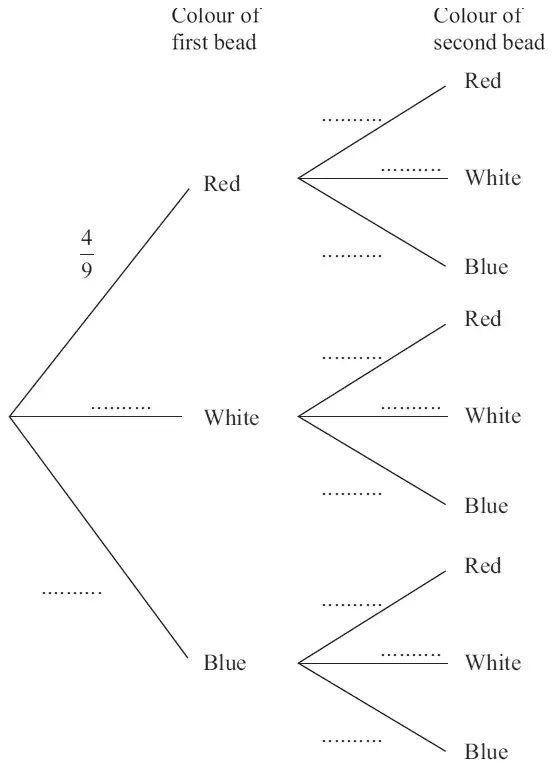
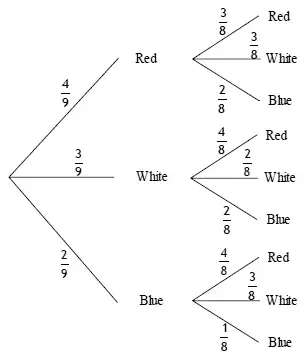
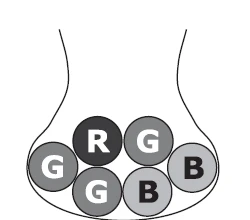
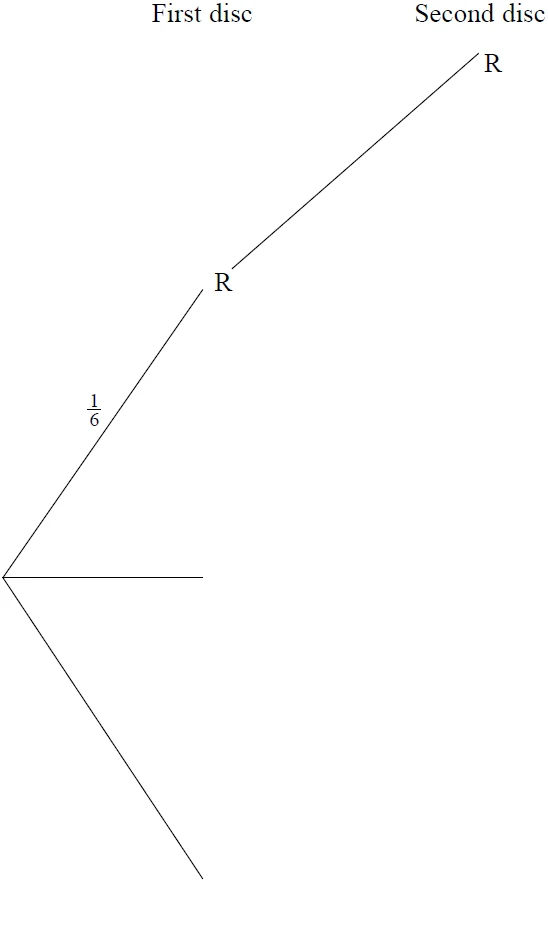
13 A bag contains 1 red disc, 2 blue discs and 3 green discs.
Xanthe chooses a disc at random from the bag. She notes its colour and replaces it. Then Xanthe chooses another disc at random from the bag and notes its colour.
(a) Complete the probability tree diagram showing all the probabilities.
(3)
(b) Calculate the probability that both discs are the same colour. (3)
(c) Calculate the probability that neither disc is red. (2)
Mark scheme (a)
Scheme
Marks
\(\frac{1}{3}\) & \(\frac{1}{2}\) oe
B1
correct structure
B1
all correct
B1
(3)
Notes
B1: correctly placed once
B1: just branches
B1: including probabilities and labels
Mark scheme (b)
Scheme
Marks
\((\frac{1}{6})^2\) or \((\frac{1}{3})^2\) or \((\frac{1}{2})^2\) oe
13 A bag contains 4 black discs and 5 white discs.
Ranjit takes a disc at random from the bag and notes its colour. He then replaces the disc in the bag. Ranjit takes another disc at random from the bag and notes its colour.
(a) Complete the probability tree diagram to show all the possibilities.(4)
(b) Calculate the probability that Ranjit takes two discs of different colours. (3)
Mark scheme (a)
Scheme
Marks
\(\frac{4}{9}\) or \(\frac{5}{9}\) seen
B1
Correct structure
B1
\(\frac{4}{9}\) or \(\frac{5}{9}\) correctly placed once
We'd like to use Google Analytics cookies to count visits and see which pages help most. They're optional, and the site works exactly the same either way. Privacy policy