t-Formulae

From an AS paper

Edexcel

A2 June 2025 Q5

EdexcelCurrent spec8 markst-Formulae

5.

(a) Use the substitution \(t = \tan\left(\dfrac{x}{2}\right)\) to show that\[\int \frac{1}{1 + \operatorname{cosec} x}\,\mathrm{d}x = \int \frac{4t}{\left(1 + t^2\right)\left(1 + t\right)^2}\,\mathrm{d}t\] (3)
(b) Hence show that\[\int \frac{1}{1 + \operatorname{cosec} x}\,\mathrm{d}x = Ax + \frac{B}{1 + \tan\left(\frac{x}{2}\right)} + k\]where \(A\) and \(B\) are constants to be determined and \(k\) is an arbitrary constant. (5)

AS June 2025 Q1

EdexcelAS paperCurrent spec9 markst-Formulae

1.

In this question you must show all stages of your working.

Solutions based entirely on calculator technology are not acceptable.

The surface temperature of the water in a lake during a particular year is modelled by the equation

\[S = 12 - \frac{15}{2}\cos x^\circ - \frac{27}{10}\sin x^\circ \qquad (\text{I})\]

where \(S\) is the temperature in degrees Celsius and \(x\) is the number of days after the start of the year.

(a) Use the model to write down the surface temperature of the water in the lake at the start of the year. (1)

Using the substitution \(t = \tan\left(\dfrac{x}{2}\right)\)

(b) show that equation \((\text{I})\) can be rewritten as\[S = \frac{At^2 + Bt + C}{10(1 + t^2)}\]where \(A\), \(B\) and \(C\) are integers to be determined. (3)
(c) Hence determine, according to the model, the number of days after the start of the year when the surface temperature of the water in the lake is \(10^\circ\mathrm{C}\) for the second time that year. Give your answer to the nearest day. (5)

A2 June 2024 Q7

EdexcelCurrent spec7 markst-Formulae

7.

In this question you must show all stages of your working.

Solutions relying on calculator technology are not acceptable.

(a) Use the substitution \(t = \tan\left(\dfrac{\theta}{2}\right)\) to show that\[\int \frac{1}{2\sin\theta + \cos\theta + 2}\,\mathrm{d}\theta = \int \frac{a}{(t + b)^2 + c}\,\mathrm{d}t\]where \(a\), \(b\) and \(c\) are constants to be determined. (3)
(b) Hence show that\[\int_{\frac{\pi}{2}}^{\frac{2\pi}{3}} \frac{1}{2\sin\theta + \cos\theta + 2}\,\mathrm{d}\theta = \ln\left(\frac{2\sqrt{3}}{3}\right)\] (4)

AS June 2024 Q4

EdexcelAS paperCurrent spec12 markst-Formulae

4.

(a) Given that \(t = \tan\dfrac{x}{2}\) prove that\[\cos x \equiv \frac{1 - t^2}{1 + t^2}\] (3)
(b) Show that the equation\[3\tan x - 10\cos x = 10\]can be written in the form\[(t + 2)(at^2 + bt + c) = 0\]where \(t = \tan\dfrac{x}{2}\) and \(a\), \(b\) and \(c\) are integers to be determined. (4)
(c) Hence solve, for \(-180^\circ \lt x \lt 180^\circ\), the equation\[3\tan x - 10\cos x = 10\] (5)

A2 June 2023 Q5

EdexcelCurrent spec8 markst-Formulae

5.

(a) Show that the substitution \(t = \tan\left(\dfrac{x}{2}\right)\) transforms the integral\[\int \frac{1}{2\sin x - \cos x + 5}\,\mathrm{d}x\]into the integral\[\int \frac{1}{3t^2 + 2t + 2}\,\mathrm{d}t\] (4)
(b) Hence determine\[\int \frac{1}{2\sin x - \cos x + 5}\,\mathrm{d}x\] (4)

AS June 2023 Q2

EdexcelAS paperCurrent spec7 markst-Formulae

2.

(a) Use the substitution \(t = \tan\left(\dfrac{x}{2}\right)\) to show that the equation\[3\cos x - 2\sin x = 1\]can be written in the form\[2t^2 + 2t - 1 = 0\] (3)
(b) Hence solve, for \(-180^\circ \lt x \lt 180^\circ\), the equation\[3\cos x - 2\sin x = 1\]giving your answers to one decimal place. (4)

AS June 2022 Q3

EdexcelAS paperCurrent spec7 markst-Formulae

3.

(a) Use \(t = \tan\dfrac{\theta}{2}\) to show that, where both sides are defined\[\frac{29 - 21\sec\theta}{20 - 21\tan\theta} \equiv \frac{5t + 2}{2t + 5}\] (4)
(b) Hence, again using \(t = \tan\dfrac{\theta}{2}\), prove that, where both sides are defined\[\frac{20 + 21\tan\theta}{29 + 21\sec\theta} \equiv \frac{29 - 21\sec\theta}{20 - 21\tan\theta}\] (3)

A2 June 2022 Q2

EdexcelCurrent spec7 markst-Formulae

2. During 2029, the number of hours of daylight per day in London, \(H\), is modelled by the equation

\[H = 0.3\sin\left(\frac{x}{60}\right) - 4\cos\left(\frac{x}{60}\right) + 11.5 \qquad 0 \leqslant x \lt 365\]

where \(x\) is the number of days after 1st January 2029 and the angle is in radians.

(a) Show that, according to the model, the number of hours of daylight in London on the 31st January 2029 will be 8.13 to 3 significant figures. (1)
(b) Use the substitution \(t = \tan\left(\dfrac{x}{120}\right)\) to show that \(H\) can be written as\[H = \frac{at^2 + bt + c}{1 + t^2}\]where \(a\), \(b\) and \(c\) are constants to be determined. (2)
(c) Hence determine, according to the model, the date of the first day of 2029 when there will be at least 12 hours of daylight in London. (4)

A2 October 2021 Q2

EdexcelCurrent spec10 markst-Formulae

2.

(i) Use the substitution \(t = \tan\dfrac{x}{2}\) to prove the identity\[\frac{\sin x - \cos x + 1}{\sin x + \cos x - 1} \equiv \sec x + \tan x \qquad x \neq \frac{n\pi}{2} \quad n \in \mathbb{Z}\] (5)
(ii) Use the substitution \(t = \tan\dfrac{\theta}{2}\) to determine the exact value of\[\int_0^{\frac{\pi}{2}} \frac{5}{4 + 2\cos\theta}\,\mathrm{d}\theta\]giving your answer in simplest form. (5)

A2 October 2020 Q8

EdexcelCurrent spec16 markst-Formulae

8.

\[\mathrm{f}(x) = \frac{3}{13 + 6\sin x - 5\cos x}\]

Using the substitution \(t = \tan\left(\dfrac{x}{2}\right)\)

(a) show that \(\mathrm{f}(x)\) can be written in the form \[\frac{3(1 + t^2)}{2(3t + 1)^2 + 6}\] (3)
(b) Hence solve, for \(0 \lt x \lt 2\pi\), the equation \[\mathrm{f}(x) = \frac{3}{7}\] giving your answers to 2 decimal places where appropriate. (5)
(c) Use the result of part (a) to show that \[\int_{\frac{\pi}{3}}^{\frac{4\pi}{3}}\mathrm{f}(x)\,\mathrm{d}x = K\left(\arctan\left(\frac{\sqrt{3} - 9}{3}\right) - \arctan\left(\frac{\sqrt{3} + 3}{3}\right) + \pi\right)\] where \(K\) is a constant to be determined. (8)

AS October 2020 Q3

EdexcelAS paperCurrent spec11 markst-Formulae

3.

(i) Use the substitution \(t = \tan\left(\dfrac{x}{2}\right)\) to prove that\[\cot x + \tan\left(\frac{x}{2}\right) = \operatorname{cosec} x \qquad x \neq n\pi,\ n \in \mathbb{Z}\] (2)
(ii)
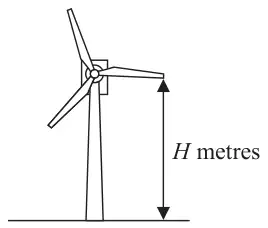
Figure 1: wind turbine on horizontal ground, with the height H metres marked from the ground up to the tip of one blade
Figure 1

An engineer models the vertical height above the ground of the tip of one blade of a wind turbine, shown in Figure 1. The ground is assumed to be horizontal.

The vertical height of the tip of the blade above the ground, \(H\) metres, at time \(x\) seconds after the wind turbine has reached its constant operating speed, is modelled by the equation

\[H = 90 - 30\cos(120x)^\circ - 40\sin(120x)^\circ \qquad (\text{I})\]
(a) Show that \(H = 60\) when \(x = 0\) (1)

Using the substitution \(t = \tan(60x)^\circ\)

(b) show that equation \((\text{I})\) can be rewritten as\[H = \frac{120t^2 - 80t + 60}{1 + t^2}\] (3)
(c) Hence find, according to the model, the value of \(x\) when the tip of the blade is 100 m above the ground for the first time after the wind turbine has reached its constant operating speed. (5)

A2 June 2019 Q5

EdexcelCurrent spec8 markst-Formulae

5.

\[I = \int\frac{1}{4\cos x - 3\sin x}\,\mathrm{d}x \qquad 0 \lt x \lt \frac{\pi}{4}\]

Use the substitution \(t = \tan\left(\dfrac{x}{2}\right)\) to show that

\[I = \frac{1}{5}\ln\left(\frac{2 + \tan\left(\frac{x}{2}\right)}{1 - 2\tan\left(\frac{x}{2}\right)}\right) + k\]

where \(k\) is an arbitrary constant.

(8)

AS June 2019 Q1

EdexcelAS paperCurrent spec9 markst-Formulae

1.

(a) Write down the \(t\)-formula for \(\sin x\). (1)
(b) Use the answer to part (a)
(i) to find the exact value of \(\sin x\) when\[\tan\left(\frac{x}{2}\right) = \sqrt{2}\]
(ii) to show that\[\cos x = \frac{1 - t^2}{1 + t^2}\] (4)
(c) Use the \(t\)-formulae to solve for \(0 \lt \theta \leqslant 360^\circ\)\[7\sin\theta + 9\cos\theta + 3 = 0\]giving your answers to one decimal place. (4)

AS June 2018 Q1

EdexcelAS paperCurrent spec7 markst-Formulae

1.

(a) Use the substitution \(t = \tan\left(\dfrac{x}{2}\right)\) to show that the equation\[5\sin x + 12\cos x = 2\]can be written in the form\[7t^2 - 5t - 5 = 0\] (3)
(b) Hence solve, for \(-180^\circ \lt x \lt 180^\circ\), the equation\[5\sin x + 12\cos x = 2\]giving your answers to one decimal place. (4)