Numerical Methods

From an AS paper

Edexcel

Edexcel · Old spec

AS June 2025 Q2

EdexcelAS paperCurrent spec7 marksNumerical Methods

2. Water is leaking from a hole in the base of a large spherical tank. The depth of water, \(H\) metres, in the tank is modelled by the differential equation

\[3(5H - H^2)\frac{\mathrm{d}H}{\mathrm{d}t} = -4\sqrt{H} \qquad 0 \lt H \lt 5\]

where \(t\) is the time in hours after the leak started.

The depth of water in the tank 10 minutes after the leak started was 2 m.

Use two applications of the approximation formula

\[\left(\frac{\mathrm{d}y}{\mathrm{d}x}\right)_n \approx \frac{(y_{n+1} - y_n)}{h}\]

to estimate the depth of water in the tank, one hour after the leak started.

(7)

A2 June 2025 Q1

EdexcelCurrent spec6 marksNumerical Methods

1.

(a) Given that\[y = \mathrm{e}^{\operatorname{cosec}^2 x}\]complete the table below with the value of \(y\) corresponding to \(x = 2\), giving your answer to 2 decimal places.
\(x\)1.51.7522.252.5
\(y\)2.732.815.2216.31
(1)
(b) Use Simpson’s rule, with all the values of \(y\) in the completed table, to estimate, to one decimal place, the value of\[\int_{1.5}^{2.5} \mathrm{e}^{\operatorname{cosec}^2 x}\,\mathrm{d}x\] (3)
(c) Using your answer to part (b) and making your method clear, estimate the value of\[\int_{1.5}^{2.5} \mathrm{e}^{\cot^2 x}\,\mathrm{d}x\] (2)

AS June 2024 Q2

EdexcelAS paperCurrent spec6 marksNumerical Methods

2. An area of woodland contains a mixture of blue and yellow flowers.

A study found that the proportion, \(x\), of blue flowers in the woodland area satisfies the differential equation

\[\frac{\mathrm{d}x}{\mathrm{d}t} = \frac{xt(0.8 - x)}{x^2 + 5t} \qquad t \gt 0\]

where \(t\) is the number of years since the start of the study.

Given that exactly 3 years after the start of the study half of the flowers in the woodland area were blue,

(a) use one application of the approximation formula \(\left(\dfrac{\mathrm{d}y}{\mathrm{d}x}\right)_n \approx \dfrac{y_{n+1} - y_n}{h}\) to estimate the proportion of blue flowers in the woodland area half a year later. (5)
(b) Deduce from the differential equation the proportion of flowers that will be blue in the long term. (1)

A2 June 2024 Q1

EdexcelCurrent spec5 marksNumerical Methods

1.

(a) Given that\[y = \ln\left(3 + x^2\right)\]complete the table with the value of \(y\) corresponding to \(x = 3\), giving your answer to 4 significant figures.
\(\boldsymbol{x}\)22.533.544.55
\(\boldsymbol{y}\)1.9462.2252.7252.9443.1463.332
(1)

In part (b) you must show all stages of your working.

Solutions relying entirely on calculator technology are not acceptable.

(b) Use Simpson’s rule with all the values of \(y\) in the completed table to estimate, to 3 significant figures, the value of\[\int_2^5 \ln\left(3 + x^2\right)\,\mathrm{d}x\] (3)
(c) Using your answer to part (b) and making your method clear, estimate the value of\[\int_2^5 \ln\sqrt{\left(3 + x^2\right)}\,\mathrm{d}x\] (1)

AS June 2023 Q4

EdexcelAS paperCurrent spec6 marksNumerical Methods

4. A teacher made a cup of coffee. The temperature \(\theta^\circ\mathrm{C}\) of the coffee, \(t\) minutes after it was made, is modelled by the differential equation

\[\frac{\mathrm{d}\theta}{\mathrm{d}t} + 0.05(\theta - 20) = 0\]

Given that

  • the initial temperature of the coffee was \(95^\circ\mathrm{C}\)
  • the coffee can only be safely drunk when its temperature is below \(70^\circ\mathrm{C}\)
  • the teacher made the cup of coffee at 1.15 pm
  • the teacher needs to be able to start drinking the coffee by 1.20 pm

use two iterations of the approximation formula

\[\left(\frac{\mathrm{d}y}{\mathrm{d}x}\right)_n \approx \frac{y_{n+1} - y_n}{h}\]

to estimate whether the teacher will be able to start drinking the coffee at 1.20 pm.

(6)

A2 June 2023 Q1

EdexcelCurrent spec5 marksNumerical Methods

1.

(a) Use Simpson’s rule with 4 intervals to find an estimate for\[\int_0^2 \mathrm{e}^{\sin^2 x}\,\mathrm{d}x\]Give your answer to 3 significant figures. (4)

Given that \(\displaystyle \int_0^2 \mathrm{e}^{\sin^2 x}\,\mathrm{d}x = 3.855\) to 4 significant figures,

(b) comment on the accuracy of your answer to part (a). (1)

A2 June 2022 Q4

EdexcelCurrent spec6 marksNumerical Methods

4. The velocity \(v\,\mathrm{m\,s^{-1}}\), of a raindrop, \(t\) seconds after it falls from a cloud, is modelled by the differential equation

\[\frac{\mathrm{d}v}{\mathrm{d}t} = -0.1v^2 + 10 \qquad t \geqslant 0\]

Initially the raindrop is at rest.

(a) Use two iterations of the approximation formula \(\left(\dfrac{\mathrm{d}y}{\mathrm{d}x}\right)_n \approx \dfrac{y_{n+1} - y_n}{h}\) to estimate the velocity of the raindrop 1 second after it falls from the cloud. (5)

Given that the initial acceleration of the raindrop is found to be smaller than is suggested by the current model,

(b) refine the model by changing the value of one constant. (1)

AS June 2022 Q2

EdexcelAS paperCurrent spec7 marksNumerical Methods

2. A population of deer was introduced onto an island.

The number of deer, \(P\), on the island at time \(t\) years following their introduction is modelled by the differential equation

\[\frac{\mathrm{d}P}{\mathrm{d}t} = \frac{P}{5000}\left(1000 - \frac{P(t + 1)}{6t + 5}\right) \qquad t \gt 0\]

It was estimated that there were 540 deer on the island six months after they were introduced.

Use two applications of the approximation formula \(\left(\dfrac{\mathrm{d}y}{\mathrm{d}x}\right)_n \approx \dfrac{y_{n+1} - y_n}{h}\) to estimate the number of deer on the island 10 months after they were introduced.

(7)

A2 October 2021 Q8

EdexcelCurrent spec17 marksDifferential EquationsNumerical Methods

8. A community is concerned about the rising level of pollutant in its local pond and applies a chemical treatment to stop the increase of pollutant.

The concentration, \(x\) parts per million (ppm), of the pollutant in the pond water \(t\) days after the chemical treatment was applied, is modelled by the differential equation

\[\frac{\mathrm{d}x}{\mathrm{d}t} = \frac{3 + \cosh t}{3x^2\cosh t} - \frac{1}{3}x\tanh t \qquad \text{(I)}\]

When the chemical treatment was applied the concentration of pollutant was 3 ppm.

(a) Use the iteration formula\[\left(\frac{\mathrm{d}y}{\mathrm{d}x}\right)_n \approx \frac{(y_{n+1} - y_n)}{h}\]once to estimate the concentration of the pollutant in the pond water 6 hours after the chemical treatment was applied. (4)
(b) Show that the transformation \(u = x^3\) transforms the differential equation (I) into the differential equation\[\frac{\mathrm{d}u}{\mathrm{d}t} + u\tanh t = 1 + \frac{3}{\cosh t} \qquad \text{(II)}\] (3)
(c) Determine the general solution of equation (II) (4)
(d) Hence find an equation for the concentration of pollutant in the pond water \(t\) days after the chemical treatment was applied. (3)
(e) Find the percentage error of the estimate found in part (a) compared to the value predicted by the model, stating if it is an overestimate or an underestimate. (3)

A2 October 2020 Q2

EdexcelCurrent spec6 marksNumerical Methods

2.

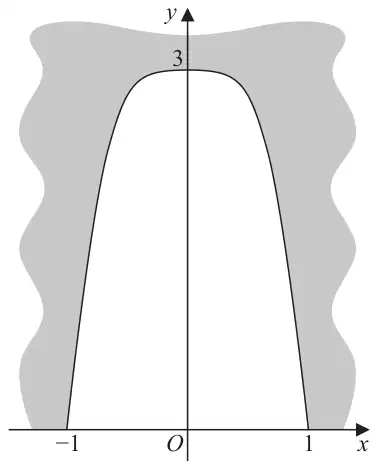
Sketch of the tunnel entrance cross-section: an arch-shaped curve from x = -1 to x = 1 with maximum height 3 on the y-axis, set in shaded rock
Figure 1

Figure 1 shows a sketch of the vertical cross-section of the entrance to a tunnel. The width at the base of the tunnel entrance is 2 metres and its maximum height is 3 metres.

The shape of the cross-section can be modelled by the curve with equation \(y = \mathrm{f}(x)\) where

\[\mathrm{f}(x) = 3\cos\left(\frac{\pi}{2}x^2\right) \qquad x \in [-1, 1]\]

A wooden door of uniform thickness 85 mm is to be made to seal the tunnel entrance.

Use Simpson’s rule with 6 intervals to estimate the volume of wood required for this door, giving your answer in m3 to 4 significant figures.

(6)

AS October 2020 Q1

EdexcelAS paperCurrent spec7 marksNumerical Methods

1. The variables \(x\) and \(y\) satisfy the differential equation

\[\frac{\mathrm{d}^2y}{\mathrm{d}x^2} = 2y^2 - x - 1\]

where \(\dfrac{\mathrm{d}y}{\mathrm{d}x} = 3\) and \(y = 0\) at \(x = 0\)

Use the approximations

\[\left(\frac{\mathrm{d}^2y}{\mathrm{d}x^2}\right)_n \approx \frac{(y_{n+1} - 2y_n + y_{n-1})}{h^2} \quad \text{and} \quad \left(\frac{\mathrm{d}y}{\mathrm{d}x}\right)_n \approx \frac{(y_{n+1} - y_{n-1})}{2h}\]

with \(h = 0.1\) to find an estimate for the value of \(y\) at \(x = 0.2\)

(7)

AS June 2019 Q3

EdexcelAS paperCurrent spec7 marksNumerical Methods

3. Julie decides to start a business breeding rabbits to sell as pets.

Initially she buys 20 rabbits. After \(t\) years the number of rabbits, \(R\), is modelled by the differential equation

\[\frac{\mathrm{d}R}{\mathrm{d}t} = 2R + 4\sin t \qquad t \gt 0\]

Julie needs to have at least 40 rabbits before she can start to sell them.

Use two iterations of the approximation formula

\[\left(\frac{\mathrm{d}y}{\mathrm{d}x}\right)_n \approx \frac{y_{n+1} - y_n}{h}\]

to find out if, according to the model, Julie will be able to start selling rabbits after 4 months.

(7)

A2 June 2019 Q1

EdexcelCurrent spec5 marksNumerical Methods

1. Use Simpson’s rule with 4 intervals to estimate

\[\int_{0.4}^{2}\mathrm{e}^{x^2}\,\mathrm{d}x\]

(5)

AS June 2018 Q2

EdexcelAS paperCurrent spec7 marksNumerical Methods

2. The temperature, \(\theta^\circ\mathrm{C}\), of coffee in a cup, \(t\) minutes after the cup of coffee is put in a room, is modelled by the differential equation

\[\frac{\mathrm{d}\theta}{\mathrm{d}t} = -k(\theta - 20)\]

where \(k\) is a constant.

The coffee has an initial temperature of \(80^\circ\mathrm{C}\)

Using \(k = 0.1\)

(a) use two iterations of the approximation formula \(\left(\dfrac{\mathrm{d}y}{\mathrm{d}x}\right)_0 = \dfrac{y_1 - y_0}{h}\) to estimate the temperature of the coffee 3 minutes after it was put in the room. (6)

The coffee in a different cup, which also had an initial temperature of \(80^\circ\mathrm{C}\) when it was put in the room, cools more slowly.

(b) Use this information to suggest how the value of \(k\) would need to be changed in the model. (1)

FP2 June 2007 Q9

EdexcelOld spec5 marksNumerical Methods

9. \[\frac{\mathrm{d}y}{\mathrm{d}x} = y\mathrm{e}^{x^2}.\]

It is given that \(y = 0.2\) at \(x = 0\).

(a) Use the approximation \(\dfrac{y_1 - y_0}{h} \approx \left(\dfrac{\mathrm{d}y}{\mathrm{d}x}\right)_0\), with \(h = 0.1\), to obtain an estimate of the value of \(y\) at \(x = 0.1\). (2)
(b) Use your answer to part (a) and the approximation \(\dfrac{y_2 - y_0}{2h} \approx \left(\dfrac{\mathrm{d}y}{\mathrm{d}x}\right)_1\), with \(h = 0.1\), to obtain an estimate of the value of \(y\) at \(x = 0.2\).
Gives your answer to 4 decimal places. (3)