
MOG 2017 Q1
All the digits 1 to 9 are to be placed in the circles in Figure 1, one in each, so that the total of the numbers in any line of four circles is the same. In the example shown in Figure 2, the total is equal to 20.
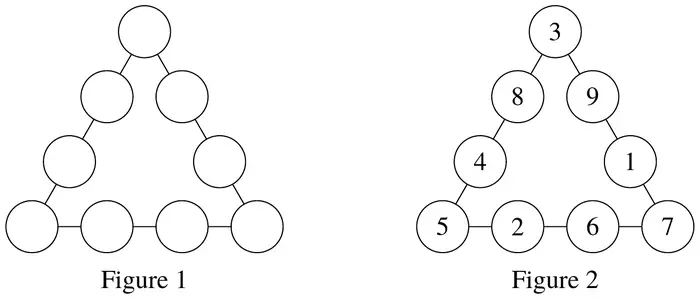
Prove that if the total \(T\) is possible then the total \(40 - T\) is possible.
Mathematical Olympiad for Girls 2017, Question 1. © UK Mathematics Trust. Original paper on ukmt.org.uk
Commentary
A sensible way to start is to try and create different totals. For example, try filling in the numbers so that the total on each line is 23; then try to make 17. This may lead you to spot a connection between the two configurations.
It is natural to ask which totals \(T\) are possible. That question can be answered (see the note after the solution), but it turns out that the answer is not needed to solve the actual problem.
The key is to look for a connection between a configuration with total \(T\) and one with total \(40 - T\). Since there are four numbers in each line, if each number \(d\) is replaced by \(10 - d\), the total of the four numbers in each line will change from \(T\) to \(40 - T\). It is important to check that this new configuration satisfies the conditions of the problem: that all the digits are different and each one is still between 1 and 9. (Even if this seems obvious, you should mention in your solution that you have checked it.)
Consider a numbering in which the total is \(T\). In each circle replace the number \(d\) with the number \(10 - d\). The digits 1 to 9 will still all be used once each, and now each line has total \(40 - T\).
Note
You can find which totals are possible by considering the sum of all nine numbers: \(1 + 2 + \dots + 9 = 45\). This should equal \(3T\) minus the sum of three corner numbers which are counted twice.
Denote the corner numbers \(a\), \(b\) and \(c\). Then\[3T - (a + b + c) = 45 \implies 3T = 45 + (a + b + c).\]Since \(a\), \(b\) and \(c\) are all different numbers between 1 and 9, the smallest and largest possible values of \(a + b + c\) are 6 and 24, respectively. This means that \(17 \le T \le 23\).
The question given an example with \(T = 20\). Try to construct examples with \(T = 17\) and \(T = 19\). You can then use the method described in the solution to find examples with \(T = 23\) and \(T = 21\).
To get \(T = 18\) we need \(a + b + c = 9 = 1 + 2 + 6 = 1 + 3 + 5 = 2 + 3 + 4\). For each of those options there are only a few possibilities to check, and none of them give a valid configuration. So \(T = 18\) is not possible. It follows that \(T = 22\) is not possible either.
In conclusion, the only possible totals are 17, 19, 20, 21 and 23.
Solution © UK Mathematics Trust, from the MOG 2017 solutions.