
Hamilton 2020 Q5
5. In the diagram, \(ABCD\) is a parallelogram, \(M\) is the midpoint of \(AB\) and \(X\) is the point of intersection of \(AC\) and \(MD\).
What is the ratio of the area of \(MBCX\) to the area of \(ABCD\)?
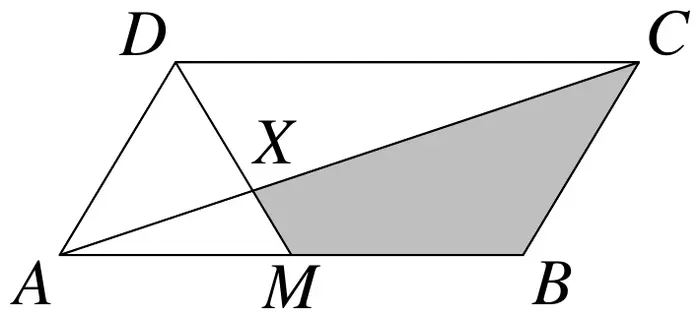
Hamilton Olympiad 2020, Question 5. © UK Mathematics Trust. Original paper on ukmt.org.uk
Answer: \(5 : 12\)
Solution 1
Say that the area of triangle \(XAM\) is 1 square unit. Note that \(\angle XMA = \angle XDC\) and \(\angle XAM = \angle XCD\) (since they are alternate angles between parallel lines), so triangles \(XCD\) and \(XAM\) are similar. Since \(DC = 2AM\), the area of \(XCD\) is \(1 \times 2^2 = 4\) square units.
Say the area of triangle \(DAX\) is \(x\) square units. Then, since the area of \(ACD\) is twice the area of \(AMD\) (they are triangles with equal heights and one base half that of the other), we have \(2 \times (1 + x) = 4 + x\), which gives \(x = 2\) square units.
The area of \(ABCD\) is twice that of \(ACD\), which is 12 square units.
The area of \(MBCX\) is \(12 - (4 + 2 + 1) = 5\) square units.
So the desired ratio is 5:12.
Solution 2
Note that \(\angle XMA = \angle XDC\) and \(\angle XAM = \angle XCD\) (since they are alternate angles between parallel lines), so triangles \(XCD\) and \(XAM\) are similar. Since \(DC = 2AM\), the perpendicular from \(DC\) to \(X\) is twice the perpendicular from \(AM\) to \(X\).
Hence the perpendicular height of the triangle \(AMX\) is one third of the perpendicular height of the parallelogram. Hence the area of \(AMX\) is \(\tfrac{1}{2} \times \tfrac{1}{2} \times \tfrac{1}{3} = \tfrac{1}{12}\) of the area of the parallelogram.
The area of triangle \(ABC\) is clearly half of the area of the parallelogram, so the area of \(MBCX\) is \(\tfrac{1}{2} - \tfrac{1}{12} = \tfrac{5}{12}\) of the area of the whole parallelogram.
Hence the desired ratio is 5:12.
Solution © UK Mathematics Trust, from the Hamilton Olympiad 2020 solutions.