
Hamilton 2019 Q6
6. Nine dots are arranged in the \(2 \times 2\) square grid shown. The arrow points north.
Harry and Victoria take it in turns to draw a unit line segment to join two dots in the grid.
Harry is only allowed to draw an east-west line segment, and Victoria is only allowed to draw a north-south line segment. Harry goes first.
A point is scored when a player draws a line segment that completes a \(1 \times 1\) square on the grid.
Can either player force a win, no matter how the other person plays?
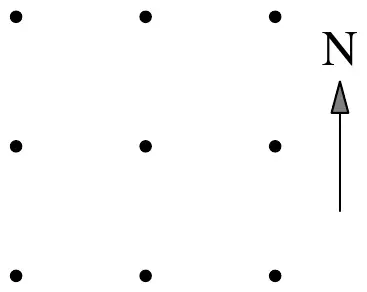
Hamilton Olympiad 2019, Question 6. © UK Mathematics Trust. Original paper on ukmt.org.uk
Answer: Yes, Victoria can force a win
Victoria can force a win, by adopting the following strategy.
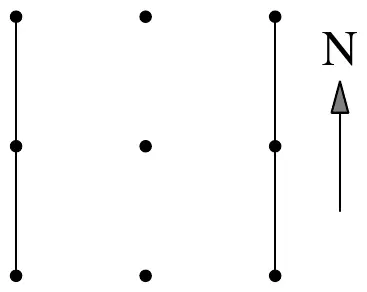
She plays her first four moves on the sides of the grid, as shown alongside (where only Victoria’s moves are shown).
Victoria then plays to complete \(1 \times 1\) squares.
Why does this strategy work?
If Victoria plays in this way, then Harry is unable to score with his first five moves (since there are no squares with their two north-south edges drawn whenever he plays, so he cannot possibly draw the fourth edge of a square).
After Harry has played for the fifth time, he will have drawn both east-west edges of at least one of the \(1 \times 1\) squares. Victoria can then draw one of the central two north-south lines to complete at least one square and so score.
When Harry plays his sixth (and final) move, he has no choice where to play. This move may complete a square and win Harry a point (but cannot complete more than one, since one of the central north-south lines remains undrawn so there are two squares which Harry cannot possibly complete yet).
Once Harry has drawn his final segment, there are two adjacent \(1 \times 1\) squares which share a common undrawn edge, and all other squares have been completed. On her sixth move, therefore, Victoria can draw the final remaining undrawn line segment, completing these final two squares.
Since Harry has scored at most one point and Victoria has scored on two separate occasions, her points total is higher than his, and so she wins.
NoteThere are two possible ways to interpret the scoring, depending on whether one or two points are awarded for completing two \(1 \times 1\) squares in the same move. The strategy we give works in either case.
Solution © UK Mathematics Trust, from the Hamilton Olympiad 2019 solutions.