
Hamilton 2019 Q3
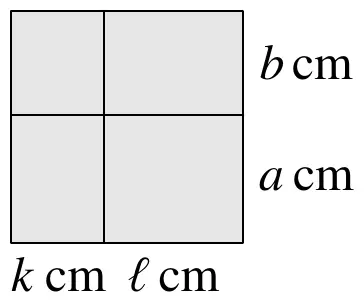
3. A 4 cm × 4 cm square is split into four rectangular regions using two line segments parallel to the sides.
How many ways are there to do this so that each region has an area equal to an integer number of square centimetres?
Hamilton Olympiad 2019, Question 3. © UK Mathematics Trust. Original paper on ukmt.org.uk
Answer: 17
Let the lengths of the sides of the regions be \(k\) cm, \(\ell\) cm, \(a\) cm and \(b\) cm, as shown. We know that each of these is less than 4 cm.
Then the regions have areas \(ka\) cm2, \(kb\) cm2, \(\ell a\) cm2 and \(\ell b\) cm2 respectively, and thus each of \(ka\), \(kb\), \(\ell a\) and \(\ell b\) is an integer.
Hence \(ka + kb = k(a + b) = 4k\) is an integer, so that \(k\) is an integer multiple of \(\tfrac{1}{4}\). Similarly, each of \(\ell\), \(a\) and \(b\) is an integer multiple of \(\tfrac{1}{4}\).
However, none of \(k\), \(\ell\), \(a\) and \(b\) is an integer multiple of 4, because each is between 0 and 4. Hence each of them has to be an integer multiple of \(\tfrac{1}{2}\) in order that each of \(ka\), \(kb\), \(\ell a\) and \(\ell b\) is an integer.
If both \(\boldsymbol{a}\) and \(\boldsymbol{k}\) are integers
If one of \(\boldsymbol{a}\) or \(\boldsymbol{k}\) is not an integer (that is, an odd multiple of \(\boldsymbol{\tfrac{1}{2}}\))
Note that once \(a\) and \(k\) have been chosen, then these determine \(b\) and \(\ell\) uniquely.
Thus altogether there are \(9 + 4 + 4 = 17\) ways.
NoteIf the grid can be rotated or reflected, so that, for example, \(a = 1\) is counted as being the same as \(k = 1\) or \(a = 3\), then there are 5 ways, given by the following pairs of values of \((a, k)\) or \((k, a)\):
as shown below.

Solution © UK Mathematics Trust, from the Hamilton Olympiad 2019 solutions.