
Hamilton 2018 Q6
6. The figure shows seven circles joined by three straight lines.
The numbers 9, 12, 18, 24, 36, 48 and 96 are to be placed into the circles, one in each, so that the product of the three numbers on each of the three lines is the same.
Which of the numbers could go in the centre?
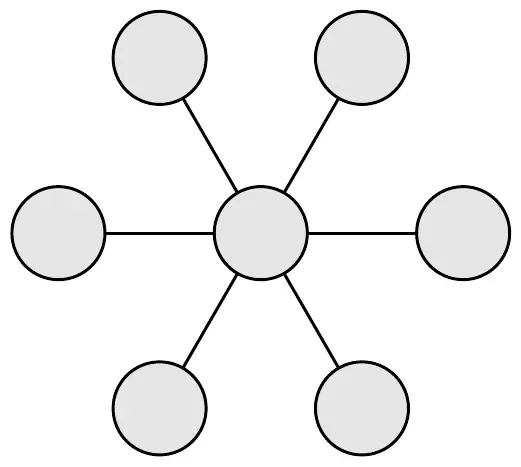
Hamilton Olympiad 2018, Question 6. © UK Mathematics Trust. Original paper on ukmt.org.uk
Answer: 12 or 96
Comment
It is possible to argue that, once the centre number has been selected, the other six must be paired ‘largest with smallest’ etc. – but a complete convincing argument can be difficult to assemble. The method below demonstrates an alternative way (which was chosen by the majority of successful candidates) to show the only possible solutions.
It is worth remembering that showing that 12 and 96 are the only centre numbers that could possibly work does not fully answer the question – we must show that arrangements are indeed possible (and this is easily done by direct construction).
Solution
Since we are interested in the products of various numbers, it seems natural to find the prime factorisations of the seven numbers we are given:
| Number | 9 | 12 | 18 | 24 | 36 | 48 | 96 |
| Prime Factorisation | \(3^2\) | \(2^2 \times 3\) | \(2 \times 3^2\) | \(2^3 \times 3\) | \(2^2 \times 3^2\) | \(2^4 \times 3\) | \(2^5 \times 3\) |
Let the six numbers around the edge of the figure be \(a\), \(b\), \(c\), \(d\), \(e\) and \(f\), and the central number \(x\) (as in the diagram below).
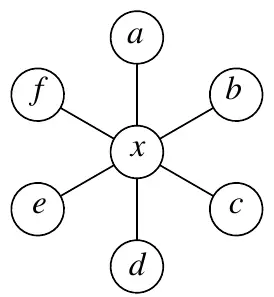
Then we need \(a \times x \times d = b \times x \times e = c \times x \times f\). Since \(x \neq 0\), we can divide by \(x\), giving \(ad = be = cf\).
Now consider the number \(abcdef\). This must be a cube (since it is equal to, for example, \((ad)^3\)). This number can also be written as \(\dfrac{abcdefx}{x}\), which is useful since \(abcdefx\) is just the product of the seven numbers we have been given. Hence \(abcdef = \dfrac{2^{17} \times 3^{10}}{x}\), and, if we write \(x\) as \(2^m \times 3^n\), we have \(abcdef = 2^{17 - m} \times 3^{10 - n}\).
Note that, since \(x\) must be one of the given numbers, there are only a few possible values for \(m\) and \(n\); in particular \(m \leqslant 5\) and \(n \leqslant 2\).
Since \(abcdef\) is a cube, \(2^{17 - m}\) and \(3^{10 - n}\) must both be cubes too, which means that both \(17 - m\) and \(10 - n\) must be multiples of 3. Hence \(m\) could be equal to 2 or 5, and \(n\) must be equal to 1.
Hence \((m, n) = (2,\ 1)\) which gives \(x = 12\), or \((m, n) = (5,\ 1)\) which gives \(x = 96\).
As mentioned in the comment above, we must now check that each of these cases enables the shape to be filled as required by the question:
When \(x = 12\), we have \(abcdef = 2^{15} \times 3^9\), so each pair of outside numbers must multiply to \(2^5 \times 3^3\).
When \(x = 96\), we have \(abcdef = 2^{12} \times 3^9\), so each pair of outside numbers must multiply to \(2^4 \times 3^3\).
In each case, a small amount of experimentation quickly leads to arrangements that work in each case, such as:
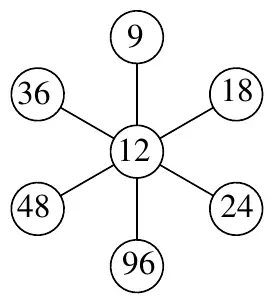
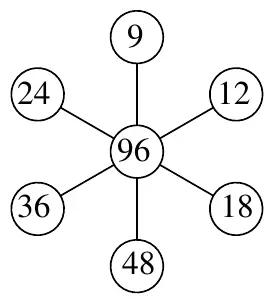
Hence both cases are possible and there are two numbers that could go in the centre space; namely 12 and 96.
Solution © UK Mathematics Trust, from the Hamilton Olympiad 2018 solutions.