
Hamilton 2018 Q4
4. The diagram shows a circle and a trapezium \(ABCD\) in which \(AD\) is parallel to \(BC\) and \(AB = DC\). All four sides of \(ABCD\) are tangents of the circle. The circle has radius 4 and the area of \(ABCD\) is 72.
What is the length of \(AB\)?
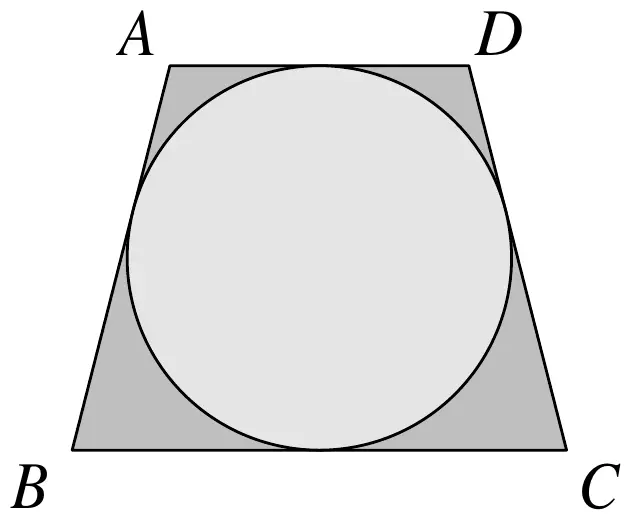
Hamilton Olympiad 2018, Question 4. © UK Mathematics Trust. Original paper on ukmt.org.uk
Answer: 9
Comment
The solution to this question is dependent on the circle theorem which states that the two tangents to a circle from any external point are equal in length. The proof of this is straightforward (join the point to the centre of the circle and find two triangles which are congruent) − if you haven't seen it before you may want to work it through to satisfy yourself that it is indeed true.
Solution
Note that the height of the trapezium is equal to the diameter of the circle = 8.
Since the area of the trapezium is 72, we have \(\dfrac{AD + BC}{2} \times 8 = 72\) and so \(AD + BC = 18\).
Let \(E\), \(F\), \(G\) and \(H\) be the points on \(AB\), \(BC\), \(CD\) and \(DA\) respectively where the circle is tangent to the sides of the trapezium, as shown in the diagram below.
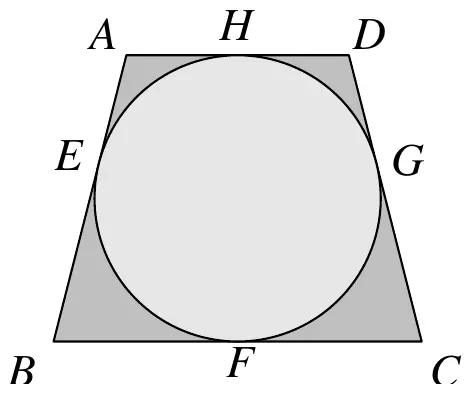
Since the two tangents to a circle from any external point are equal in length, we know that \(AE = AH\).
Similarly, \(BE = BF\), \(CF = CG\) and \(DG = DH\).
Then \(AB + DC = (AE + BE) + (CG + DG) = AH + BF + CF + DH = AD + BC\), which we know is equal to 18.
Since \(AB = DC\), we have \(AB + DC = 2AB = 18\) and hence \(AB = 9\).
Solution © UK Mathematics Trust, from the Hamilton Olympiad 2018 solutions.