
JMO 2016 B5
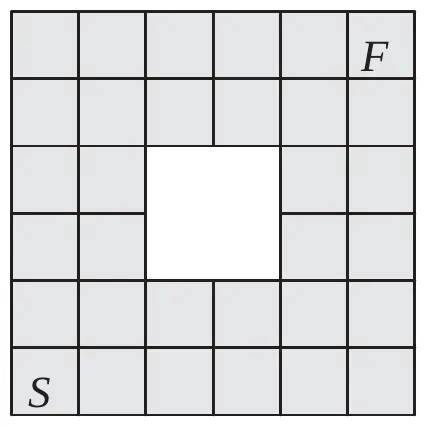
B5. The board shown has 32 cells, one of which is labelled \(S\) and another
\(F\). The shortest path starting at \(S\) and finishing at \(F\) involves exactly
nine other cells and ten moves, where each move goes from cell to
cell ‘horizontally’ or ‘vertically’ across an edge.
How many paths of this length are there from \(S\) to \(F\)?
Junior Mathematical Olympiad 2016, Question B5. © UK Mathematics Trust. Original paper on ukmt.org.uk
Answer: 52
From \(S\), there are two starting paths: 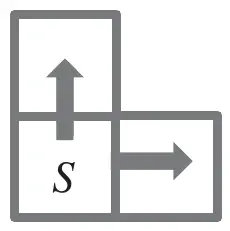 and we can represent the number of paths to reach a square like this:
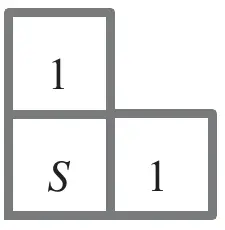 .
There is only one way to travel along the edges and we can build up our diagram like this, noticing that each square not on an edge can only be reached from the left or from below 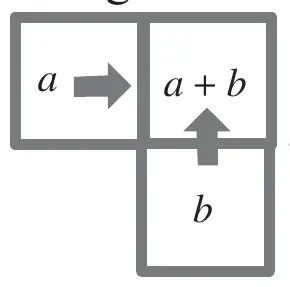 .
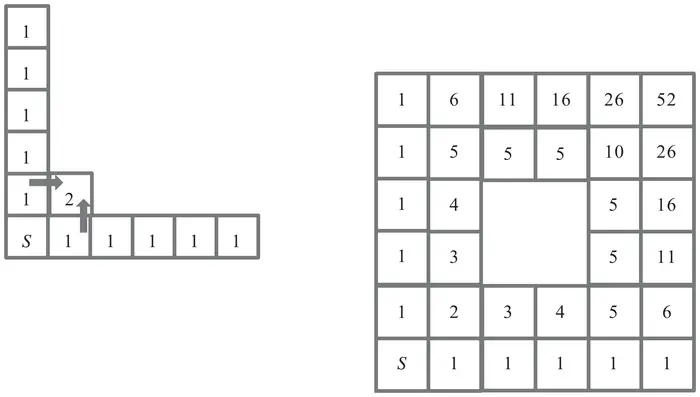
Since \(F\) is 5 steps above and 5 steps to the right of \(S\), each of the 10 moves can only be upwards or to the right and so there are 52 paths from \(S\) to \(F\).
Solution © UK Mathematics Trust, from the JMO 2016 solutions.