
JMO 2015 B5
B5. I have two types of square tile. One type has a side length of 1 cm and the other has a side length of 2 cm.
What is the smallest square that can be made with equal numbers of each type of tile?
Junior Mathematical Olympiad 2015, Question B5. © UK Mathematics Trust. Original paper on ukmt.org.uk
Answer: 10 cm × 10 cm
Each of the 1 cm tiles has area 1 cm2 and each of the 2 cm tiles has area 4 cm2. Suppose there are \(n\) tiles of each type. Then the assembled square must have area \(5n\) cm2 and \(5n\) must be a square number.
The smallest \(n\) could be is 5. This would require the tiles to fit together to form a 5 cm × 5 cm square. However the first four 2 cm tiles are placed in a 5 cm square, the fifth 2 cm tile cannot be placed in the remaining space. So \(n\) cannot be 5.
The next smallest \(n\) for which \(5n\) is a square is 20. This would require the tiles to fit together to form a 10 cm × 10 cm square. This arrangement is possible; an example is shown below. Hence the smallest square that can be made is a 10 cm × 10 cm square.
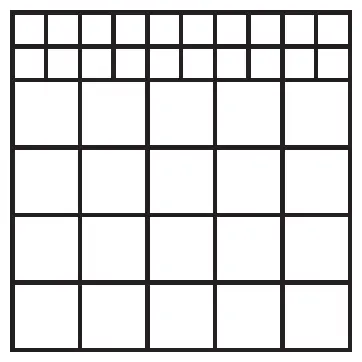
Solution © UK Mathematics Trust, from the JMO 2015 solutions.