
JMO 2015 B3
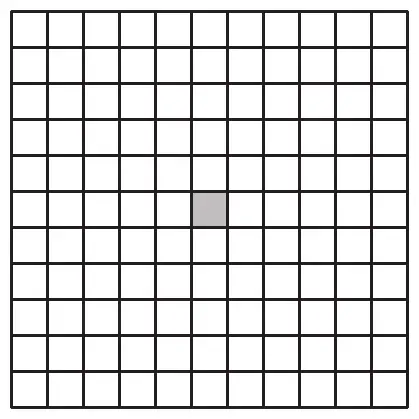
B3. Jack starts in the small square shown shaded on the
grid, and makes a sequence of moves. Each move is to
a neighbouring small square, where two small squares
are neighbouring if they have an edge in common. He
may visit a square more than once.
Jack makes four moves. In how many different small
squares could Jack finish?
Junior Mathematical Olympiad 2015, Question B3. © UK Mathematics Trust. Original paper on ukmt.org.uk
Answer: 25
Let the starting square be labelled (0, 0) and the square to the right of the starting square be labelled (1, 0), and so on for the remaining squares in the grid.
Each move may be represented by (+1, +0), (+0, +1), (−1, +0) or (+0, −1) where, for example, (+1, +0) represents a move of one square to the right and (+0, −1) represents a move of one square downwards.
Each move increases or decreases the sum of the coordinates of the occupied square by 1. At (0, 0) the sum of the coordinates is 0. After one move, the sum of the coordinates must be 1 or −1. So after two moves the sum of the coordinates is 2, 0 or −2. After three moves, the sum of the coordinates of the occupied square is 3, 1, −1 or −3. Finally, after the fourth move, the sum of the coordinates of the occupied square is 4, 2, 0, −2, or −4.
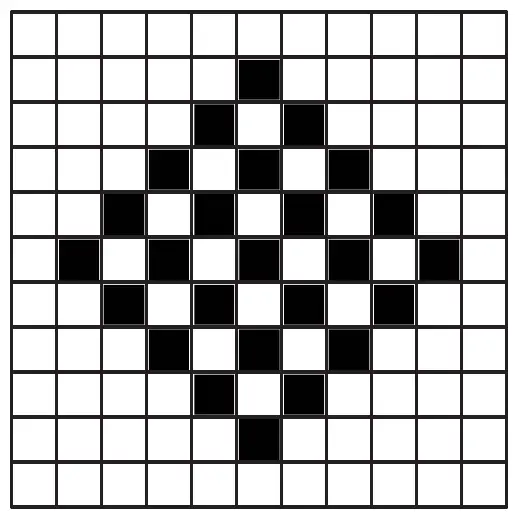
This means the sequence of four moves can end at any one of the 25 squares shown in black.
Solution © UK Mathematics Trust, from the JMO 2015 solutions.