
Maclaurin 2019 Q4
4. The diagram shows the two squares \(BCDE\) and \(FGHI\) inside the triangle \(ABJ\), where \(E\) is the midpoint of \(AB\) and \(C\) is the midpoint of \(FG\).
What is the ratio of the area of the square \(BCDE\) to the area of the triangle \(ABJ\)?
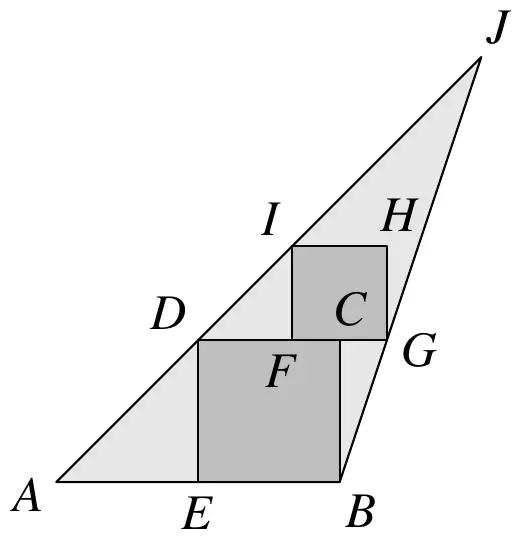
Maclaurin Olympiad 2019, Question 4. © UK Mathematics Trust. Original paper on ukmt.org.uk
Answer: 1 : 3
Let \(K\) be the foot of the perpendicular from \(J\) to \(AB\) produced, as shown alongside.
Since \(E\) is the midpoint of \(AB\), we have \(AE = EB = ED\) and so \(\angle DAE = \angle JAK = 45^\circ\).
Let \(FG = 2y\) and \(BK = x\). Then \(FC = CG = y\), \(DF = FI = 2y\) and \(DC = BC = 3y\).
Triangles \(GCB\) and \(BKJ\) are similar, since their angles are equal.
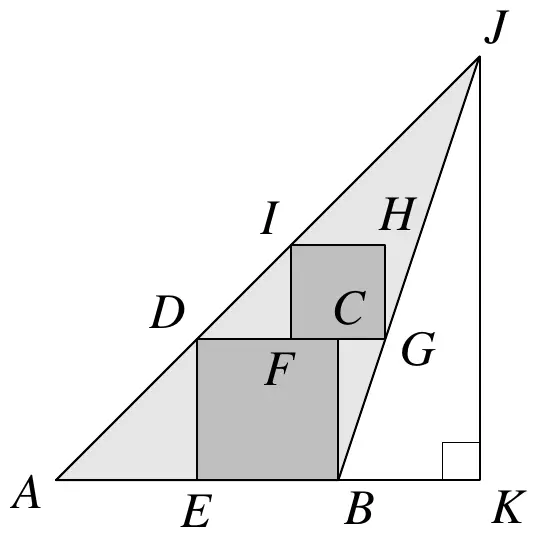
Hence \(\dfrac{JK}{KB} = \dfrac{CB}{CG} = 3\) and so \(JK = 3x\).
But \(JK = AK = 6y + x\). It follows that \(3x = 6y + x\) and so \(x = 3y\).
The area of \(BCDE\) is \(9y^2\) and that of \(ABJ\) is \(27y^2\), so the required ratio is \(1 : 3\).
Solution © UK Mathematics Trust, from the Maclaurin Olympiad 2019 solutions.