
PK 2020 Q25
25. A zig-zag line starts at the point \(P\), at one end of the diameter \(PQ\) of a circle. Each of the angles between the zig-zag line and the diameter \(PQ\) is equal to \(\alpha\) as shown. After four peaks, the zig-zag line ends at the point \(Q\). What is the size of angle \(\alpha\)?
- A 60°
- B 72°
- C 75°
- D 80°
- E 86°
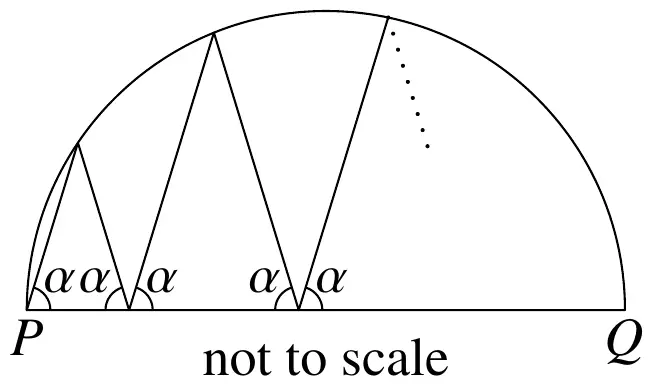
Pink Kangaroo 2020, Question 25. © UK Mathematics Trust. Original paper on ukmt.org.uk
Answer: B 72°
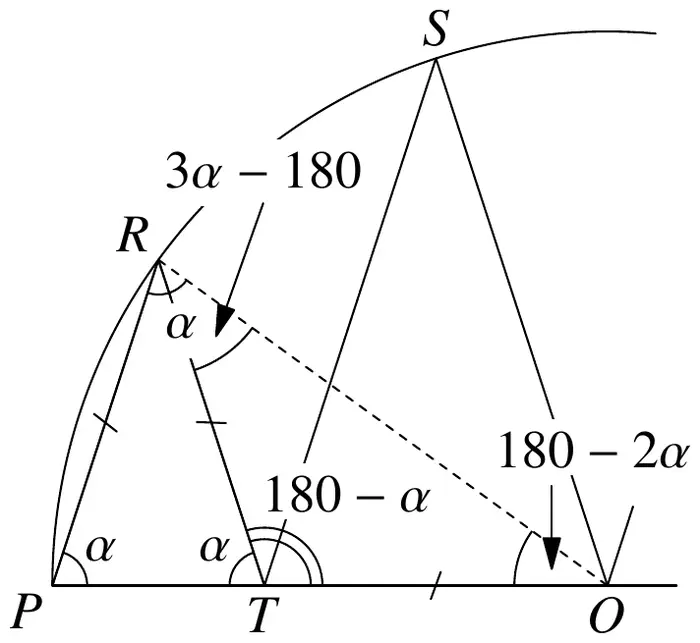
After four peaks the zig-zag is at the end of the diameter, so after two peaks it must be at the centre \(O\) of the circle. The triangle \(OPR\) is isosceles since \(OP\) and \(OR\) are both radii, hence angle \(PRO = \alpha\) and angle \(POR = 180° - 2\alpha\). Angle \(OTR = 180° - \alpha\) (angles on a straight line), and hence angle \(TRO = 3\alpha - 180°\) (angles in triangle \(TRO\)).
Triangle \(OTS\) is isosceles because its base angles are equal, and hence \(ST = SO\). Therefore triangles \(OPR\) and \(OTS\) are congruent because they both have two sides which equal the radius of the circle, with angle \(180° - 2\alpha\) between (SAS). Hence \(OT = PR = TR\) (since \(PR = RT\) in isosceles triangle \(PRT\)). Hence triangle \(OTR\) is isosceles, and its base angles are equal, that is \(180° - 2\alpha = 3\alpha - 180°\). Solving this gives \(\alpha = 72°\).
Solution © UK Mathematics Trust, from the PK 2020 solutions.