
PK 2019 Q18
18. A square has two of its vertices on a semicircle and the other two on the diameter of the semicircle as shown. The radius of the circle is 1. What is the area of the square?
- A \(\dfrac{4}{5}\)
- B \(\dfrac{\pi}{4}\)
- C 1
- D \(\dfrac{4}{3}\)
- E \(\dfrac{2}{\sqrt{3}}\)
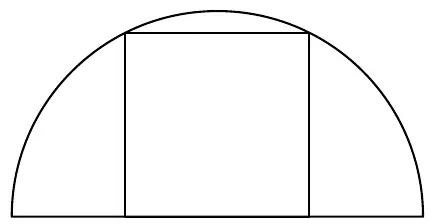
Pink Kangaroo 2019, Question 18. © UK Mathematics Trust. Original paper on ukmt.org.uk
Answer: A \(\dfrac{4}{5}\)
Let \(O\) be the centre of the circle, and \(P\), \(Q\), \(P'\) and \(Q'\) the vertices of the square. The triangles \(OPQ\) and \(OP'Q'\) are congruent since they are right-angled and have two equal sides (\(PQ = P'Q'\) since they are edges of a square, and \(OP = OP'\) because each is a radius). Hence \(OQ = OQ'\), and \(O\) is thus the midpoint of the edge of the square.
Let the side of the square be \(2x\). And \(OP = 1\) since it is a radius. And by Pythagoras’ Theorem on triangle \(OPQ\) we have \((2x)^2 + x^2 = 1^2\), so \(4x^2 + x^2 = 1\), and \(5x^2 = 1\). This gives \(x^2 = \tfrac{1}{5}\). The area of the square is \((2x)^2 = 4x^2 = 4 \times \tfrac{1}{5} = \tfrac{4}{5}\).
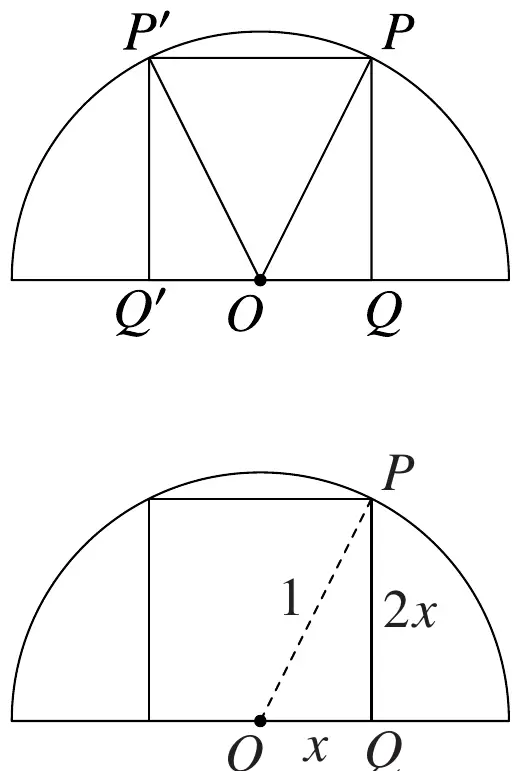
Solution © UK Mathematics Trust, from the PK 2019 solutions.