
PK 2017 Q25
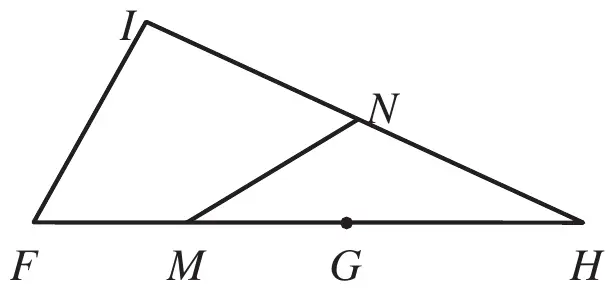
25. The diagram shows a triangle \(FHI\), and a point \(G\) on \(FH\) such that \(GH = FI\). The points \(M\) and \(N\) are the midpoints of \(FG\) and \(HI\) respectively. Angle \(NMH = \alpha°\). Which of the following gives an expression for \(\angle IFH\)?
- A \(2\alpha°\)
- B \((90 - \alpha)°\)
- C \(45 + \alpha°\)
- D \(\left(90 - \tfrac{1}{2}\alpha\right)°\)
- E 60°
Pink Kangaroo 2017, Question 25. © UK Mathematics Trust. Original paper on ukmt.org.uk
Answer: A \(2\alpha°\)
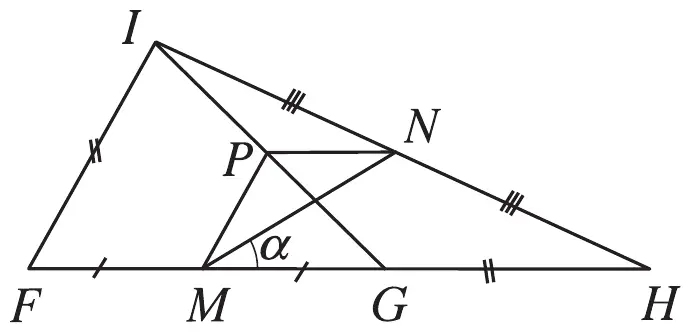
We start by drawing the line segment \(IG\). Let \(P\) be the point on \(IG\) such that \(PN\) is parallel to \(FH\). The angle \(PNM\) is alternate to \(NMH\) so \(\angle PNM = \alpha\). Also, the triangle \(PNI\) is similar to the triangle \(GHI\) (the angles of each triangle are clearly the same); moreover since \(N\) is the midpoint of \(HI\), \(PN = \tfrac{1}{2}GH\). Also \(IP = \tfrac{1}{2}IG\), so \(PG = \tfrac{1}{2}IG\). Since \(MG = \tfrac{1}{2}FG\), the triangle \(PMG\) is similar to \(IFG\), and in particular, \(PM = \tfrac{1}{2}IF\). However, we know \(IF\) is equal in length to \(GH\) so we have \(PN = \tfrac{1}{2}GH = \tfrac{1}{2}IF = PM\), so triangle \(MNP\) is isosceles and \(\angle PMN = \angle PNM = \alpha\).
Since triangles \(PMG\) and \(IFG\) are similar, we have \(\angle IFG = \angle PMG = \alpha + \alpha = 2\alpha\).
Solution © UK Mathematics Trust, from the PK 2017 solutions.