
PK 2015 Q21
21. In a right-angled triangle, the angle bisector of an acute angle divides the opposite side into segments of length 1 and 2. What is the length of the bisector?
- A \(\sqrt{2}\)
- B \(\sqrt{3}\)
- C \(\sqrt{4}\)
- D \(\sqrt{5}\)
- E \(\sqrt{6}\)
Pink Kangaroo 2015, Question 21. © UK Mathematics Trust. Original paper on ukmt.org.uk
Answer: C \(\sqrt{4}\)
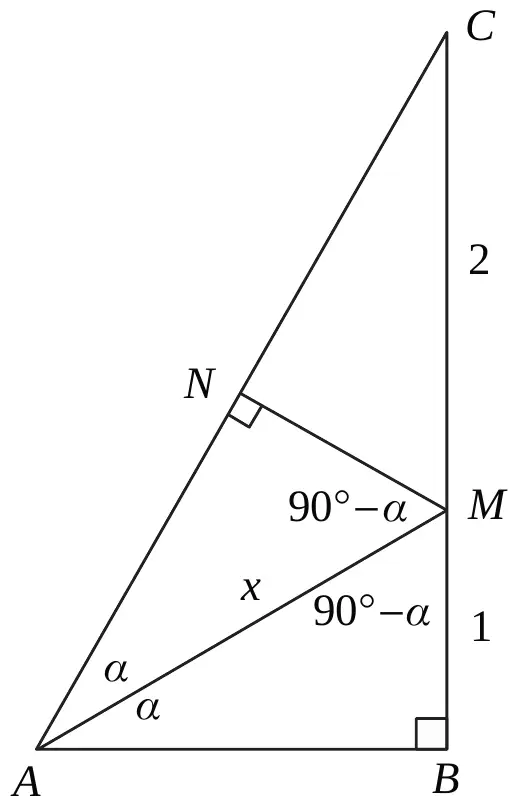
Label the vertices of the right-angled triangle as \(A\), \(B\), \(C\), with angle \(ABC = 90°\). Let \(M\) be the point where the angle bisector of \(CAB\) meets the side \(BC\). Let \(N\) be the point where the perpendicular from \(M\) meets the side \(AC\). Let \(x\) be the length of the bisector \(AM\).
Then triangles \(ABM\) and \(ANM\) are congruent (they have all three angles the same, and one corresponding side \(AM\) in common). Thus \(MN = 1\).
If we reflect triangle \(MNC\) in the line \(NC\), then we have an equilateral triangle with all sides equal to length 2. Hence \(\angle NCM = 30°\) (half of 60°). Thus \(\angle CAB = 180° - 90° - 30° = 60°\), and \(\alpha = 30°\). Then triangles \(MNC\) and \(MNA\) are congruent (all angles the same, and common length \(MN\)), so \(AM = MC = 2\).
An alternative solution can be obtained using the Angle Bisector Theorem. This gives us \(AB : AC = BM : CM = 1 : 2\). Suppose, then, that \(AB = x\) and \(AC = 2x\). By Pythagoras' Theorem applied to triangle \(ABC\), \((2x)^2 = x^2 + 3^2\). Therefore \(x^2 = 3\). Therefore, by Pythagoras' Theorem applied to triangle \(MBA\), \(AM^2 = x^2 + 1^2 = 3 + 1 = 4\). Therefore \(AM = \sqrt{4} = 2\).
Solution © UK Mathematics Trust, from the PK 2015 solutions.