
GK 2015 Q19
19. A square with area 30 cm2 is divided in two by a diagonal and then into triangles as shown.
The areas of some of these triangles are given in the diagram (which is not drawn to scale). Which part of the diagonal is the longest?
- A \(a\)
- B \(b\)
- C \(c\)
- D \(d\)
- E \(e\)
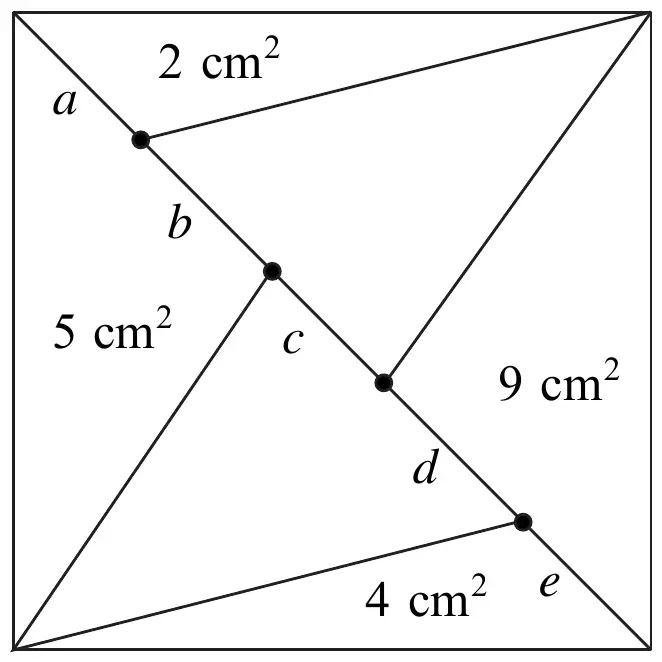
Grey Kangaroo 2015, Question 19. © UK Mathematics Trust. Original paper on ukmt.org.uk
Answer: D \(d\)
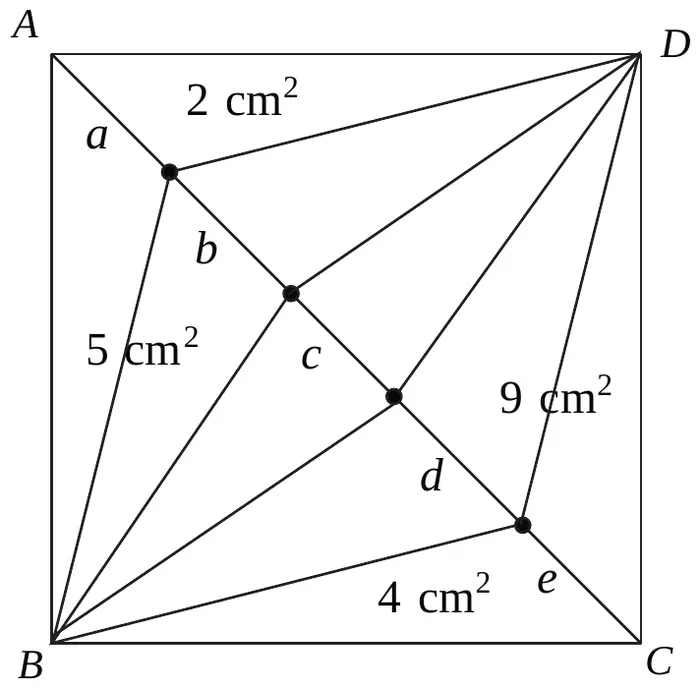
Label the corners of the square \(A\), \(B\), \(C\) and \(D\) going anticlockwise from the top left corner. Draw in the lines from each marked point on the diagonal to \(B\) and to \(D\). All the triangles with a base on the diagonal and a vertex at \(B\) or \(D\) have the same perpendicular height. Hence their areas are directly proportional to the length of their bases. The two triangles with \(e\) as their base both have area 4 cm2. Hence the two triangles with base \(d\) both have area 5 cm2. Similarly the two triangles with base \(a\) have area 2 cm2, and so the two triangles with base \(b\) have area 3 cm2. Finally, since the area of the square is 30 cm2, the two triangles with base \(c\) have area 1 cm2. Since the triangles with largest area are those of area 5 cm2, the longest base is that part labelled \(d\).
Solution © UK Mathematics Trust, from the GK 2015 solutions.