
SK 2019 Q8
8. The function \(J(x)\) is defined by:
\[J(x) = \begin{cases} 4 + x & \text{for } x \leq -2, \\ -x & \text{for } -2 < x \leq 0, \\ x & \text{for } x > 0. \end{cases}\]
How many distinct real solutions has the equation \(J(J(J(x))) = 0\)?
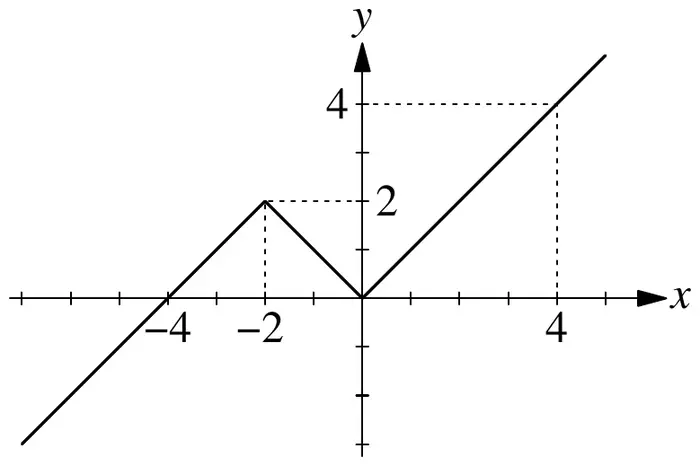
Senior Kangaroo 2019, Question 8. © UK Mathematics Trust. Original paper on ukmt.org.uk
Answer: 004
The only solutions to \(J(x) = 0\) are \(x = 0, -4\).
Since \(J(0) = 0\), both will also be solutions of \(J(J(J(x))) = 0\).
Any solution to \(J(x) = -4\) will also be a solution to \(J(J(x)) = 0\). The only solution to \(J(x) = -4\) is \(x = -8\). Since \(J(x) = 0\), \(x = -8\) is also a solution of \(J(J(J(x))) = 0\).
Any solution to \(J(x) = -8\) will also be a solution to \(J(J(J(x))) = 0\). The only solution to \(J(x) = -8\) is \(x = -12\).
Therefore, there are four distinct solutions, \(x = 0, -4, -8\) and \(-12\).
Solution © UK Mathematics Trust, from the SK 2019 solutions.