
SK 2017 Q16
16. The curve \(x^2 + y^2 = 25\) is drawn. Points on the curve whose \(x\)-coordinate and \(y\)-coordinate are both integers are marked with crosses. All of those crosses are joined in turn to create a convex polygon \(P\). What is the area of \(P\)?
Senior Kangaroo 2017, Question 16. © UK Mathematics Trust. Original paper on ukmt.org.uk
Answer: 074
The curve \(x^2 + y^2 = 25\) is a circle of radius 5 centred at the origin.
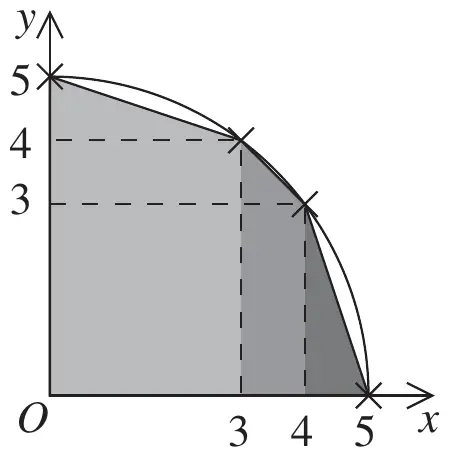
The polygon \(P\) has vertices at coordinates \((0,5)\), \((3,4)\), \((4,3)\), \((5,0)\), \((4,–3)\), \((3,–4)\), \((0,–5)\), \((–3, –4)\), \((–4, –3)\), \((-5,\ 0)\), \((–4, 3)\), \((–3, 4)\).
We may find the area of that part of \(P\) in the upper-right quadrant by splitting it into two trapezia and a triangle as shown in the diagram. This area is
\[\left(\tfrac{1}{2}(5 + 4) \times 3\right) + \left(\tfrac{1}{2}(4 + 3) \times 1\right) + \left(\tfrac{1}{2} \times 3 \times 1\right) = \tfrac{37}{2}.\]
Therefore the area of \(P\) is \(4 \times \tfrac{37}{2} = 74\).
Solution © UK Mathematics Trust, from the SK 2017 solutions.