
SK 2017 Q5
5. The figure shows a quadrilateral \(ABCD\) in which \(AD = DC\) and \(\angle ADC = \angle ABC = 90°\). The point \(E\) is the foot of the perpendicular from \(D\) to \(AB\). The length \(DE\) is 25. What is the area of quadrilateral \(ABCD\)?
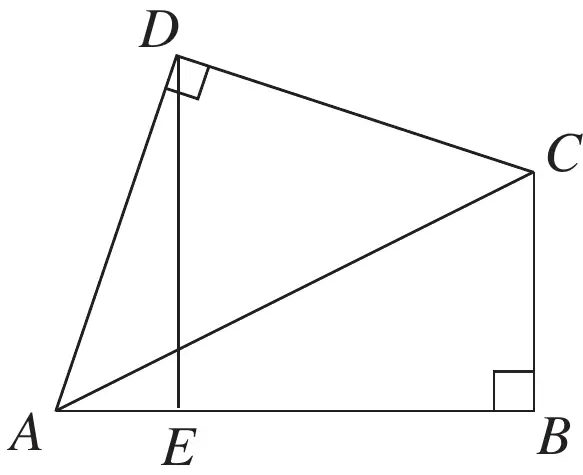
Senior Kangaroo 2017, Question 5. © UK Mathematics Trust. Original paper on ukmt.org.uk
Answer: 625
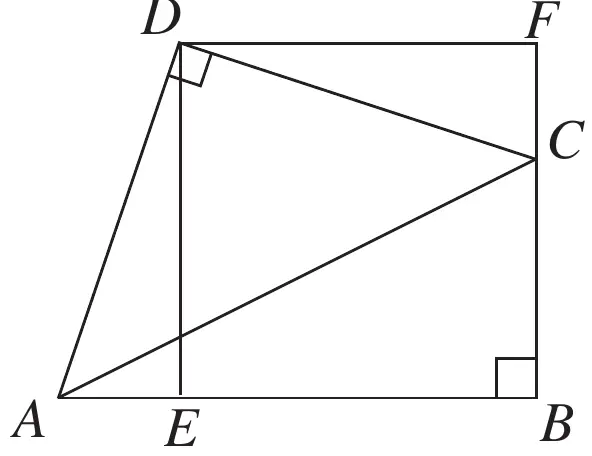
Draw a line through \(D\) that is parallel to \(AB\). Let \(F\) be the intersection of that line with \(BC\) extended, as shown in the diagram.
| Now | \(\angle EDC + \angle CDF = \angle EDC + \angle ADE = 90°\) |
| Therefore | \(\angle CDF = \angle ADE = 90° - \angle ECD\) |
| Also | \(\angle DFC = \angle DEA = 90°\) |
Therefore triangles \(ADE\) and \(CDF\) are similar because they have the same set of angles. Because \(AD = CD\) they must also be congruent.
Therefore the area of quadrilateral \(ABCD\) is equal to the area of rectangle \(FDEB\). By the congruent triangles \(ADE\) and \(CDF\) we know that \(DF = DE = 25\). Therefore the required area is \(25 \times 25 = 625\).
Solution © UK Mathematics Trust, from the SK 2017 solutions.